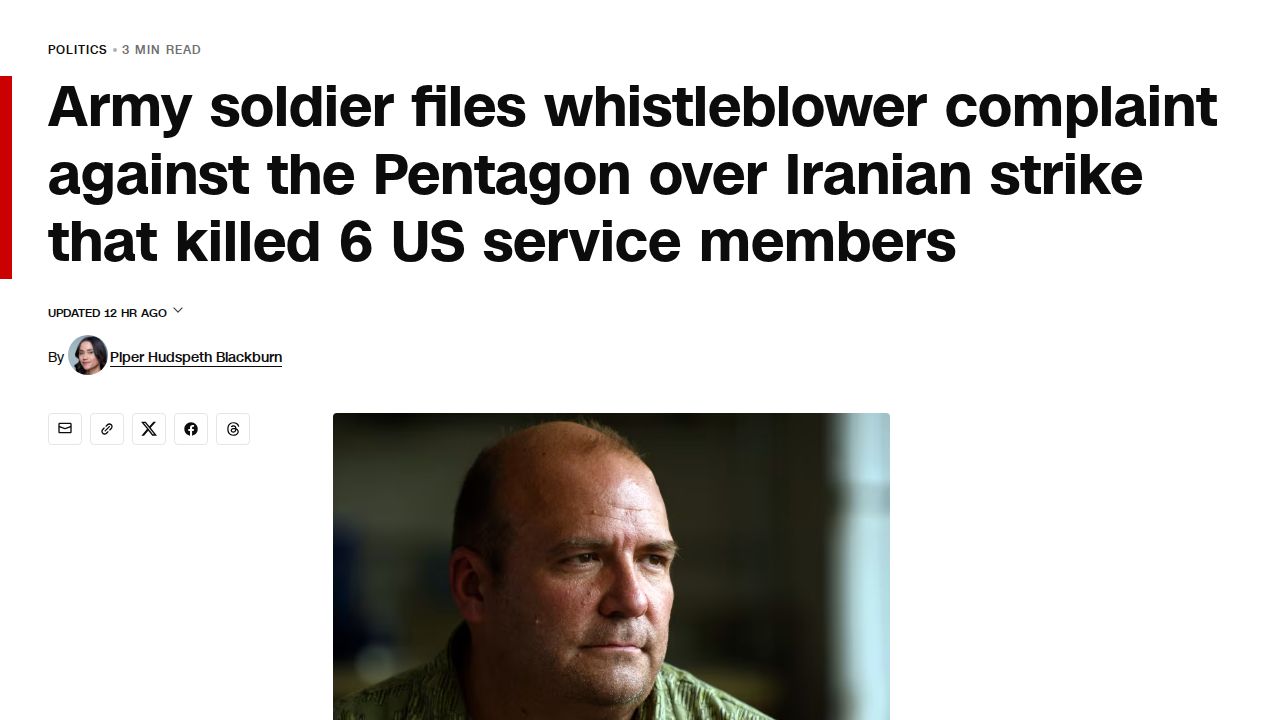
Six U.S. troops were killed in a March strike by Iran, an event that has prompted a whistleblower complaint from a U.S. Army Major. The complaint, filed by Major Ramsbottom, alleges that the military was fundamentally under-equipped and unprepared for the specific aerial threats encountered during those operations.
The Whistleblower Complaint
According to the report, Major Ramsbottom filed a whistleblower complaint following the Iranian strike that resulted in the deaths of six U.S. troops. The core of his complaint is that the military lacked the necessary equipment and preparation to defend against the specific aerial threats faced during the mission.
The complaint highlights a discrepancy between the operational reality faced by troops and the resources provided to them. Ramsbottom's actions suggest a belief that the current defensive posture is insufficient to protect personnel against competent adversaries.
Official Defense Claims
The official government stance on the incident has faced scrutiny. Following the March attack, Defense Secretary Pete Hegseth stated that the U.S. possesses 'incredible air defenders,' while simultaneously acknowledging that 'one' projectile successfully breached those defenses.
This acknowledgment of a breach, contrasted with the 'incredible' descriptor, serves as a focal point for the whistleblower's claims. It highlights a potential gap between public-facing confidence and the technical limitations of current defensive systems.
Community Perspectives and Trade-offs
The Hacker News discussion surrounding the report revealed a range of viewpoints regarding military readiness. One commenter, writing as nico, expressed suspicion that the complaint might be used as a justification to secure more funding for the war rather than a critique of the war itself.
Other commenters, such as freddealmeida, argued that no military can be fully prepared for the rapid evolution of technological warfare and criticized the major's decision to go public. Conversely, a commenter identified as 27183 noted the institutional difficulty of funding defenses against hypothetical threats, comparing the challenge to the difficulties faced in the cybersecurity sector.
The discussion also touched on the rapid evolution of low-cost threats. One commenter, ex1fm3ta, pointed out that the U.S. Army has only recently recognized that $2,000 drones can be as effective as more expensive missiles, necessitating a shift toward cost-effective protection.
Unresolved Questions
The specific technical details of the 'proper equipment' Ramsbottom identified as missing remain undisclosed in the current reporting. Furthermore, the exact nature of the 'one' projectile that breached the defenses has not been detailed.
The tension between proactive defense spending and the 'chicken little' perception of hypothetical threats remains a central unresolved theme. It remains unclear how the military will balance the need for rapid technological adaptation with the bureaucratic hurdles of securing funding for non-traditional threats.