On November 11, 2026, Nvidia's board accepted the immediate resignation of its founder and CEO, Jensen Huang, a move that triggered a sharp decline in the company's market value and sparked a wave of accusations ranging from accounting fraud to treason.
The Timeline of the Leadership Collapse
The sequence of events surrounding Jensen Huang's departure began with reports that American intelligence had known about his relationship with a woman suspected of ties to China since 2025. By May 2026, the Trump administration was reportedly briefed on these ties while preparing for diplomatic meetings with Chinese leadership.
Following these briefings, a series of rapid developments occurred: major allegations became public on October 29, Huang resigned on November 11, and new restrictions on Chinese access to AI computing were announced on November 16. This final development occurred just three days before a scheduled meeting with Xi Jinping in Shenzhen.
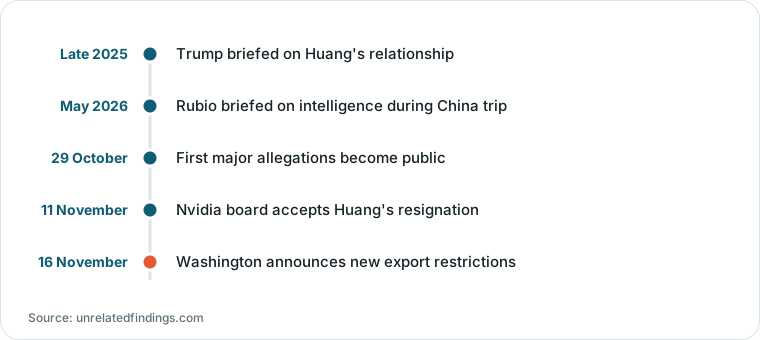
Chart drawn by HN Digest from figures reported by unrelatedfindings.com; values are shown as written in the source.
“The negotiating position is no longer a threat to introduce new restrictions. The restrictions already exist. Relaxing them becomes a concession.”
— The most expensive bargaining chip in history · Unrelated Findings
The 'Good Cop, Bad Cop' Policy Dynamic
Internal friction within the administration has been highlighted by public attacks from Treasury Secretary Scott Bessent against Commerce Secretary Howard Lutnick. Bessent has advocated for restrictive controls on advanced semiconductors, while Lutnick has warned that antagonizing Beijing risks a wider confrontation.

This image illustrates the internal friction between the 'hawk' and 'dove' factions mentioned in the policy dynamic section.
The newly issued export-control rules explicitly state they were written at the direction of the Treasury Department and the National Security Council. This shift suggests that the more restrictive 'hawk' faction successfully influenced policy just ahead of the diplomatic summit.
The Bargaining Chip Hypothesis
One theory suggests that the scandal involving Nvidia's leadership is a calculated cost intended to improve U.S. negotiating leverage. By creating an urgent national security crisis, the administration can present new restrictions as a non-negotiable requirement for safety rather than a coercive tactic for concessions.
Under this framework, the U.S. could demand concessions—such as access to rare earth minerals—in exchange for relaxing the very restrictions the 'scandal' necessitated. This would allow the administration to claim victory on both fronts: securing strategic materials and maintaining a hard line on technology.

This visual supports the theory that Nvidia's leadership scandal could be used as leverage to secure rare earth minerals.
Market Risks and Uncertainties
The primary risk of this strategy is the potential for permanent damage to Nvidia's market value and investor confidence. While a diplomatic breakthrough might eventually stabilize the situation, the disruption to financing and technical execution may not be easily reversible.
It remains unknown whether the Nvidia board was pressured to accept Huang's resignation or if they are being instructed to delay his reinstatement until negotiations conclude. The hypothesis remains speculative, as no direct evidence of coordination between Washington and Nvidia's board has been publicly disclosed.
What Hacker News readers are saying
- Alternative: One commenter suggested that the situation might be a simple case of domestic intelligence agencies intercepting and bugging shipments to China, citing historical precedents of such actions. comment ↗
- Skeptical: Another user expressed skepticism regarding the theory of a calculated political move, arguing that the current administration lacks the strategic sophistication to execute such a complex plan. comment ↗
- Skeptical: A commenter pointed out that the narrative presented in the article remains a hypothesis and noted a lack of evidence to support the specific line of reasoning. comment ↗
Summarized opinions from the Hacker News thread, not verified facts. Read the full discussion ↗