The 'How To Make (almost) Anything' (HTMAA) course at MIT offers a dense, semester-long curriculum covering everything from computer-aided design (CAD) and electronics to 3D printing and machine building. By prioritizing a 'breadth-first' approach, the course aims to equip students with a broad toolkit of possibilities rather than specialized, deep-dive expertise in a single area.
Course Overview and Curriculum
The HTMAA 2026 syllabus outlines a rapid progression through diverse engineering disciplines. Students move from initial concepts like computer-aided design and project management into technical areas such as electronics design, 3D scanning, and motor control.
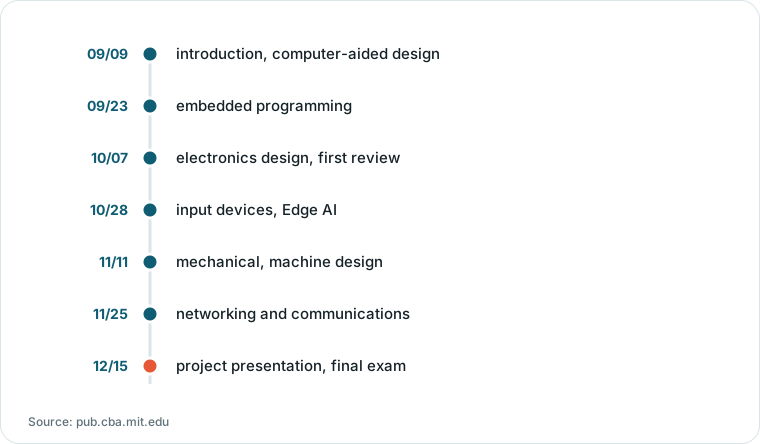
Chart drawn by HN Digest from figures reported by pub.cba.mit.edu; values are shown as written in the source.
The schedule culminates in system integration and project development, where students are expected to build and present functional projects. This progression is designed to take a student from a conceptual idea to a physical, integrated product.
Pedagogical Philosophy and Discussion
The course's design is a deliberate pedagogical choice to provide a 'whirlwind tour' of fundamentals. Commenters on Hacker News argued that this approach is valuable because it teaches students what is possible, allowing them to know where to start looking when faced with a new problem.
One commenter, writing as renehsz, suggested that this breadth is particularly important for managerial roles and in an era where AI agents can handle specific implementations. Others, such as thomascountz, noted that the course is intended for students from wide backgrounds, including non-technical ones, making cross-disciplinary awareness a key feature.
Conversely, some participants expressed concern over the superficiality of the coverage. One commenter, writing as mitchweaver, argued that cramming complex fields like CAD into a single lecture can feel like an enumeration of tools rather than a deep dive.
Practical Constraints and Trade-offs
The pace of the course is described by some as 'insane,' with a syllabus that covers a massive amount of ground in a short timeframe. One commenter, writing as Animats, pointed out that while computer-controlled tools are accessible to programmers, manual skills like welding require endless practice that a single course cannot fully provide.
The trade-off for this breadth is a lack of professional-level mastery in any one area. However, supporters argue that the goal is not to produce professional machinists, but to create generalists who can navigate various tools to build products end-to-end.
The specific hardware and software resources available in the lab are not detailed in the primary source, leaving the exact scope of the 'kitchen sink' of tools available to students as an unknown factor.
Student Outcomes and Portfolios
The course emphasizes practical lab work where students are expected to problem-solve. According to the discussion, the success of this approach is reflected in student portfolios over the years, which demonstrate the ability to create functional, integrated systems.
The ultimate goal is to foster creativity by ensuring engineers understand the full spectrum of available fabrication and design methods. By knowing what can be done, students can more effectively leverage their tools to solve complex problems.