A galvanized trash can can provide significant protection against electromagnetic pulses (EMPs) by acting as a Faraday cage, provided the gaps between the lid and the body are sealed. In a series of tests, a noise generator and a radio receiver were used to measure signal attenuation, revealing that while a standard lid provides substantial shielding, taping the seams eliminates detectable leaks across a wide frequency range.
The Mechanics of EMP Vulnerability
An electromagnetic pulse (EMP) is a burst of energy that can destroy electronics, particularly those with long conductors like the power grid. While many modern devices have improved shielding, some are more vulnerable because they are never fully powered off, such as those with integrated lithium-ion batteries and management systems.
A Faraday cage protects against these pulses by enclosing an object in a conductive material. As long as there are no gaps in the metal structure, the electromagnetic field remains outside the container, preventing the internal components from being hit by high-voltage inductions.
“Taping the seam fixes the leak. Once I taped all the way around I didn't detect the source at any frequency, including the problem frequencies above.”
— Testing a Trash Can Faraday Cage
Experimental Setup and Methodology
To test the effectiveness of a common galvanized trash can, a broadband radio-frequency noise generator was paired with a 29-inch telescoping antenna. The setup was powered by a portable power station to ensure the noise source remained isolated from the wall outlet.
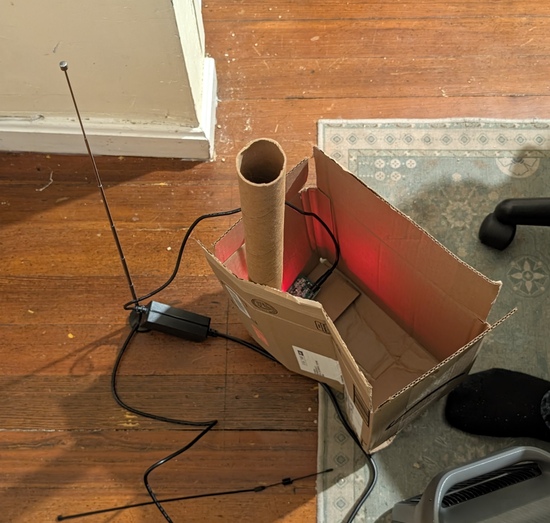
This image shows the baseline configuration of the noise source used in the experiment before any shielding was applied.
A Nooelec NESDR SMArt v5 receiver was used to measure the power of the noise source across a range of 24 MHz to 1.7 GHz. The experiment compared four configurations: the source with no cage, the source in a can with the lid off, the source in a can with the lid on, and the source in a can with the lid on and the seam taped.
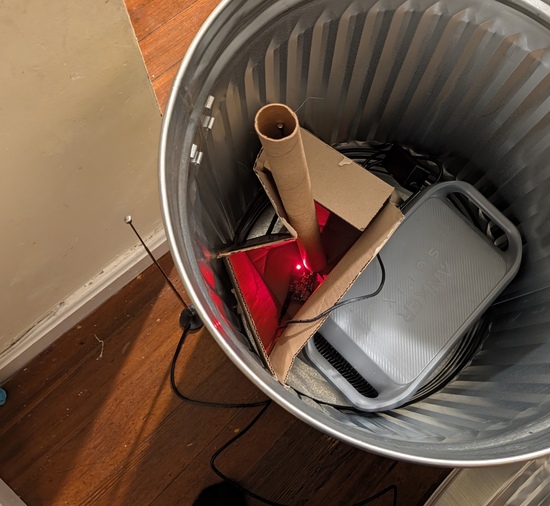
This visual demonstrates one of the four configurations tested to measure signal attenuation.

Chart drawn by HN Digest from figures reported by jefftk.com; values are shown as written in the source.
Shielding Results and Frequency Leakage
The data showed that the trash can lid provided significant attenuation, but it leaked at the seams. At the highest frequency of 1.2–1.7 GHz, the lid alone provided about 29 dB of reduction, which is a factor of ten in power reduction.
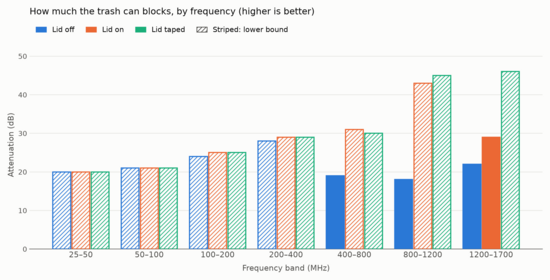
This chart provides the quantitative data for the shielding results discussed in the results section.
Taping the seam with metallic tape successfully closed these leaks. Once the tape was applied, the source was no longer detectable at any frequency within the receiver's range, indicating a high level of shielding effectiveness.
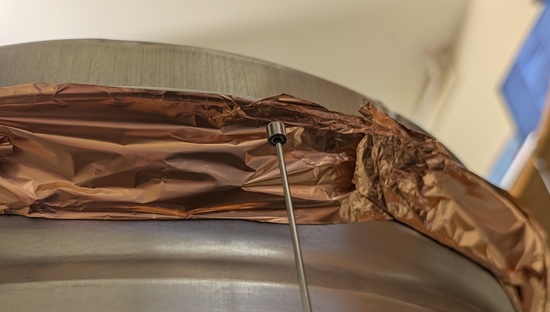
This image illustrates the final configuration that achieved the highest level of shielding effectiveness.
Physics suggests that the steel wall is effectively opaque at lower frequencies. While the test was weakest below 100 MHz, estimates suggest the trash can could provide 30–60 dB of attenuation in that critical range with a bare lid, and 50–80 dB when taped.
Limitations and Practical Considerations
The primary limitation of this test is the difficulty of measuring low-frequency signals below 100 MHz. Short antennas do not perform well at these frequencies, and strong background broadcast signals make it difficult to distinguish the noise source from the environment.
Furthermore, the test measured electric field blocking more than magnetic field blocking due to the distance between the antennas. While the results suggest a taped trash can is a viable DIY Faraday cage, the most reliable protection remains keeping electronics unplugged and powered down.
What Hacker News readers are saying
- Technical note: One commenter noted that the experiment was conducted in the near field regime, suggesting that the direction of the signal relative to the container might not significantly impact the results. comment ↗
- Experience: A commenter shared their experience testing various containers and reported that while some metal boxes failed to block signals, adding an aluminum foil seal successfully improved the shielding. comment ↗
- Alternative: Another user suggested that turning a standard trash can upside down over the equipment could provide a continuous rolled seam, potentially eliminating the need for conductive tape. comment ↗
Summarized opinions from the Hacker News thread, not verified facts. Read the full discussion ↗