Space-based solar panels in dawn-dusk sun-synchronous orbits can produce roughly 3 to 5 times the energy of the same panels at a good terrestrial site. This massive energy advantage, combined with the lack of grid interconnection delays, is driving a shift in how companies might plan the next generation of AI compute infrastructure.
The Economics of Orbital Energy
The primary economic driver for orbital data centers (ODCs) is the continuous and intense sunlight available in specific orbits. Unlike terrestrial sites, which require massive battery storage and backup generation to handle night cycles and weather, space-based panels can generate power more consistently.
Research indicates that space solar becomes cheaper than any current terrestrial energy source once launch costs drop to roughly $50/kg. At a more achievable target of $250/kg, space solar reaches cost parity with the cheapest present-day terrestrial energy sources.
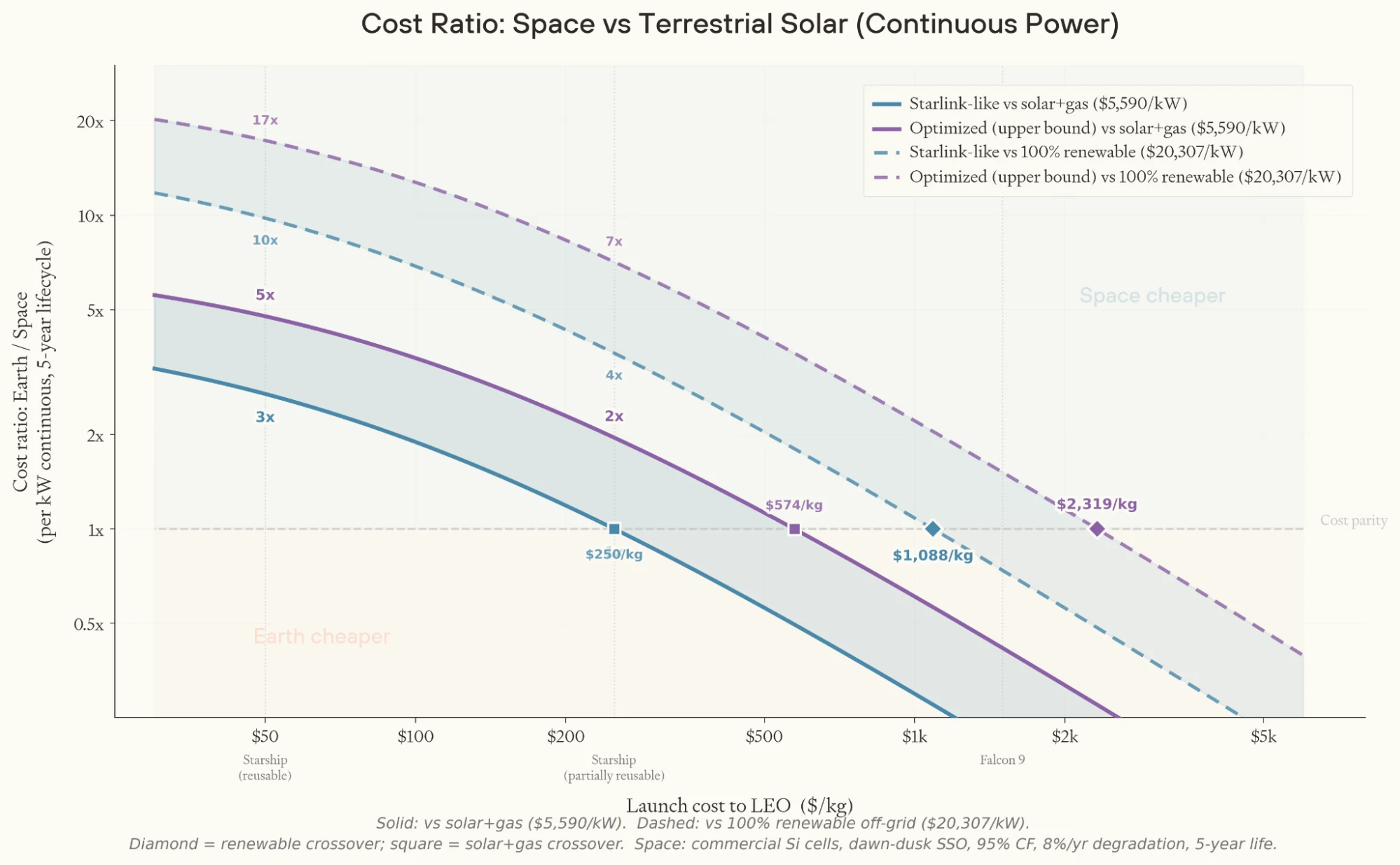
This chart illustrates the specific launch cost thresholds where space solar reaches cost parity with terrestrial energy sources.
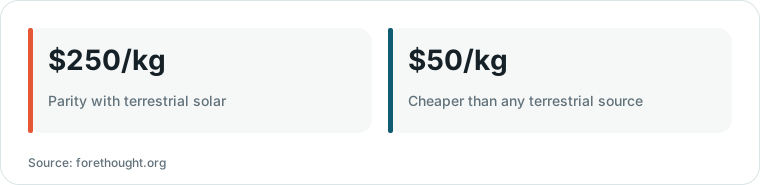
Chart drawn by HN Digest from figures reported by forethought.org; values are shown as written in the source.
“Space-based solar reaches cost parity with present-day off-grid terrestrial power continuously at roughly $250/kg to orbit, and becomes cheaper than any current terrestrial energy source at around $50/kg, from the present-day launch cost of roughly $1,500/kg.”
— Will We Really Put Data Centers in Space?
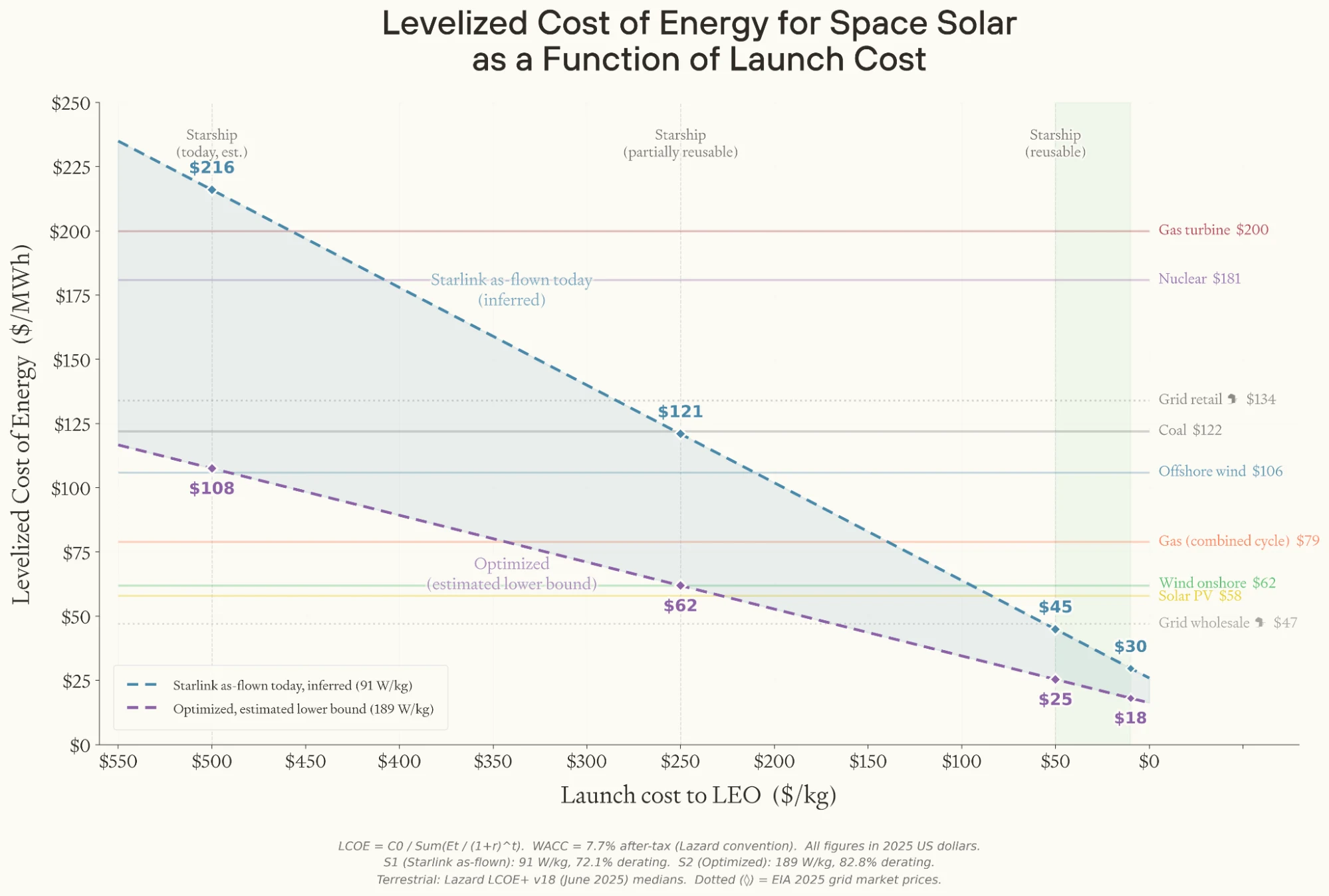
This visual provides a comparative overview of how space-based solar power stacks up against current terrestrial energy sources.
Overcoming Thermal and Maintenance Hurdles
Radiative cooling is often cited as a fatal obstacle for space computing, but new materials may solve this. Passive radiators using selective coatings and lightweight carbon fiber panels could achieve 163–346 W/kg at the system level, making thermal hardware a small fraction (2-5%) of total data center costs.
A significant trade-off is the 'maintenance gap.' Because hardware cannot be easily serviced in orbit, a dead chip results in permanent infrastructure loss. To mitigate this, ODCs may require a 38% overbuy of non-compute hardware—such as solar arrays and cooling racks—to compensate for a modeled 9% annual chip bleed.
Timeline and Scalability Constraints
The feasibility of this shift depends heavily on SpaceX's Starship. If Starship achieves full reusability, the necessary launch cadence and cost reductions could make ODCs cost-competitive within 3–5 years. However, the transition may be slowed by the current immaturity of the space-based supply chain.
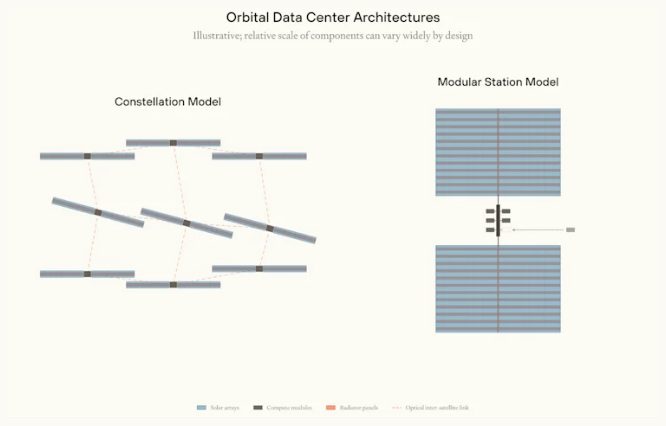
The article discusses the shift in infrastructure planning; these models represent the two primary architectural paths for ODCs.
While ODCs might not represent a significant share of compute before 2030, they could house a majority of new buildouts in the 2030s. At that stage, the primary constraint is expected to shift from launch capacity to the physical production rates of AI chips.
What Hacker News readers are saying
- Technical note: One commenter argued that the viability of orbital data centers depends on specific low-throughput workloads, suggesting that ocean-based facilities might be a more practical alternative due to lower launch costs and easier maintenance. comment ↗
- Skeptical: Several commenters expressed skepticism regarding the economic feasibility, noting that the high costs of radiation-hardened components and massive solar arrays might make space-based centers less economical than terrestrial sites. comment ↗
- Skeptical: One reader pointed out significant security and physical risks, arguing that orbital facilities are vulnerable to various types of interference and that underground locations would be safer for sensitive data. comment ↗
- Alternative: Commenters noted that another perspective suggested that orbital data centers might be more practical for specific use cases, such as reducing the mass required for Mars missions by processing data in orbit. comment ↗
Summarized opinions from the Hacker News thread, not verified facts. Read the full discussion ↗