New Regency Productions has filed a lawsuit in Los Angeles federal court to block director Michael Mann from reclaiming the copyright to the 1995 film 'Heat.' The studio argues that Mann’s attempt to use statutory termination rights is invalid because the screenplay was produced as a 'work made for hire' by his own loan-out company, which would legally make the corporation—not Mann personally—the author of the work.

This provides visual context for the 1995 film 'Heat' discussed in the opening paragraph of the article.
The Mechanics of Copyright Termination
Under Section 203(a) of the Copyright Act, authors generally have the right to terminate grants of their work starting 35 years after the initial agreement. This provision is designed to allow creators to regain control of their intellectual property once a work has achieved significant commercial value.
There is a critical exception for 'works made for hire.' In these cases, the employer is treated as the legal author from the moment of creation. Because a corporation cannot be an 'author' in the context of termination rights, and an individual cannot terminate a grant they did not personally make, the use of a loan-out company can effectively bar a creator from reclaiming their own work.
“The Oral Assignment on which the First Termination Notice is based supposedly derives from an oral agreement that Mann allegedly made with himself, in which Mann, like a Shakespearean actor playing multiple parts, simultaneously spoke on his own individual behalf, as well as on behalf of MMCo. and ZZY,”
— Michael Mann Seeks to Reclaim Rights to Original ‘Heat’ Screenplay
The 'Loan-Out' Conflict
Hollywood creators frequently use loan-out corporations to provide services to studios. New Regency points to a 1994 registration for 'Heat' that explicitly lists 'Michael Mann Company, Inc.' as the employer for hire. This paper trail suggests that the rights were assigned by the company, not by Mann as an individual.

This image illustrates the specific 1994 registration mentioned in the article that New Regency uses to argue the work was a 'work made for hire.'
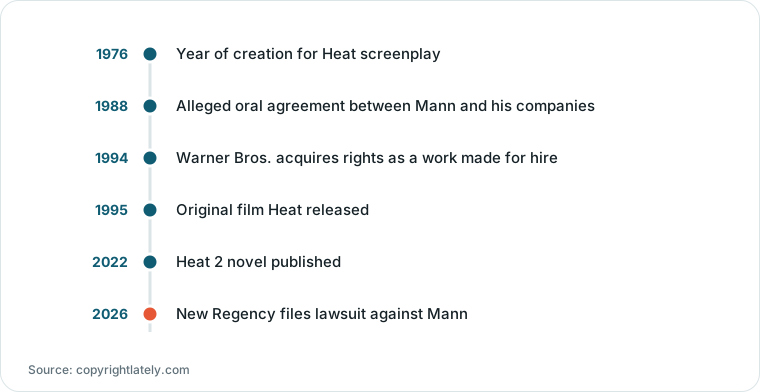
Chart drawn by HN Digest from figures reported by copyrightlately.com; values are shown as written in the source.
Mann’s defense rests on the claim that he wrote the foundational material in the early 1980s as an 'unemployed author' outside of his corporate structure. However, New Regency argues that Mann's own records, including a 1989 agreement, show him warranting that the rights had not been transferred elsewhere, potentially undermining his claim that the work was independent of his corporate dealings.
The 'Deal with Himself' and Future Projects
A central point of contention is an alleged 1988 oral agreement Mann claims he made with two companies he controlled. New Regency argues that because Mann was acting as both the author and the representative of the companies, the agreement is legally unenforceable or impossible to document.
The immediate production of 'Heat 2' is shielded from this litigation. Amazon MGM has signed agreements with both Mann and New Regency that account for the dispute, ensuring the sequel can proceed regardless of the court's final ruling on the underlying 'Heat' copyright. The primary stakes of the lawsuit involve the long-term value of the franchise and the rights to any projects beyond the immediate sequel.
What Hacker News readers are saying
- Experience: One commenter noted that this situation is reminiscent of a previous legal case where an artist was sued for copyright infringement of their own work. comment ↗
- Skeptical: Another commenter suggested that the current copyright system should be viewed as a corporate structure rather than a system designed to benefit individual authors. comment ↗
Summarized opinions from the Hacker News thread, not verified facts. Read the full discussion ↗