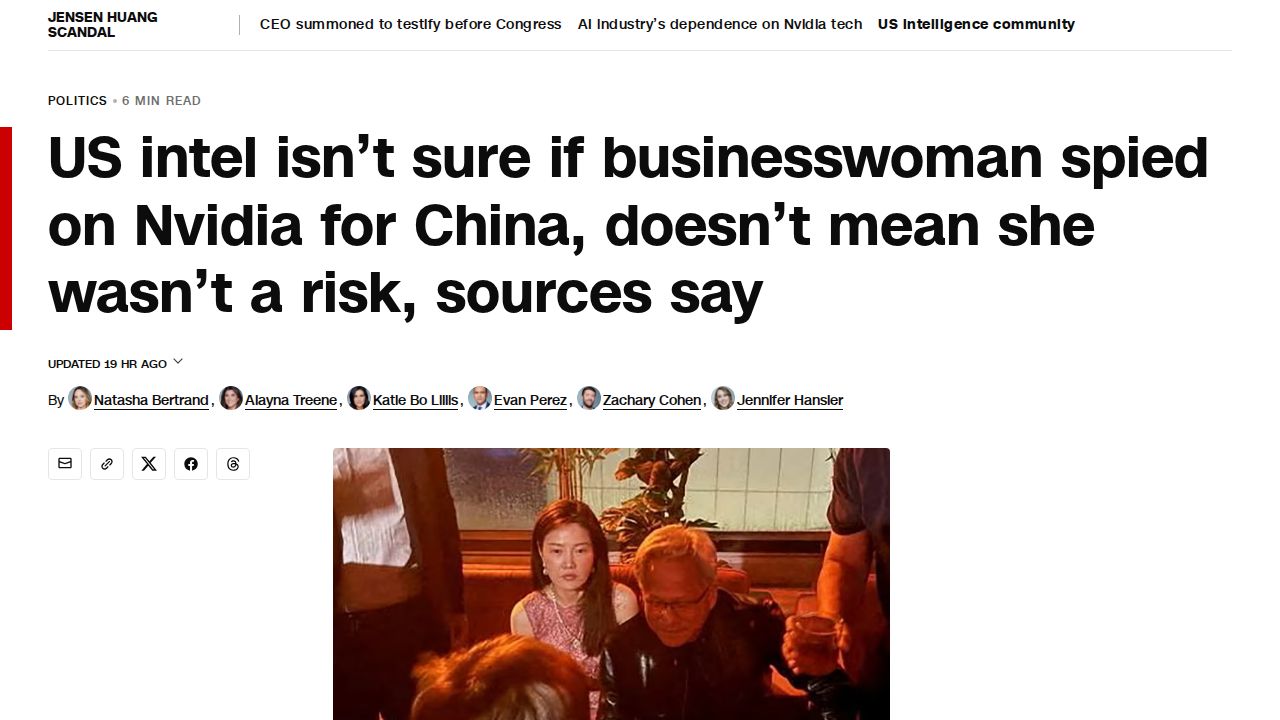
The narrative surrounding Alice Huang and her alleged role in spying on Nvidia for China has shifted significantly following the resignation of Nvidia CEO Jensen Huang. While initial reports suggested a definitive espionage link, current reports indicate that US intelligence agencies are now expressing uncertainty regarding the specific nature of her activities.
Shift in Official Narrative
The primary source reports that US intelligence is currently unsure if Alice Huang spied on Nvidia for China. This marks a notable shift from earlier reporting that characterized her actions as definitive espionage.
This change in stance occurred shortly after Jensen Huang resigned as the head of Nvidia. The timing of this shift has led some observers to question the motivations behind the changing narrative.
“US Intel isn't sure if Alice Huang spied on Nvidia for China”
— US Intel isn't sure if Alice Huang spied on Nvidia for China
Perspectives on Huang's Role
Commenters on Hacker News offered various interpretations of Huang's actual role. One commenter suggested she may have been a 'high-level smuggler' or a profit-seeker moving freight through Singapore and Malaysia in violation of contracts.
Another commenter argued that 'spying' might be the wrong term, suggesting she instead influenced Jensen Huang to push for the sale of AI chips to China. In this view, her company acted as a middleman for the chips rather than a conduit for stolen secrets.
A third perspective noted that Chinese laws requiring citizen cooperation with intelligence agencies could mean that even non-traditional 'spying' tasks are performed by individuals in positions of influence.
Speculation on Political and Corporate Motives
The Hacker News discussion included several theories regarding why the story's framing changed so rapidly. One commenter suggested the administration might be trying to 'muddy the waters' to downplay a larger scandal involving export controls.
Another commenter proposed that the 'spy' narrative was a convenient instrument to funnel public dissatisfaction regarding Nvidia's China dealings into a more sensational story. They suggested this could be a concerted effort to remove a major advocate for open-weight models.
Some participants also speculated that the shift was a move to create 'plausible deniability' for the administration regarding backroom deals that allowed chips to reach China despite existing sanctions.
Unresolved Questions and Trade-offs
The extent of the evidence remains a point of contention. Some commenters noted that intelligence is inherently about risk and that the appearance of espionage was clear enough to warrant initial concern.
The discussion also highlighted the trade-off between public-facing 'spy' narratives and the more technical, mundane issues of GPU architecture and export control policy. Some argued that the sensationalism of the 'spy' story obscures the complex reality of international trade regulations.
Evidence Boundaries
The current source material does not provide specific details on what secrets were allegedly compromised or the exact nature of the 'backroom deals' mentioned in the discussion.
The reports also do not clarify the specific evidence that led the intelligence agencies to their current state of uncertainty.