By moving from a symmetrical radius of 2.97 to a top-three leaderboard position of 2.94853, a developer demonstrated how custom visualization tools and AI-driven hill-climbing can solve complex geometric packing problems. The challenge, hosted by the venture capital firm Paradigm, requires arranging 15 identical semicircles into the smallest possible enclosing circle.
The Geometry of Semicircle Packing
The 'Pack Semicircles' puzzle tasks participants with arranging 15 identical semicircles into a configuration that minimizes the size of an enclosing circle. While circle packing is a well-studied field, the author noted a significant lack of existing literature specifically regarding the packing of semicircles.
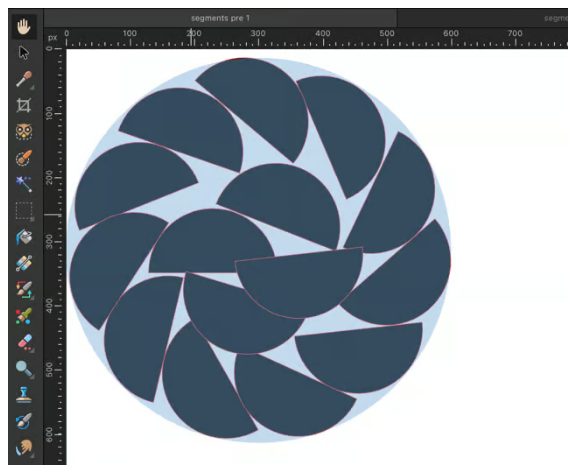
This image illustrates the initial geometric challenge of arranging semicircles to minimize the enclosing circle's radius.
Initial attempts to solve the problem using professional graphics software like Affinity Designer highlighted a major constraint: manual adjustments to one subset of shapes required a complete readjustment of all others. This made it difficult to measure progress or efficiently iterate on visual ideas.
Custom Tooling and Algorithmic Iteration
To overcome the limitations of manual editing, the developer built a custom visualization tool with the help of an AI model. The tool featured a 'Tighten' mode to automatically adjust layers of fanned semicircles into the smallest possible radius, and a 'Relax' mode to split those layouts into individual layers for more granular tweaking.
The developer eventually moved from manual visual intuition to high-level hill-climbing using AI models. This transition allowed for the discovery of asymmetrical tweaks that yielded a more efficient packing than the 'purist' symmetrical layouts initially pursued.
Trade-offs and Final Results
The final submission achieved a radius of 2.94853, placing it in the top three of the leaderboard. This result was notably non-symmetrical, illustrating a core trade-off in packing problems: the aesthetic ideal of symmetry often yields to the practical necessity of asymmetry for maximum density.
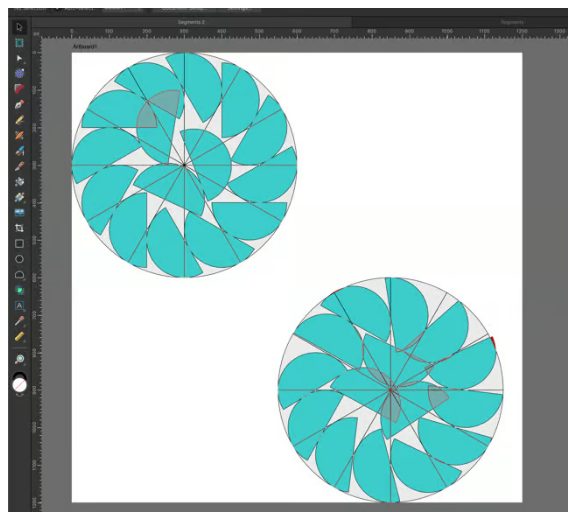
This visual demonstrates the transition from symmetrical manual designs to the more efficient asymmetrical layouts discovered via hill-climbing.
While the developer reached the top three, the absolute best solution remains held by a different entrant. The process highlights how specialized tools and iterative algorithmic search can bridge the gap between human visual intuition and mathematical optimization.