LibreOffice has highlighted its ability to function independently of internet connectivity, asserting that the software 'works 365 days a year' regardless of external service status. This positioning targets the vulnerabilities of cloud-first productivity suites, which can become inaccessible during provider outages.
The Core Claim of Local Availability
The LibreOffice project posted on X (formerly Twitter) that the software 'actually works 365 days a year.' This statement serves as a direct contrast to the 'infinite subscription' models of cloud-based productivity tools.
By operating as a locally installed application, LibreOffice ensures that users can access their documents and tools even when a provider's servers are down. This reliability is a primary draw for users seeking to avoid the risks associated with 'mediocre SaaS' models.
One commenter, writing as c0l0, noted a tradition of donating to the Document Foundation in an amount equivalent to a yearly Microsoft Office 365 subscription, framing the donation as a way to support open-source alternatives to recurring fees.
“LibreOffice actually works 365 days a year. Just saying.”
— LibreOffice (@LibreOffice) on X: LibreOffice actually works 365 days a year. Just saying.
User Perspectives on Performance and UI
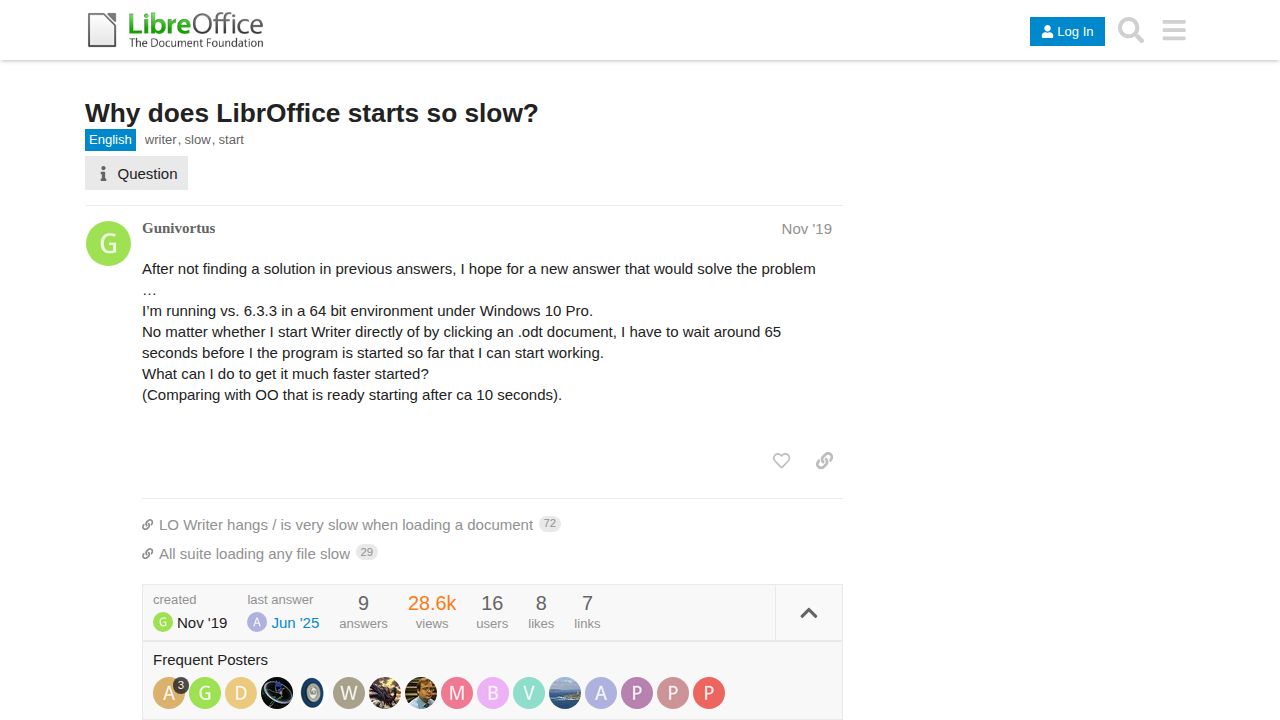
While the software's availability is praised, some users reported specific performance issues. One commenter, writing as unpopularopp, noted that LibreOffice can take 4-5 seconds to start on Windows, a delay they found noticeably slower than other applications.
The user interface also remains a point of contention. Some users described the UI as 'ugly and non-intuitive,' leading them to prefer web-based tools like Google Docs for certain tasks.
Conversely, others argued that the UI is a secondary concern to the software's utility. One commenter, writing as kbrannigan, emphasized that 'Software is not about or pretty the UI is, it's a tool,' and advocated for the privacy and ownership provided by desktop software.
Interoperability and Technical Constraints
A significant limitation for LibreOffice is its interoperability with the professional world. One commenter, writing as pearjuice, recalled past experiences with 'slightly different formatting' and 'incompatible Office quirks' when sharing files with Microsoft Office installations.
Technical reliability also varies depending on the task. One user, writing as galkk, reported that while the software generally 'works,' it has previously crashed during non-trivial work with CSV files.
The discussion also touched on the fact that offline versions of Microsoft Office exist and remain functional, suggesting that the '365 days a year' claim is a specific critique of the cloud-dependency of the 365 subscription model rather than a critique of offline software in general.
The Discussion Context
The Hacker News discussion centered on the trade-offs between open-source local software and proprietary cloud services. Commenters debated whether LibreOffice's current state is 'good enough' for mainstream adoption, with some suggesting it needs a UI transformation similar to Blender's evolution.
Some participants argued that the move toward desktop software is a reaction to the 'mediocre' nature of current SaaS offerings. They highlighted that local software allows for better data privacy and leverages the power of modern processors.
Others pointed out the practical difficulties of switching, noting that many companies choose Microsoft 365 because it is the standard for professional communication, making it difficult to move to an alternative even if the local software is more reliable during outages.