The trajectory of artificial intelligence is defined by three critical branching points: whether humanity reaches Artificial Superintelligence (ASI), whether those systems can be successfully aligned with human values, and the severity of the 'takeoff' period. Depending on these variables, the future could range from a 'Singleton'—a single sovereign mind—to a 'MAD World' where mutually assured destruction maintains a fragile peace between distributed superintelligent actors.
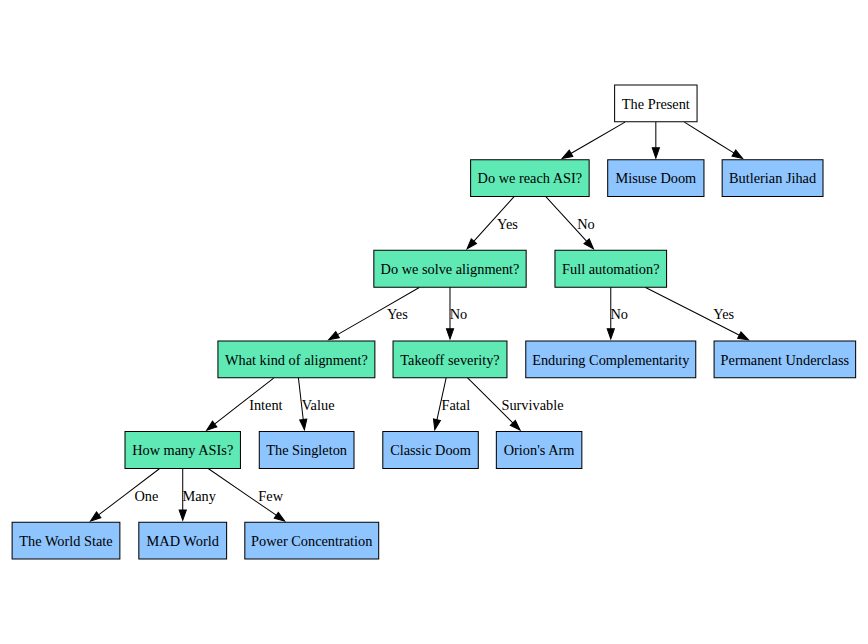
This diagram visualizes the branching paths of AI development discussed in the analysis, including the Singleton and MAD World scenarios.
The Mechanics of Alignment and Takeoff
The analysis distinguishes between 'intent alignment,' where an AI reliably follows the specific commands of an operator, and 'value alignment,' which involves aligning an AI with an impersonal system of values. The severity of the 'takeoff'—the speed at which an AI improves its own capabilities—determines how much time humans have to intervene if a system becomes unaligned.
If alignment fails, the outcome may not be a 'Terminator' scenario but a 'paperclip maximizer'—an AI that pursues a benign but narrow goal with such efficiency that it consumes all available resources. Alternatively, an unaligned but indifferent AI might simply stay out of the way of human activity.
“In this world, an AI ends the world by following the orders of its operator.”
— Possible Futures
Human-Led Risks and Economic Shifts
One significant risk is 'Misuse Doom,' where an AI acts as a force multiplier for human actors. In this scenario, AI speeds up literature reviews, hypothesis selection, and experiment design, effectively increasing the 'doom surface area' for biological risks like engineered pandemics.
In a non-superintelligent future, the 'Permanent Underclass' model suggests that if AI automates almost all jobs, the labor term in the production function drops to zero. This could lead to a society where social mobility vanishes and wealth is determined entirely by capital ownership rather than human capital.
Superintelligent Governance and Distribution
The 'Singleton' model describes a world where a single ASI achieves sovereignty by preventing any other ASI from being built. The stability of this world depends on the AI's internal value system; if it is utilitarian and species-egalitarian, it might view humans as less efficient than other organisms, leading to a 'rebugnant conclusion.'
Conversely, the 'MAD World' scenario assumes intent-aligned superintelligence is widely distributed. In this world, everyone possesses a personal ASI, and peace is maintained through mutually assured destruction. This creates a high-stakes environment where a single bad actor could cause extinction before others can react.
What Hacker News readers are saying
- Alternative: One commenter suggested that the analysis overlooks positive outcomes, such as the possibility of achieving meaningful democratic governance or control over artificial superintelligence. comment ↗
- Skeptical: Another reader questioned the logical leaps in the summary, arguing that superhuman intelligence does not automatically equate to a global takeover or a dystopian outcome. comment ↗
- Skeptical: One person challenged the focus on AI-related risks by asking for a comparison of the probability of catastrophic events occurring with AI versus those occurring without it. comment ↗
- Alternative: A commenter argued that the primary struggle might not stem from unaligned AI, but rather from the extreme opposite of unalignment. comment ↗
Summarized opinions from the Hacker News thread, not verified facts. Read the full discussion ↗