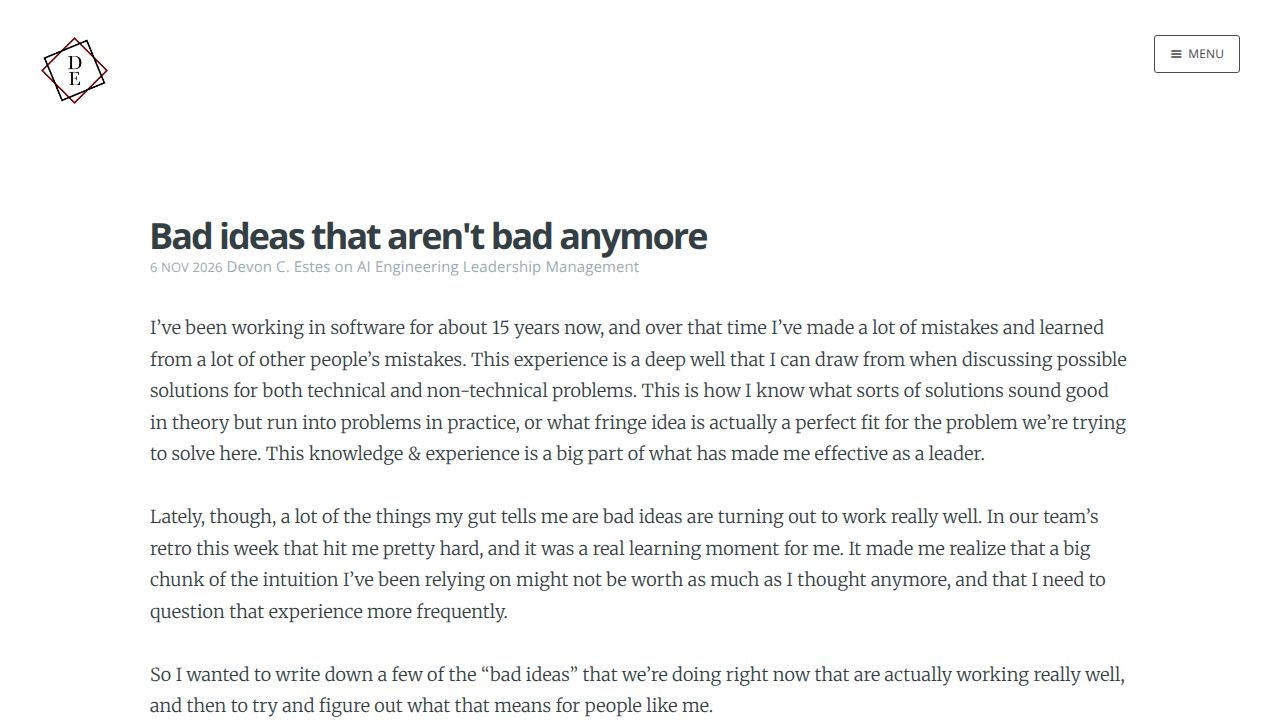
As software engineering enters a new era defined by complex architectures and AI-assisted development, the traditional focus on line-by-line code reviews is being re-evaluated. Participants in a Hacker News discussion debated whether the primary value of engineering has shifted from ensuring code correctness to maintaining shared understanding and managing long-term system liabilities.
The Evolution of Code Review
The original post, 'Bad ideas that aren't bad anymore,' prompted a discussion on the changing nature of software development practices. Commenters on Hacker News argued that code reviews should be viewed primarily as a mechanism for ensuring shared understanding and agreement among team members.
One commenter, writing as ro_sharp, suggested that the goal of a review is not just to identify current bugs, but to ensure the team understands how the code will change and behave in the future. This perspective shifts the focus from a 'mistrust' model to a collaborative knowledge-sharing model.
Architecture as the Primary Abstraction
For larger teams working on complex architectures, the importance of review may be moving upward. One commenter, bengold14, argued that while individual ownership works for small teams, large initiatives require oversight of decisions that have momentum across the entire stack.
Because code is becoming 'cheap' to produce, the human engineer's role is shifting toward managing these high-level architectural decisions. The argument is that code itself is becoming the wrong abstraction for human engineers to focus on in 2026 and beyond.
Short-Term Gains vs. Long-Term Liabilities
The discussion also highlighted the risks of rapid process changes. One commenter, lelanthran, cautioned that a process change appearing successful in a single month may only reflect short-term gains while ignoring long-term liabilities.
Others suggested that to resolve ambiguity, teams should prioritize design specifications before writing any code. One commenter, vachina, noted that if a spec cannot resolve ambiguity, the spec itself must be refined rather than the resulting code.
A more radical viewpoint was offered by mitxela, who suggested that the need for human shared understanding might be bypassed entirely in the AI era, as AI could handle the coordination of these elements.
Risks of Dependency and Automation
The conversation touched on the potential consequences of outsourcing cognitive tasks to automated systems. One commenter, Artoooooor, expressed concern about becoming dependent on 'Brain as a Service,' where global corporations own the underlying intelligence used for thinking.
Another commenter, Animats, suggested that the 'bad ideas' of the past were only problematic for human brains, implying that super-intelligences might render human experience less valuable in the development cycle.
Unresolved Questions
The discussion left several questions regarding the practical implementation of these shifts. It remains unclear how teams can accurately measure 'long-term liabilities' versus 'short-term gains' without a standardized framework.
Additionally, there is no consensus on how much 'shared understanding' can be effectively offloaded to AI without compromising the human team's ability to maintain and debug the system when the AI's output fails.