The Neovim plugin library mini.nvim has officially transitioned from a personal repository to a dedicated organization to ensure long-term project stability. This move affects users of the 'Swiss Army knife' style plugin, which provides over 45 independent Lua modules designed to enhance the Neovim experience with minimal startup overhead.
Modular 'Swiss Army Knife' Architecture
mini.nvim is structured as a collection of independent modules rather than a monolithic plugin. This design allows users to enable only the specific tools they need, such as text editing, general workflow, or appearance enhancements, without incurring the overhead of unused features.
Each module is designed to solve a specific problem while balancing feature-richness against simplicity of implementation. For example, modules like mini.ai for text objects and mini.surround for surrounding actions can be run independently of one another.
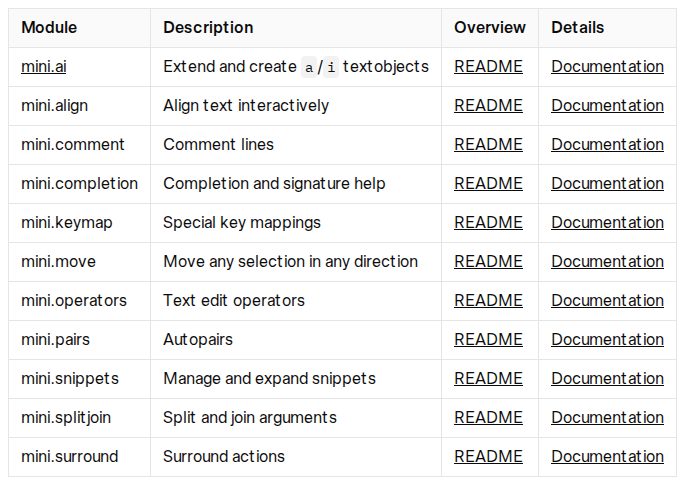
This screenshot illustrates the modular 'Swiss Army knife' architecture by showing the specific text editing tools available in the library.
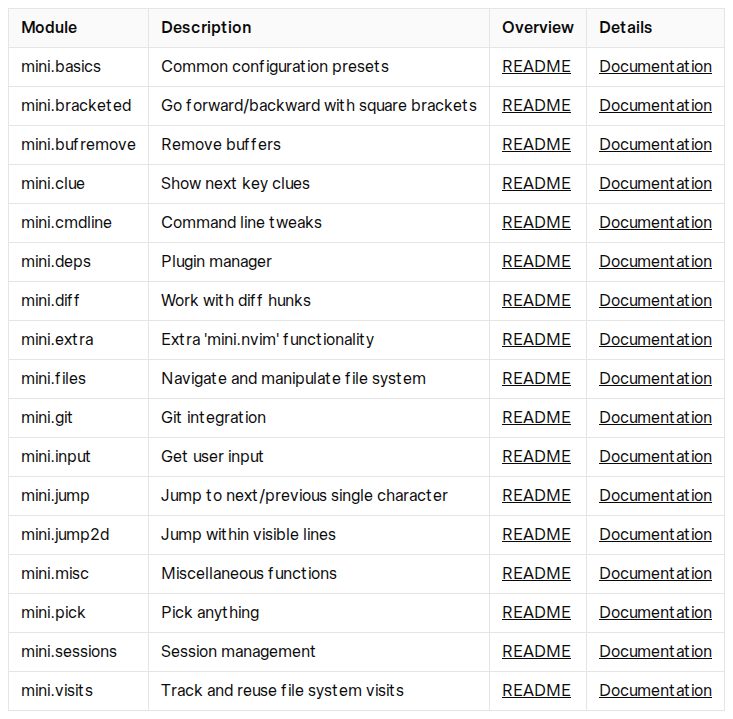
This visual demonstrates the project's ability to provide workflow-specific tools that can be enabled independently.
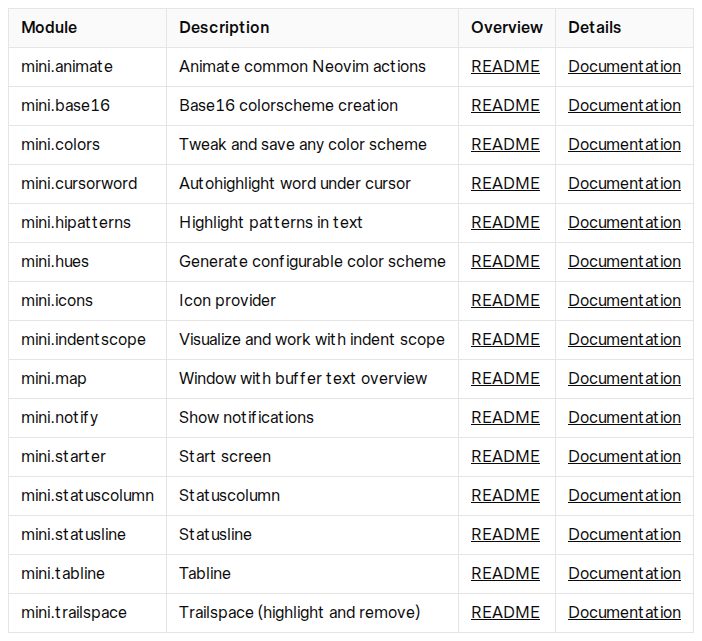
This image highlights the appearance-related modules mentioned as part of the library's modular design.
“Think about this project as "Swiss Army knife" among Neovim plugins: it has many different independent tools (modules) suitable for most common tasks.”
— mini.nvim by nvim-mini.org · Tangled
Organizational Transition and Stability
The project was previously hosted under a personal account but has been transferred to a dedicated organization. This shift is intended to provide a more stable foundation for the project's growth and long-term maintenance.
The repository is now mirrored across multiple code forges, including Tangled and Codeberg, to provide diverse hosting options for the community.
Configuration and Maintenance Trade-offs
While the modules are independent, they share consistent configuration approaches. Users must call the .setup() method for each module to enable its functionality, which then creates a global Lua object for easier access within the Neovim environment.
The project maintains a dual-branch system: the 'main' branch contains the latest development versions, while the 'stable' branch is updated only upon releases that have passed public beta-testing.
What Hacker News readers are saying
- Technical note: One commenter explained that the platform's lack of 'pull' mirroring is a technical restriction intended to prevent excessive resource consumption, suggesting manual mirrors as a workaround. comment ↗
- Experience: Several commenters noted that the 'mini' aspect refers to the modularity of the library, allowing users to pick and choose specific independent plugins rather than installing a large, monolithic suite. comment ↗
Summarized opinions from the Hacker News thread, not verified facts. Read the full discussion ↗