Establishing a peer-to-peer (P2P) connection using standard WebRTC typically requires developers to build a custom signaling infrastructure to exchange Session Description Protocol (SDP) and Interactive Connectivity Establishment (ICE) candidates. The like-webrtc library removes this hurdle by providing a high-level API that handles signaling, peer discovery, and identity management out of the box, allowing connections to be established across browsers, Node.js, and React Native.
Automated Signaling and Discovery
Standard WebRTC requires a separate signaling channel to negotiate connection parameters. like-webrtc integrates this by providing a built-in signaling server (defaulting to a WebSocket RPC protocol) that automatically handles the exchange of SDP and ICE candidates.
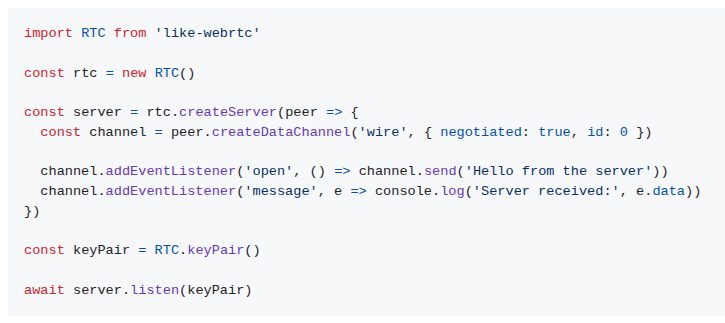
This image provides a visual example of the library's code structure and API usage.
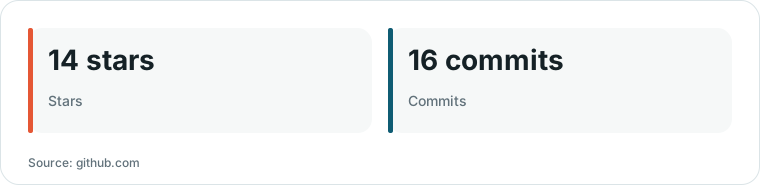
Chart drawn by HN Digest from figures reported by github.com; values are shown as written in the source.
Beyond simple connection negotiation, the library includes a peer discovery system. Developers can use 'topics' to group peers; a server can announce itself under a topic, and other peers can perform a lookup to find and connect to those participants automatically.
“Peer-to-peer WebRTC connections with built-in signaling and peer discovery.”
— GitHub - LuKks/like-webrtc: Peer-to-peer WebRTC connections with built-in signaling and peer discovery.
Cryptographic Identities and Connectivity
Instead of relying on IP addresses for identification, like-webrtc uses cryptographic key pairs. Each peer generates a public key that serves as a shareable address, allowing for more stable and secure peer identification.
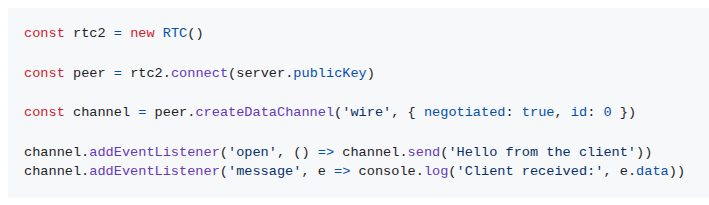
This screenshot shows the programmatic implementation of the cryptographic identities and connectivity features.
The library supports various connection types, including direct peer-to-peer links and 'swarm' configurations where multiple peers join a shared group. It maintains compatibility with the standard WebRTC API, supporting data channels, audio/video tracks, and transceivers.
Deployment and Limitations
The library is designed for broad compatibility, working in web browsers, Node.js environments, and React Native applications. It includes default configurations for STUN and TURN servers to help bypass firewalls and NATs.
A notable limitation is the current reliance on a specific signaling server hosted by the author. Additionally, while the library handles the connection, developers must ensure that RPC relay messages are end-to-end (E2E) encrypted to prevent the signaling server from accessing metadata or message content.
What Hacker News readers are saying
- Open question: One commenter expressed concern regarding the long-term viability of applications built on this library if the maintainers were to shut down the provided signaling server. comment ↗
- Open question: Another user sought clarification on whether the library functions as standard WebRTC using custom signaling and cryptography while still requiring external STUN and TURN servers. comment ↗
- Alternative: A commenter pointed out that Cloudflare offers a free tier for TURN and STUN server allowances. comment ↗
Summarized opinions from the Hacker News thread, not verified facts. Read the full discussion ↗