Anthropic CEO Dario Amodei recently claimed in a video tied to the company's IPO launch that major diseases—including cancer, Alzheimer's, heart disease, and mental illness—will become "relics of the past" in less than 10 years. This assertion has drawn sharp criticism from the pharmaceutical industry and medical researchers who argue that the timeline ignores the fundamental biological and regulatory hurdles of drug development.
This image provides visual context for the video mentioned in the opening paragraph where Dario Amodei made his assertions.
Industry Pushback on AI Timelines
Dave Ricks, the Chairman and CEO of Eli Lilly, provided a grounded counterpoint to Anthropic's optimistic projections. He noted that while he is excited about the use of AI in the pharmaceutical sector, progress is likely to be "steady and incremental" rather than a sudden revolution.
Ricks emphasized that the "map of biology is still largely a blank page," suggesting that the sheer lack of foundational biological data remains a significant barrier to the rapid cures promised by AI-centric narratives.
“I think that would be amazing and I think it’s not likely. The map of biology is still largely a blank page and randomized human proof is the long pole in the tent.”
— Breaking: Eli Lilly CEO becomes latest to push back on Dario Amodei’s ludicrous, Elizabeth Holmes-like medical claims
Biological and Regulatory Constraints
Medical researchers highlighted that the current state of biological data is insufficient for the rapid eradication of complex diseases. One expert pointed out that data currently exists for less than 1% of biology, which limits the ability of AI models to generate comprehensive solutions for complex pathologies.
A primary reason for the skepticism involves the mandatory steps of the drug development pipeline. Even if AI identifies a viable drug candidate quickly, it cannot bypass the necessary sequence of mouse experiments, manufacturing, and multi-phase clinical trials required for FDA interaction.
The Clinical Trial Bottleneck
Data regarding recent drug approvals shows that the median time from first human trials to FDA approval is 10 years. This suggests that for a cure to be realized within a decade, the drugs would need to be already in late-stage testing or very close to it.
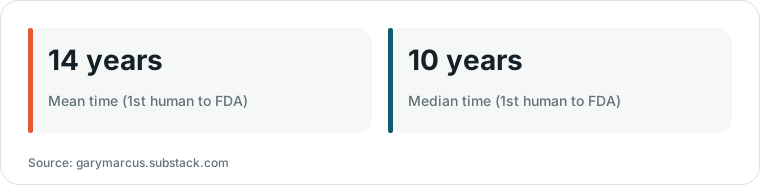
Chart drawn by HN Digest from figures reported by garymarcus.substack.com; values are shown as written in the source.
Because these clinical timelines are fixed by regulatory requirements and human safety protocols, critics argue that AI cannot significantly compress the time it takes for a drug to reach patients once it enters the human testing phase.
Comparisons to Past Overpromises
The rhetoric surrounding Anthropic's medical claims has led some observers to draw parallels to the Elizabeth Holmes and Theranos era of overpromising. Critics argue that using the word "can" to describe a future possibility can be misleading when presented as a near-term certainty in an IPO pitch.
While some experts remain optimistic about the long-term impact of AI on improving health, the consensus among those in the field is that the current 10-year timeline for curing all major diseases is a hyperbolic projection that ignores practical realities.
Unresolved Questions
The source material does not specify which specific AI models or biological data points Anthropic intends to prioritize to achieve these goals. It remains unclear whether the company's claims are based on specific upcoming milestones or represent a broader, more speculative vision for the future of medicine.
What Hacker News readers are saying
- Alternative: One commenter argued that AI's utility in medicine is currently limited because drug development involves physical production and regulation rather than just digital tasks, suggesting AI's role is better suited for data gathering. comment ↗
- Skeptical: Several commenters expressed the opinion that the claims are cynical hype or 'snake oil' that ignores the basic realities of medical science. comment ↗
Summarized opinions from the Hacker News thread, not verified facts. Read the full discussion ↗