In 1973, a forty-hour workweek produced the same amount of output that takes only sixteen hours to produce today. According to Bureau of Economic Analysis (BEA) input-output tables, an hour of work in American business now produces two and a half times what it did fifty years ago, yet the standard forty-hour week remains codified in law.
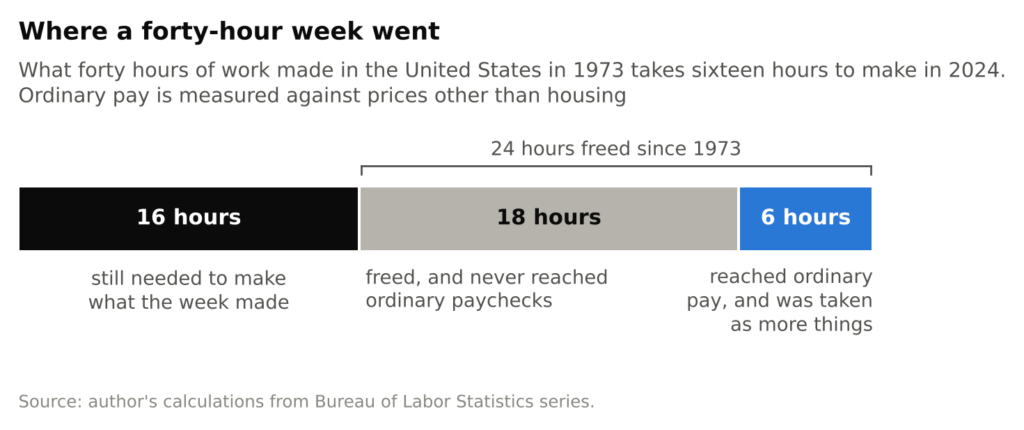
This figure illustrates the core premise that modern productivity allows for a much shorter workweek than the current standard.
The Divergence of Price and Ticket
A wage serves three distinct functions: a price that signals labor scarcity, a 'ticket' that distributes a share of national output, and a social place. For two centuries, these functions pulled in the same direction because industrial machines were 'strong and stupid,' requiring human oversight for every task.
Modern machines can now see, read, write, and decide, decoupling output from human effort. This shift has caused the 'price' of labor and the 'ticket' of the wage to pull apart, as machines learn to perform routine tasks that previously commanded higher pay.
“The fifteen-hour week arrived in terms of output, but not in the workweek.”
— Why Are We Still Working This Hard? - Wilsons Blog
Where the Freed Hours Went
Between 1950 and 1973, the output of an hour of work rose by 81 percent, while ordinary pay only rose by 66 percent. Since 1973, the output of an hour has risen two and a half times, while ordinary pay has only increased by 19 percent.
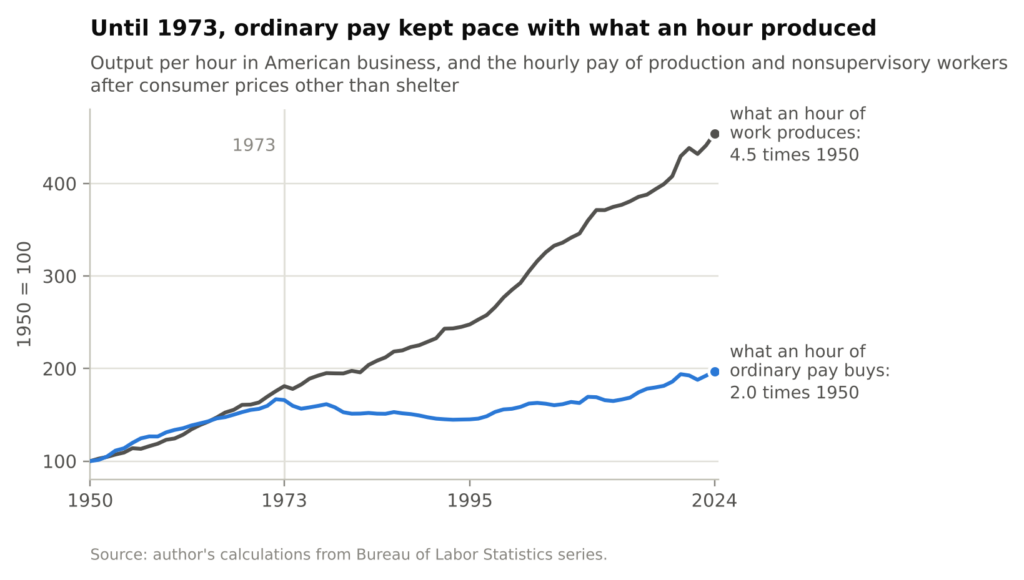
This chart supports the data regarding the divergence of labor value and wage growth since 1973.
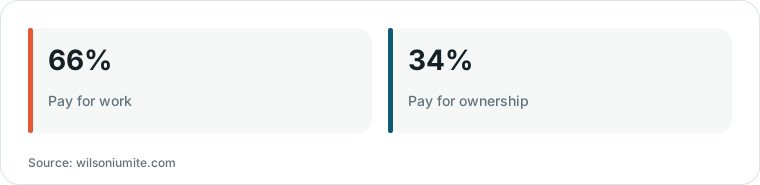
Chart drawn by HN Digest from figures reported by wilsoniumite.com; values are shown as written in the source.
This gap represents 18 hours of 'lost' time that never reached paychecks, largely due to automation replacing routine tasks. The remaining 6 hours of freed time were 'lost' because wages are often non-refusable; if a worker cannot walk away from a job, the wage records their need for survival rather than the hour's actual value.
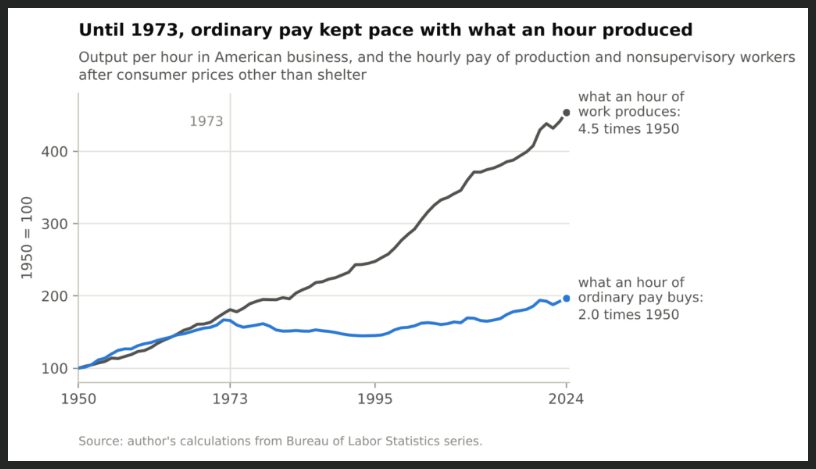
This visual explains where the 18 hours of 'lost' time and the remaining 6 hours of freed time went.
The Ownership Gap and Market Failure
The current economic structure creates a system where nine out of ten households live off each other's wages. While 34 percent of the economy pays for ownership of machines and land, the majority of the population lacks a share of that ownership and must sell their time to access the output.
Because the market for work cannot say 'enough'—since a lower price for a worker means they cannot eat—the economy produces work that is not worth doing. This consumes human time that could be spent on leisure, but because these hours are not 'paid,' they are effectively erased from the economic record.
Limits of Measurement
It is difficult to quantify the exact cost of lost leisure because most records only capture what people did when they could not refuse to do it. Research on low-income individuals receiving unconditional cash and taking roughly a sixth of that money as time suggests that those who can refuse a little will do so, but the broader systemic 'cost' remains an unknown variable.
What Hacker News readers are saying
- Experience: One commenter argued that productivity gains are absorbed by the system because completing work faster simply results in more projects being assigned to fill the newly available time. comment ↗
- Experience: Several commenters suggested that the modern work environment functions as a 'Red Queen's Race,' where workers must increase their pace just to maintain their relative position as competitors leverage the same efficiency gains. comment ↗
- Skeptical: One commenter expressed skepticism regarding the author's novelty, suggesting the piece rehashes classical economic theories and fails to provide sufficient detail on the specific macro wage model mentioned. comment ↗
- Experience: Another observer noted that while some knowledge workers may be quietly reducing their labor volume through remote work, the competitive pressure of the labor market ensures that the hardest workers still set the standard for high-paying roles. comment ↗
Summarized opinions from the Hacker News thread, not verified facts. Read the full discussion ↗