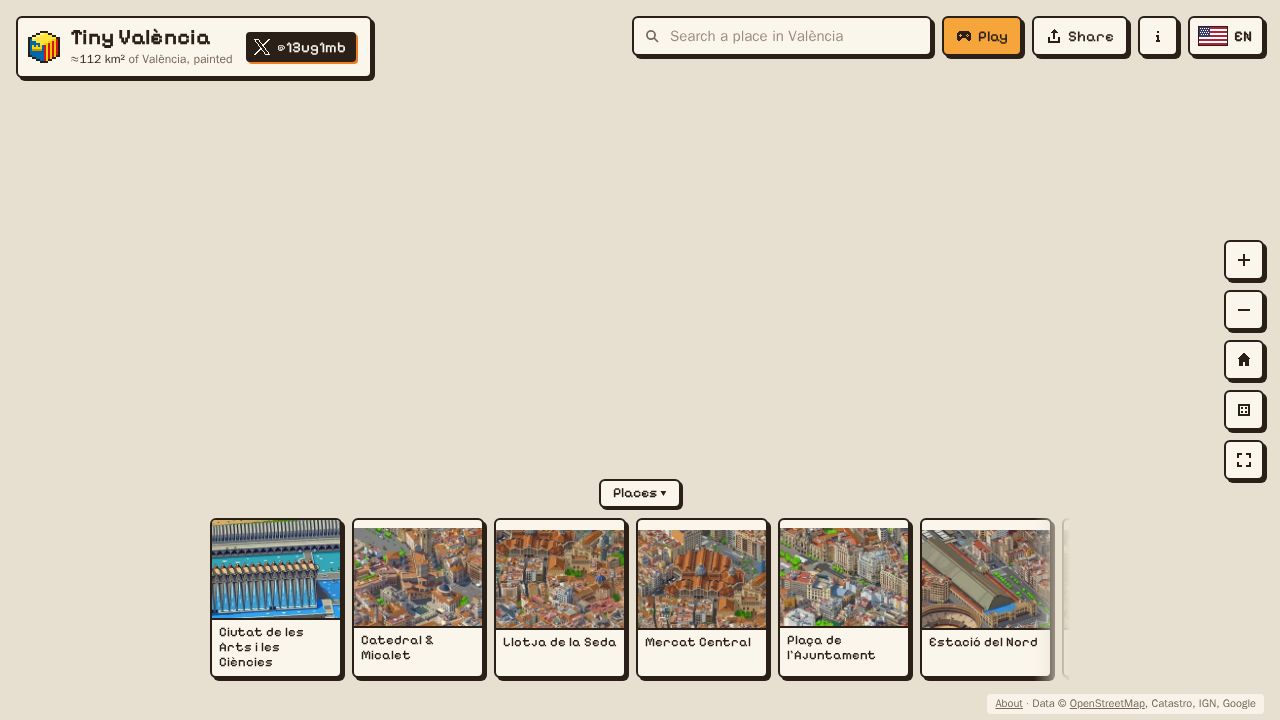
A new digital project has rendered the city of Valencia, Spain, into a seamless isometric view that mimics the aesthetic of classic city-building games like SimCity. By using an AI-driven pipeline to repaint the city tile-by-tile, the project provides a middle ground between abstract, flat maps and the high-detail but often overwhelming perspective of street-level views.
The Project and its Visual Style
The project, hosted at tinyvalencia.com, presents a stylized, isometric interpretation of Valencia's urban landscape. It aims to provide a sense of height and depth that standard maps lack while remaining more navigable than a standard street view.
The developer created the map to serve as a tool for exploration, even including mini-games where users can test their knowledge of local landmarks. This approach allows for a more immersive way to understand the city's dense development and layout.
AI Pipeline and Technical Execution
According to the project's description and community discussion, the map was created using an image model trained on a specific pixel-art style. The model repaints the city tile-by-tile, ensuring that each tile continues the visual logic of its neighbors to maintain a seamless city-wide view.
While the specific base checkpoints and LoRAs (Low-Rank Adaptations) used for the model were not fully disclosed, the technique mirrors other projects that use fine-tuned image editing models to generate consistent, stylized environments.
Community Feedback and Accuracy
Community members have noted both the successes and limitations of the AI-generated render. For example, one user pointed out that the science museum in the City of Arts and Sciences does not actually have waterfalls along its sides, a detail the AI likely hallucinated.
Other users noted that certain infrastructure, such as streetcar tracks, appears to fade out in some areas. Additionally, some residents found the default orientation of the map confusing until they centered the view on major landmarks like the Plaza de Toros.
Debate Over Artistic Classification
The project sparked a technical debate regarding the definition of 'pixel art.' One commenter argued that because the imagery is blurred and lacks the intentional, one-pixel-at-a-time creation process typical of the medium, it should be classified as 'diffusion art' rather than traditional pixel art.
This distinction highlights a growing conversation about the role of generative AI in creating aesthetic styles that mimic human-crafted techniques while utilizing machine-driven processes.
Discussion Highlights
The Hacker News discussion centered on the technical pipeline and the practical usability of the map. Commenters expressed curiosity about the amount of manual work required to align the AI's output with real-world geography and whether the process could be generalized to other cities.
Some users suggested turning the map into a playable game involving transport infrastructure or commuting time challenges, while others shared their personal experiences of living in or visiting Valencia to verify the layout.