In 1951, the CSIRAC—Australia's first programmable digital computer—performed a musical feat that predated the first recorded instance of computer music in England by several months. While the machine was a primitive, room-sized system capable of only 1,000 cycles per second, it was used to play popular tunes like 'Colonel Bogey' to an international audience during Australia's first computing conference.
Hardware Constraints and the 'Hooter'
CSIRAC was a serial computer that passed digital bits one at a time, a stark contrast to the parallel processing of modern 32-bit or 64-bit systems. It possessed very limited memory—roughly 2KB of RAM and 3KB of disk memory—and lacked a modern display, relying instead on punched paper tape for output.

This image shows the physical scale and hardware of the CSIRAC system described in the article.
The only familiar output device was a speaker known as the 'hooter.' Typically, programmers used the hooter to produce 'blurts'—short sounds at the end of a program to signal completion. To turn this debug signal into music, the system had to overcome the physical properties of its memory components.
“CSIRAC was thus the first computer in the world to play music.”
— How Australia played the world’s first music on a computer
Overcoming Mercury Memory Timing
The computer's memory consisted of mercury acoustic delay lines, where pulses traveled through tubes of mercury to be recycled. Because each memory access took a different amount of time, sending raw pulses to the speaker would normally result in random, non-musical sounds rather than steady pitches.
Geoff Hill, a mathematician with perfect pitch, solved this by calculating the timing required to ensure pulses arrived at the speaker at regular intervals. By mastering these timing variations, he was able to program the notes of a musical scale despite the machine's slow clock frequency of 1,000 cycles per second.
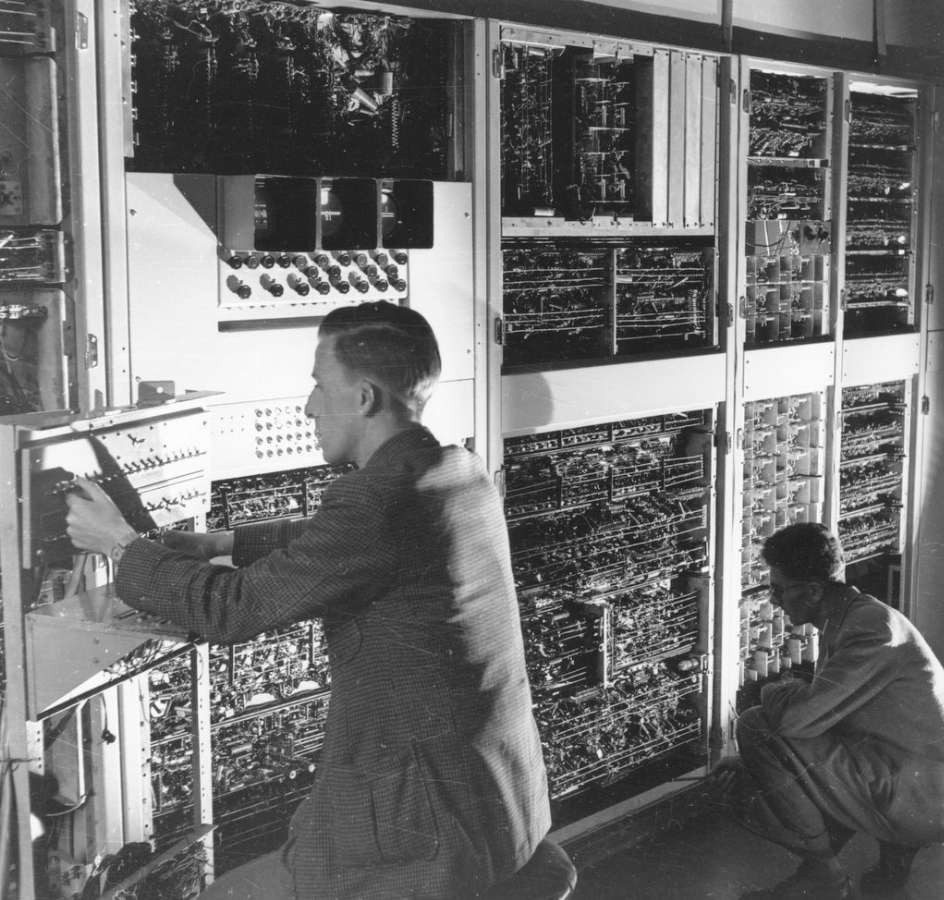
This image depicts Geoff Hill, the mathematician who programmed the first computer music, alongside the CSIRAC machine.
Legacy and Reconstruction
Although CSIRAC achieved this 'parlour trick,' the music was not recorded at the time because the CSIRO was refocusing its efforts on weather science and primary production. Consequently, the first instances of computer music remained unheard until modern efforts reconstructed the pulse shapes and software.
A team at the University of Melbourne recently used original punched-paper tapes and reconstructed valve hardware to regenerate the music accurately. This project allowed the public to finally hear the tunes CSIRAC played over 70 years ago, such as 'Auld Lang Syne' and 'The Bonnie Banks o' Loch Lomond.'