On October 1, 2026, U.S. authorities arrested a man for allegedly smuggling over $300 million worth of GPU-equipped servers to China using fraudulent paperwork intended for Malaysia and Singapore. This incident underscores the difficulty of enforcing export controls on high-end AI hardware once it leaves domestic borders, prompting a shift toward technological solutions for tracking.
Legislative Push for Hardware Tracking
To address the persistent flow of restricted technology into China, the U.S. House Foreign Affairs Committee passed a bill requiring location verification for advanced AI chips. This legislative move aims to create a technological 'Find My' system, similar to those used to locate misplaced consumer electronics.
The goal is to move beyond paper-based export controls, which can be bypassed with fraudulent shipping documents. By requiring hardware-level tracking, the government seeks to create a more robust deterrent against the diversion of strategic compute resources.

This image illustrates the concept of tracking high-end AI chips to prevent their diversion to restricted markets like China.
“The priority should be for the highest-end data center chips—the cream of the crop in high-end data center GPUs”
— Can a ‘Find My’ for AI Chips Really Stop High Stakes Smuggling?
Mechanisms for Location Verification
One primary method proposed is Ping-Based Location Verification (PLV). This system measures the time it takes for a 'ping' to travel from a chip to multiple trusted 'landmark' servers around the world and back. By calculating these travel times, manufacturers can deduce the approximate radius of a chip's physical location.
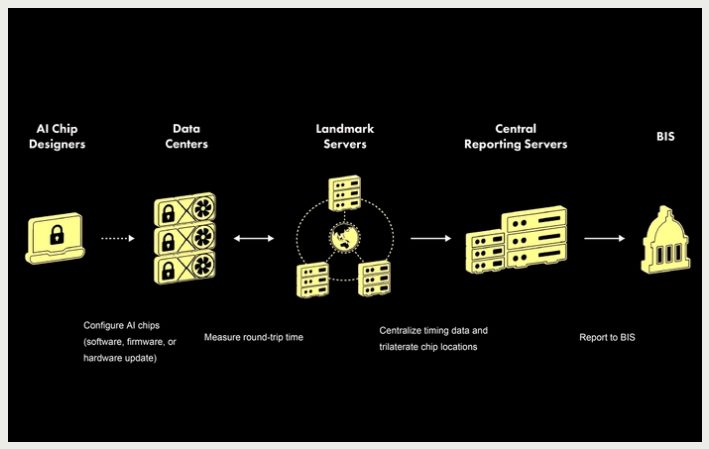
This diagram explains the technical mechanism of Ping-Based Location Verification (PLV) described in the article.
Another approach involves 'sovereignty certificates.' These are cryptographic credentials that provide verifiable, unforgeable proof of the physical location of a computing device, such as a CPU or GPU, at a specific point in time.
For chips that lack a hardware root of trust, researchers are exploring hardware fingerprinting. This involves creating unique identifiers based on manufacturing variations and random seeds to statistically verify that a chip is the specific unit it claims to be.
Operational Trade-offs and Limitations
While these technologies offer a new layer of defense, they are not a panacea. PLV can only detect a chip's location when it is powered on and connected to a network; it cannot track chips that are offline, in storage, or currently in transit.
Security experts warn that sophisticated adversaries with physical access to a chip could potentially extract cryptographic keys or spoof signals to mimic an intended location. To counter this, a 'defense in depth' strategy is recommended, combining digital pings with physical audits of data centers to generate and investigate leads.