Kirlian photography utilizes high-voltage electricity to create 'electro-photographs' by capturing the corona discharge that occurs between a subject and a metal discharge plate. Named after Semyon Davidovich Kirlian, who began developing the technique in 1939, the process does not require a camera or lens because it functions as a contact print.
The Contact Print Mechanism
To create a Kirlian photograph, a sheet of film is placed on top of a metal discharge plate, and the object to be photographed is placed on top of the film. When high voltage is applied to the plate, a corona discharge forms between the object and the plate, passing through the film to create an exposure.
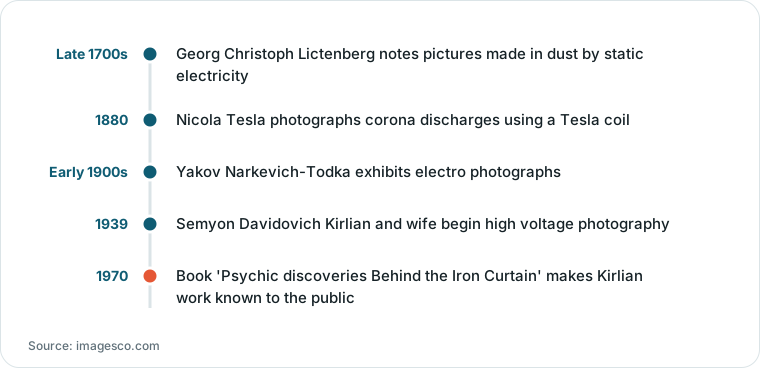
Chart drawn by HN Digest from figures reported by imagesco.com; values are shown as written in the source.
For inanimate objects like coins or leaves, the subject must be connected to an earth ground to produce a stronger discharge. If a transparent electrode is used instead of a standard metal plate, the process can be adapted to work with a standard camera or video camera.
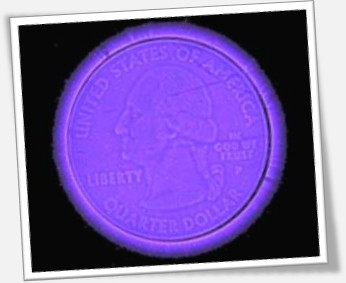
This image provides a concrete example of a Kirlian photograph of an inanimate object, as discussed in the section on contact print mechanisms.
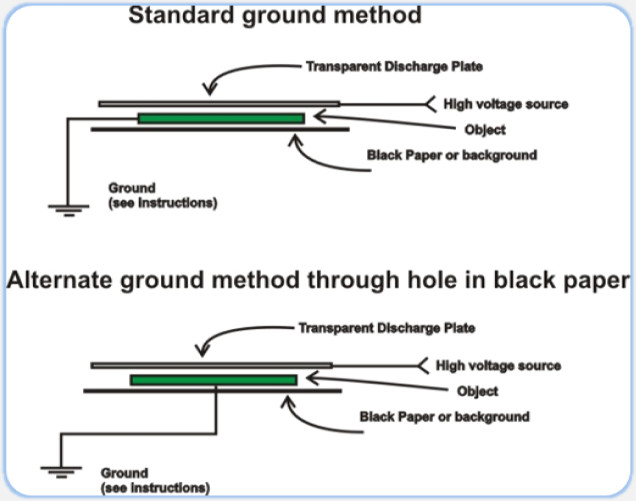
This visual supports the technical requirement of connecting inanimate subjects to an earth ground to produce a stronger discharge.
“Most observable Kirlian phenomena does not require any paranormal or bio-plasma field to be explained.”
— Kirlian Photography - Building Your Own Equipment
Physical Variables vs. Paranormal Claims
The resulting images often feature a corona discharge, sometimes referred to as an 'aura.' While some researchers claim these images reveal 'bio-plasma' fields or pre-symptomatic illnesses, the author of the source material attributes these effects to known physical laws.
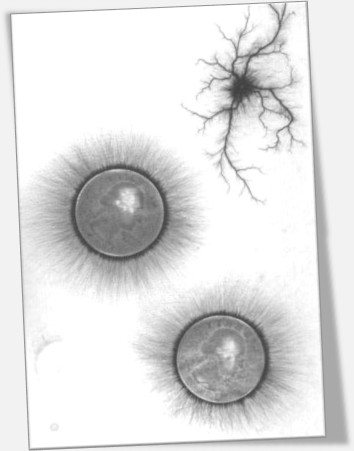
This image illustrates the 'aura' or corona discharge mentioned in the discussion of physical variables versus paranormal claims.
For example, stress or the act of lying can be detected via changes in galvanic skin resistance, which directly alters the corona discharge in a Kirlian photograph. Other influencing factors include the object's pressure against the film, air humidity, air pressure, and the specific voltage and frequency of the power supply.
DIY Equipment and Technical Requirements
A basic manual Kirlian device can be built using a high-voltage (HV) auto-transformer, a capacitor bank (C1-C4), and a battery power supply. The circuit uses a 'momentary' toggle switch to close the current path to the transformer and capacitors, preventing the batteries from draining when not in use.
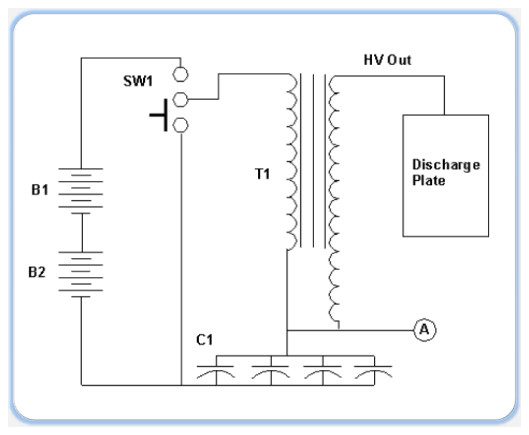
This image provides a visual reference for the DIY equipment and circuit components described in the technical requirements section.
The discharge plate is typically made from a copper-clad board covered with a thin plastic sheet to prevent the subject from making direct contact with the metal. For the film, black and white ortho film is recommended for beginners because it allows for easier development and feedback compared to color sheet film.
The Phantom Leaf and Experimental Limits
One of the most notable claims in the field is the 'phantom leaf' experiment, where a small portion of a leaf appears as a ghostly apparition in the photograph. Soviet researchers claimed this was proof of an ethereal bio-plasma body.
However, the author notes that they have been unable to successfully replicate these specific results. The exact experimental parameters—such as the precise voltage and frequency required—are either unavailable or have not yielded the 'phantom' effect in independent testing.