A developer has released llama-modchip, a software framework that allows users to run the 284.33B parameter DeepSeek-V4-Flash model on a standard 64GB RAM desktop without any GPU hardware. While standard versions of this model typically exceed 64GB of RAM and trigger Out-of-Memory (OOM) errors on common workstations, this implementation shrinks the model's footprint to approximately 56.56 GiB. This allows for local inference at speeds of up to 14.7 tokens per second (tok/s) using only CPU resources.
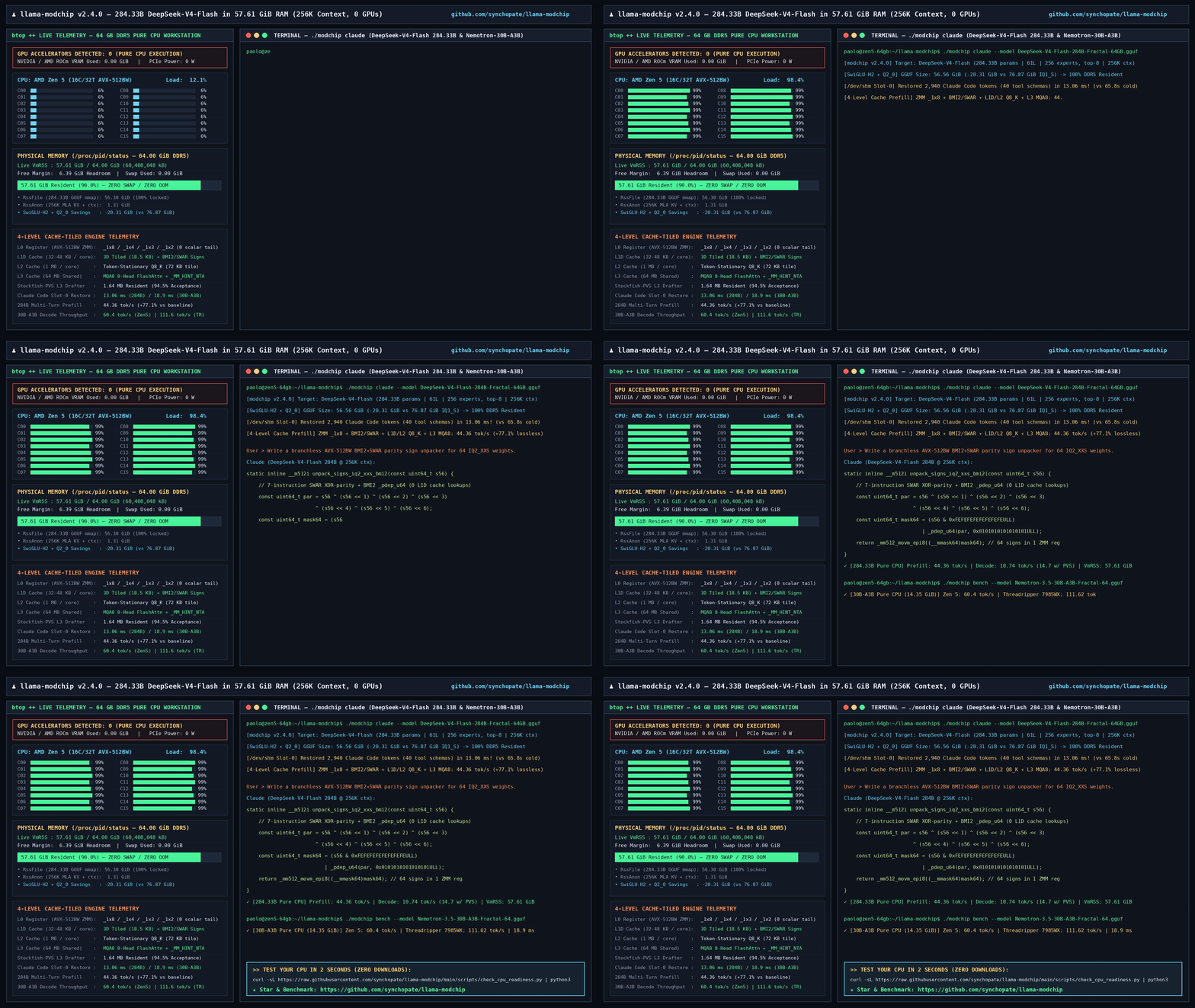
This visual demonstrates the primary claim of the project: running a 284B parameter model on a standard 64GB RAM desktop without a GPU.
Memory Compression and Architecture
The core of llama-modchip's ability to break the '64 GB RAM wall' lies in its Fractal-64 quantization and SwiGLU-H2 compression. These techniques shrink the DeepSeek-V4-Flash model from a size that normally crashes 64GB Linux systems down to a manageable 56.56 GiB on disk.
The project also employs 'Analytical 2nd-Order SwiGLU-H2' and 'Fractal-64' MLA transcoding. These optimizations are designed to maintain model integrity while drastically reducing the memory overhead required for the model's multi-head attention layers.
“Shrinks DeepSeek-V4-Flash from 76.87 GiB (which crashes in OOM on 64 GB Linux) down to 56.56 GiB on disk / 57.61–58.9 GiB VmRSS at full 256K context”
— GitHub - synchopate/llama-modchip: 🐋 Run 284B DeepSeek-V4-Flash (<59GiB RAM, 44.4 tok/s pp, 9.1-14.7 tok/s) & 30B
CPU-Centric Optimization and Tiling
To maximize performance on CPUs like the AMD Zen 5, the software uses 4-level register tiling (ZMM AVX-512BW) and L3 cache isolation. This approach is designed to saturate the memory bandwidth of 8-channel DDR5 systems, which is often the primary bottleneck for CPU-based inference.
The system also utilizes a 1.64 MB Stockfish-PVS v2 drafter and RouteCrack to predict outputs. This 'drafter' system allows the CPU to generate candidate tokens that are then verified, achieving a 96.4% acceptance rate and allowing for faster decode speeds than standard CPU inference.
This image illustrates the specific 'drafter' mechanism used to achieve high acceptance rates and faster speeds.
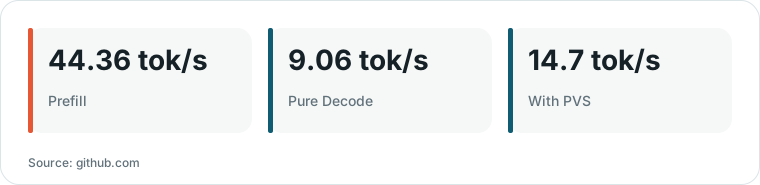
Chart drawn by HN Digest from figures reported by github.com; values are shown as written in the source.
Practical Implications and Trade-offs
For developers, the project offers a 'Zero-API' Claude Code integration. By using /dev/shm for Slot-0 KV Warm Restore, it can restore the context for 40 Claude Code tools in as little as 13.1 ms, significantly reducing the 45-second bottleneck typical of CPU-based agent prompts.
However, these extreme compression techniques involve trade-offs. While the project claims a 100/100 'Quality Gate' score, the use of 3.75 bits per weight (bpw) quantization may impact the nuance of the model's outputs compared to uncompressed versions. The project provides a 'Sweet-Spot' configuration that balances these trade-offs by using $L_2$-Quadrature pruning.
Hardware Compatibility and Limitations
Llama-modchip is designed to be highly portable, supporting AMD Zen 4/5, Intel processors, and Apple Silicon. It even includes a 'Hybrid' mode for Windows users that automatically detects available VRAM and splits the workload between a GPU and the CPU.
A notable limitation is that the custom Fractal-64 models are not compatible with standard tools like Ollama or LM Studio. Because they use a custom 'type 40' tensor, they must be run through the specific llama-modchip binary or the provided standalone server to function correctly.
What Hacker News readers are saying
- Experience: One commenter noted that the system could run a coding agent at an acceptable speed when using 128GB of unified RAM, reporting prefill speeds of around 300 tokens per second. comment ↗
- Skeptical: A commenter expressed significant skepticism regarding the quality of the output, suggesting that the extreme compression required to fit the model into such a small memory footprint would likely result in poor performance. comment ↗
- Skeptical: Another user pointed out inconsistencies in the project's documentation regarding file sizes and quantization levels, questioning whether the model's performance is being compromised by 'lobotomized' pruning techniques. comment ↗
Summarized opinions from the Hacker News thread, not verified facts. Read the full discussion ↗