Reasoning in large language models can be redefined as a pathfinding problem where the model navigates a high-dimensional 'token space' to reach a valid conclusion. This shift in perspective moves beyond simple next-token prediction, framing the reasoning chain as a dynamic navigation strategy designed to avoid logical dead ends.
Reasoning as Token Pathfinding
In this framework, reasoning is not a linear progression of text but a navigation task through the space of possible tokens. The model treats the correct answer as a destination and the reasoning chain as the path taken to get there.
By viewing reasoning as pathfinding, the objective becomes identifying the most viable route to a solution. This involves evaluating multiple potential directions in the token space and selecting those that maintain logical consistency.
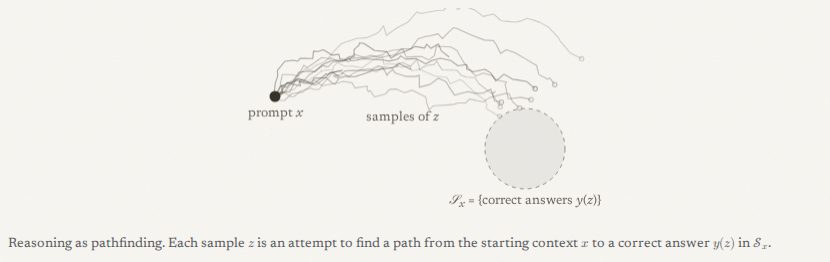
This figure illustrates the core concept of the article: reasoning as a navigation task through token space to reach a destination.
Hillclimbing and Logic Avoidance
The navigation process behaves like a hillclimbing algorithm, where the model moves toward a 'peak' of correctness. A significant part of this process involves identifying and steering away from logical fallacies that would lead to an incorrect conclusion.
A primary benefit of this mechanism is the prevention of 'absolutely silly' logic flaws. By recognizing these errors early, the model can pivot its reasoning path before the error propagates through the rest of the output.
Mechanisms of Correction
Models that expose their internal 'thinking' often show patterns of self-correction, such as 'but wait!' moments. These serve as internal flags that signal a deviation from the intended logical path, allowing the model to navigate around the obstacle.
While the model navigates through token space to solve a specific prompt, a parallel process occurs during training where the model's weights are optimized. This creates a dual narrative of pathfinding: one through the sequence of words and one through the underlying parameters.
Trade-offs and Uncertainties
A key trade-off in this model is the balance between exposing the path to a solution and the ability to flag problems. Effective reasoning requires the model to not only know the correct direction but also to recognize when it has veered off course.
It remains an open question how to precisely measure the efficiency of these 'hillclimbing' movements. While the conceptual framework provides a way to visualize reasoning, specific metrics for how a model weighs a 'logical flaw' against a 'correct path' are still being explored.
What Hacker News readers are saying
- Alternative: One commenter suggested that reasoning should be measured by both the ability to identify solutions and the ability to flag problems, noting that preventing basic logical flaws appears to be a primary benefit. comment ↗
- Skeptical: One reader argued that the author's framework contradicts the idea that intelligence necessarily improves through more reasoning, potentially undermining assumptions about recursive self-improvement. comment ↗
Summarized opinions from the Hacker News thread, not verified facts. Read the full discussion ↗