Register allocation is the critical process of mapping an unlimited number of virtual registers—used during high-level compilation—to the finite set of physical storage resources provided by hardware, such as x86 general-purpose registers (GPRs) and floating-point registers (FPRs). To do this efficiently, a compiler must first perform 'liveliness analysis' to determine exactly when a value is 'alive' and when it can be safely discarded or overwritten.
The Mechanics of Liveliness Analysis
The analysis works by traversing the code's basic blocks to observe every point where a virtual register is defined or used. In the provided implementation, the compiler walks through blocks, visiting terminators first to see all final usages, then visiting instructions in reverse to capture definitions and intermediate uses.
For each virtual register, the system maintains a tuple of (lo, hi) positions. The 'lo' position is updated at every point of use, while the 'hi' position is only set once at the very last point of use. This creates a clear window of 'liveliness' for every value in the program.
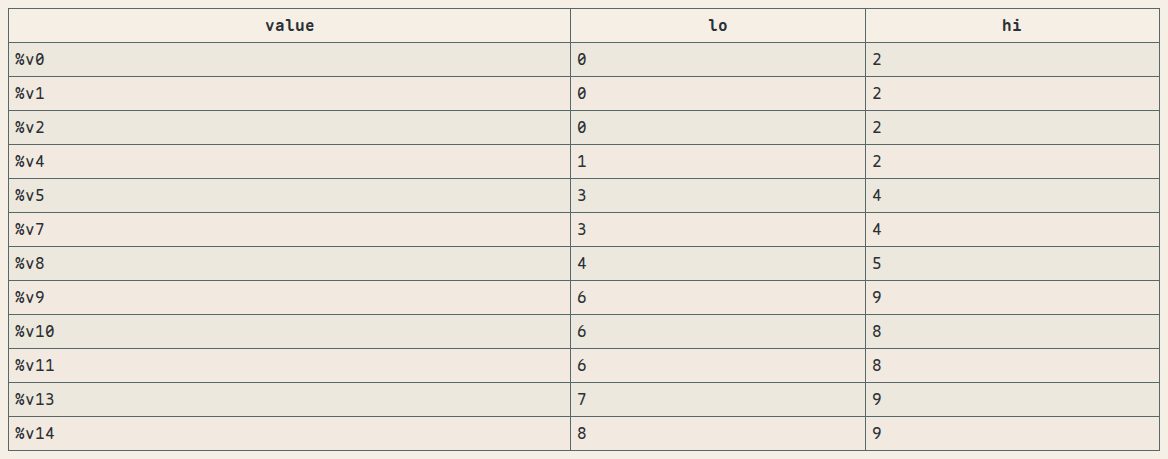
This table visually represents the livelinetset, showing how the compiler tracks the start and end points of a value's active range.
“Register allocation is assigning the unlimited amount of virtual registers to the limited set of storage resources hardware has, specifically the gprs (general purpose registers), the fprs (floating point registers) and the stack”
— An ode to livelyness analysis; SSA to registers
Integrating SSA with Register Mapping
The project uses a Static Single Assignment (SSA) form, which simplifies analysis because every virtual register (notated as %vN) is assigned exactly once. Unlike some IRs that use phi nodes, this specific implementation uses block parameters and terminators to facilitate interblock dataflow.
By calculating the livelinetset, the compiler can perform a preallocation pass. This allows the backend to decide whether a value can reside in a hardware register or must be placed in a stack slot, effectively abstracting the complexity of spilling and restoring values during the lowering process.
Implementation and Trade-offs
The developer demonstrates the lowering of binary operations into bytecode, using Rust macros to handle different instruction types like addition, multiplication, and comparisons. This process ensures that even complex operations are mapped to the correct register or stack location based on the pre-calculated livelinetset.

This code snippet provides a concrete example of the logic used to process instructions and manage register mapping.
A primary trade-off in this system is the management of 'spilling.' When the number of active virtual registers exceeds the available hardware registers, the compiler must move values to the stack. The liveliness analysis is what makes this manageable, as it tells the compiler exactly which values are safe to move without breaking the program's logic.