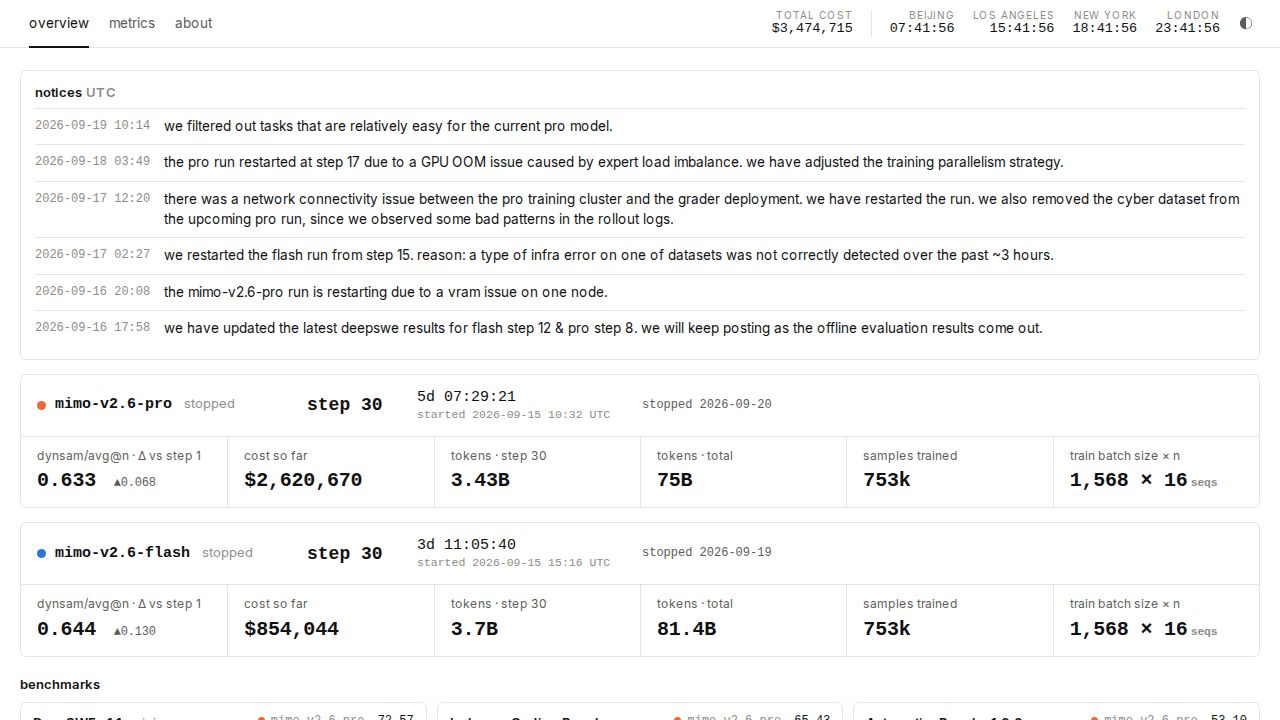
Xiaomi is providing a rare level of transparency in the AI space by hosting a live dashboard for the post-training of its Mimo 2.6 model. This dashboard allows the public to monitor real-time progress bars, reinforcement learning (RL) environment scores, and estimated training costs. While the specific hardware configurations and Model Flops Utilization (MFU) metrics remain undisclosed, observers have estimated the daily training costs to be around $432,000 based on the visible counters. This level of openness is notable as many major AI providers typically keep training telemetry private.
Users who have utilized the previous iteration, Mimo 2.5-pro, describe it as a reliable 'workhorse' for coder and tester agents. While the 2.5-pro version was noted for being conservative in its implementations, early experiences with the upcoming 2.6 version suggest a step up in multi-tasking capabilities and a more ambitious approach to solving well-defined issues. Despite these improvements, the model is characterized by its 'obedient' nature, making it a preferred choice for executing specific implementation tasks that are planned by other, more complex models.
One of the primary draws of the Mimo series is its high return on investment (ROI). Commenters have noted that while other frontier models like DS4.1 or Gemini Flash offer high intelligence, Mimo provides comparable quality at a significantly lower cost per token. However, this efficiency comes with trade-offs; users have reported occasional 'hallucination loops' and noted that the model may still require human steering for large-scale projects. The live dashboard serves as a public record of these trade-offs, showing how the model is being tuned to balance performance, cost, and reliability in a competitive coding landscape.