Thinking Machines Lab has launched Inkling 2 Small, its second generation of models specifically engineered for long-horizon autonomous work. The model utilizes a Mixture-of-Experts (MoE) architecture, featuring a total of 594 billion parameters with 17 billion active parameters. It is designed to support image inputs and variable effort levels, aiming to provide more robust performance in complex, multi-step workflows compared to its predecessor. The lab reports that the model achieved a score of 31 on the Artificial Analysis Intelligence Index, which they attribute to significant gains in reasoning, knowledge work, vision, and agentic coding.
A core differentiator for Inkling 2 Small is its proficiency in 'agentic' tasks—scenarios where the model must iteratively refine its own work based on feedback. For example, the model can use Three.js to procedurally generate a full city simulator from scratch or build a Linux PC emulator in Python that boots a live kernel in a web browser. These capabilities were bolstered by a training process that moved beyond simple unit-test rewards. Instead, the lab used an agentic RL (Reinforcement Learning) grader that evaluates the model's approach to a problem, rather than just whether the final code passed a test. This training included hundreds of thousands of long-horizon coding tasks across various agent harnesses and context-compaction strategies.
Beyond coding, the model demonstrates 'autoresearch' capabilities, such as autonomously training other models. In a documented test, Inkling 2 Small was tasked with training a Qwen3.5-4B model to forecast time-series data like electricity demand and weather. The model independently analyzed the task, wrote its own evaluation scripts, curated training datasets, and experimented with different supervised fine-tuning (SFT) and RL recipes. While the model is currently available with closed weights on the Tinker platform, Thinking Machines Lab intends to release the full weights under an Apache 2.0 license following the completion of external safety testing and red-teaming. Because these benchmarks are self-reported by the developer, independent verification of the model's performance relative to competitors like DeepSeek or Claude remains a pending factor for the community.
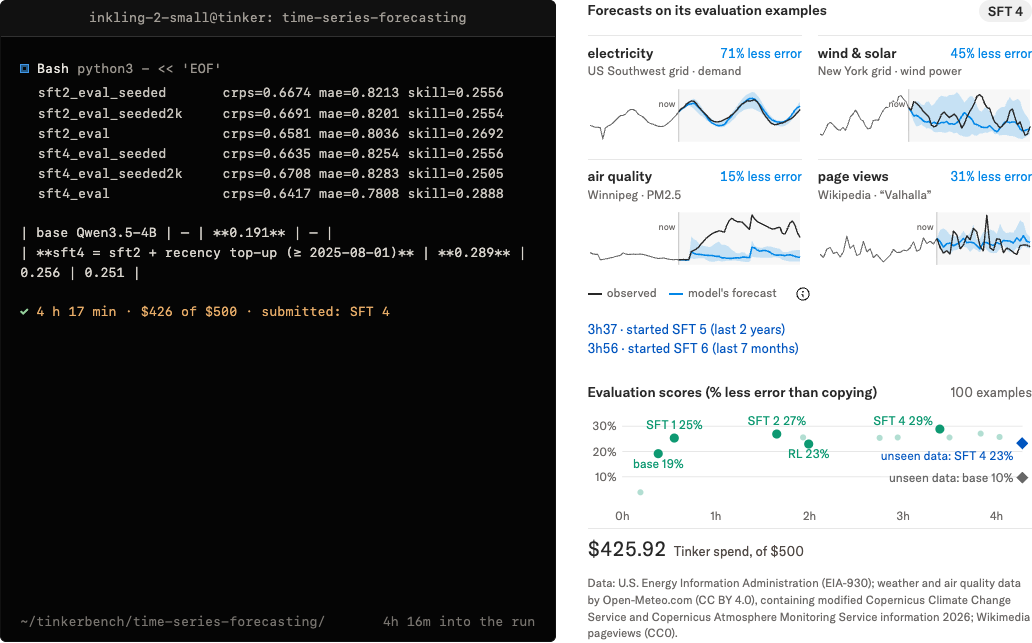
This visual illustrates the model's ability to autonomously train other models and evaluate their performance on time-series data.