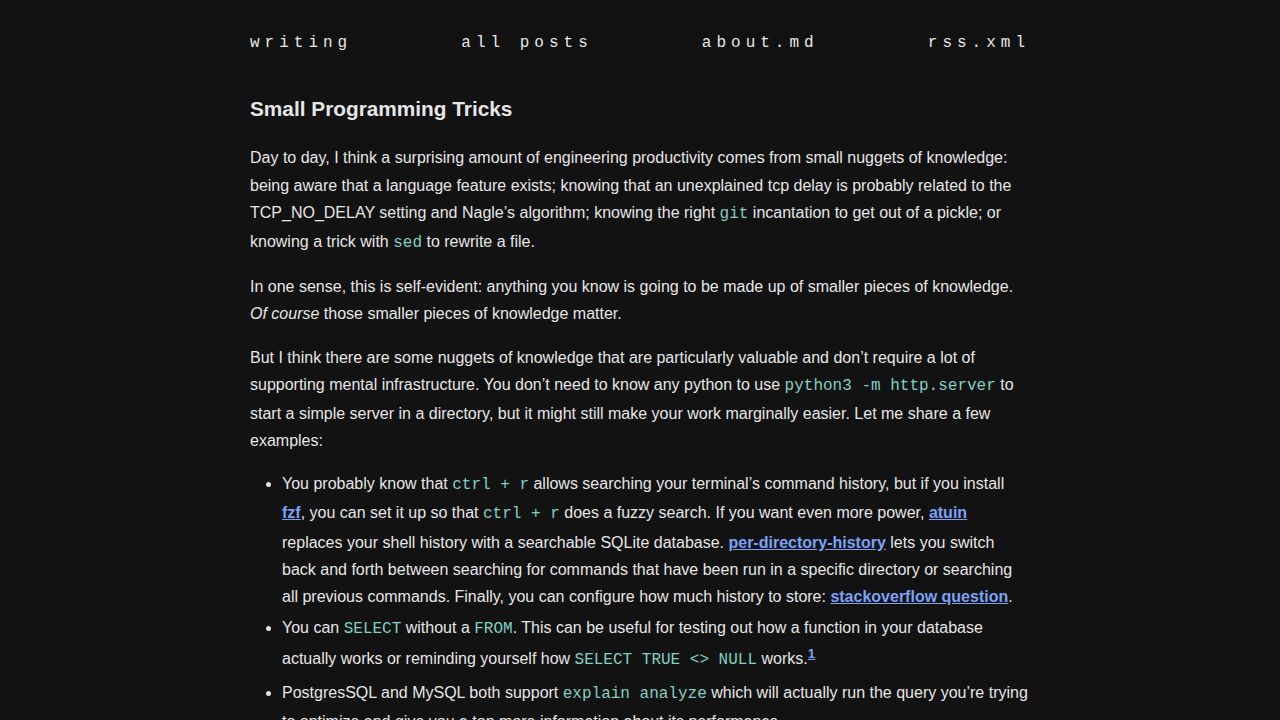
Engineering productivity is often built on a foundation of 'small tricks': niche pieces of knowledge that solve specific friction points without requiring a deep architectural understanding. These include being aware of a specific language feature, knowing the correct command to navigate a complex Git history, or understanding why a network delay is occurring. While these may seem minor, they are high-leverage because they provide immediate utility, allowing engineers to bypass common hurdles and maintain flow.
These tricks manifest across various domains of software development. In terminal navigation, tools like `fzf` or `atuin` can transform standard command history into searchable databases, while `git log -S` (the 'pickaxe' command) can identify exactly when a string was added or removed in an older codebase. In database management, using `EXPLAIN ANALYZE` allows developers to see the actual execution plan of a query to identify performance bottlenecks. Even in modern JavaScript, adopting newer features like `Array.flatMap` or `Promise.withResolvers` can streamline code. These examples demonstrate how a single command or syntax choice can replace a more cumbersome manual process.
Beyond technical syntax, 'company-specific' tricks often provide the highest leverage in a professional environment. These are nuggets of tribal knowledge, such as knowing which person to contact for a specific area, which command triggers a manual scaling event, or which data source is best for debugging a specific problem. To maximize the impact of these tricks, they must be integrated into a workflow; simply knowing a shortcut is insufficient if the 'path of least resistance' remains the old habit. Some engineers mitigate this by maintaining a personal directory of documentation to quickly reference these tricks when they are not top-of-mind. Furthermore, modern tools like AI can serve as a discovery mechanism for these tricks, allowing engineers to observe and learn advanced commands—such as those used in performance profiling—while maintaining manual oversight of the execution.