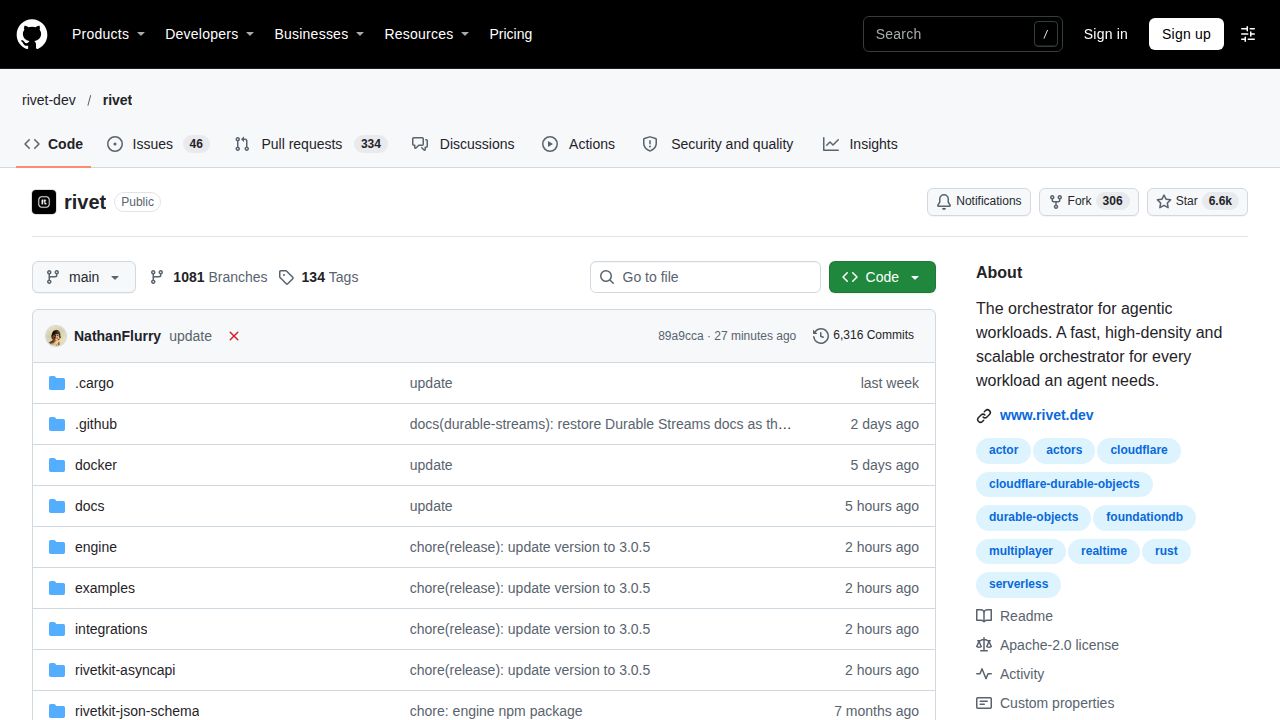
Current infrastructure for AI agents often relies on running each agent within a dedicated sandbox. However, these sandboxes are frequently inefficient because they are expensive to maintain, slow to boot, and spend much of their time idle. Rivet addresses these bottlenecks by using an actor model, where each agent is represented by a lightweight actor rather than a full sandbox. These actors maintain in-memory state for context, provide a WebSocket server for multiplayer interactions, and utilize durable SQLite storage. This shift significantly reduces resource overhead: Rivet actors have a 72 KB baseline compared to the 512 MB required for a minimal sandbox, and they achieve a p99 startup time of 4.9 ms versus 1.7 seconds for sandboxes.
To balance performance with cost, Rivet employs a tiered storage architecture backed by Amazon S3. Because agents can generate massive amounts of data—such as session transcripts and full POSIX filesystems—storing everything on high-performance SSDs becomes cost-prohibitive. Rivet solves this by using an SSD tier to acknowledge writes immediately (across three availability zones) while batching that data to S3 in the background. This ensures that S3 is never on the critical write path, allowing the system to maintain SSD-level speeds while making data storage 10x cheaper than standard EBS gp3 volumes. This architecture supports durable writes in approximately 1.07 ms and reads in 1.36 ms, with a fallback to object storage for uncached data.
Practical applications of this model include companies like Amp, which migrated from Cloudflare Durable Objects to Rivet to bypass platform limitations and deploy within their own private VPCs. While the technical efficiency of the actor model is a primary draw, some early users have noted a steep learning curve regarding the platform's user experience and specific edge cases. Furthermore, technical discussions around the model suggest that by decoupling the agent loop from the sandbox, developers can minimize costs during inference phases where the agent is waiting for a response. One notable limitation remains: the provided materials do not specify how Rivet handles security isolation for untrusted AI-generated code without the traditional sandbox environment, which is a common requirement for many agentic workloads.