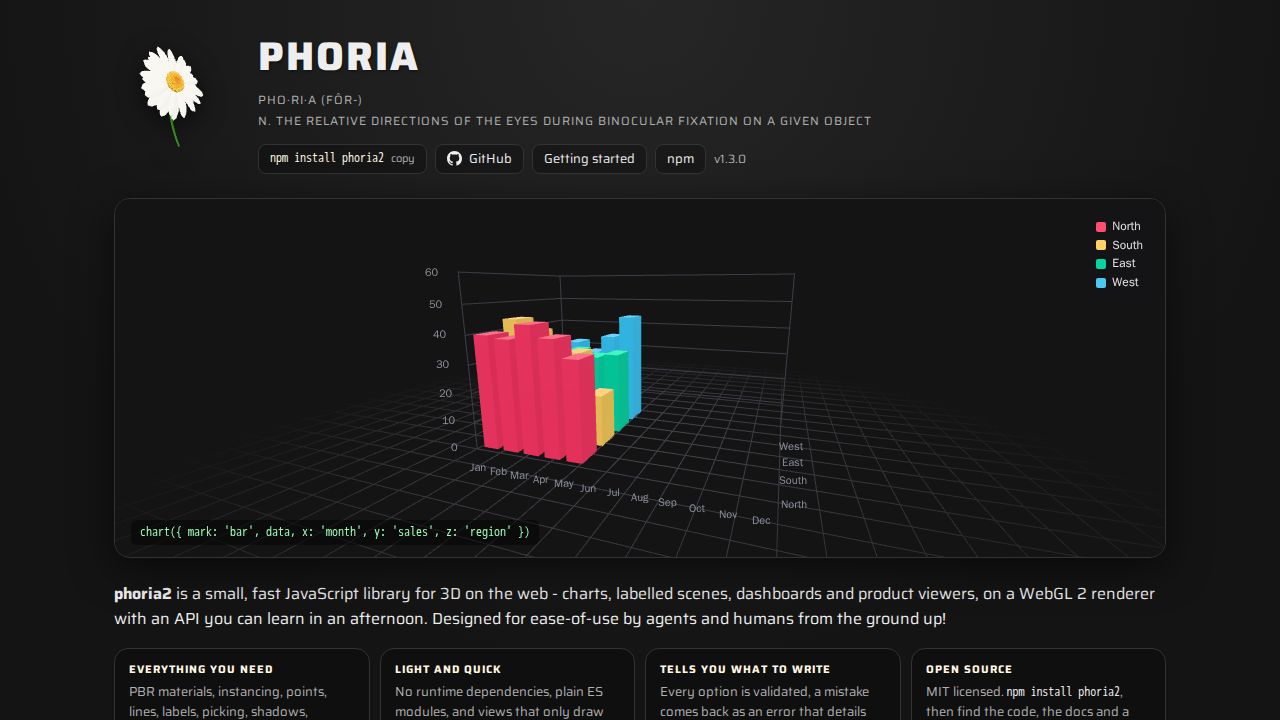
The developer of phoria2, kevs3d, designed the library to address a specific niche: 'business' use cases that require high-density data visualization. While general-purpose 3D libraries like Three.js or Babylon.js are capable of rendering complex scenes, phoria2 focuses on the practical requirements of dashboards—such as those used for financial trading—where a single page might display dozens or even hundreds of charts simultaneously. The library provides specialized primitives for time-series data, heat-colored surface charts, and tiled dashboards, aiming to provide the visual depth of 3D without the overhead of a full-scale game engine.
One of the core mechanisms that differentiates phoria2 is its approach to GPU resource management. In many standard 3D implementations, a continuous render loop (often 60 frames per second) can consume significant GPU power even when the data on the screen is static. To counter this, phoria2 implements views that only render when there is an actual update to the data. This is particularly relevant for complex dashboards where multiple views are open at once; by avoiding unnecessary redraws, the library preserves performance for the components that require active updates. Additionally, the library includes specific error messages in its option validation designed to help coding bots and developers quickly identify and correct configuration issues.
In terms of scale and accessibility, phoria2 aims to be significantly more compact than its larger competitors. The developer noted that in 'agent tests'—where AI coding agents are tasked with building specific features—phoria2's codebase was approximately 50% smaller than Three.js for the same tasks. This smaller footprint is intended to make the library easier to integrate and manage. However, the library currently has limitations in specific areas: it does not yet feature a streaming API for real-time geometry updates (such as adding new data points to a live candle chart in real-time), and some users have noted that 'hover' interactions may behave inconsistently on certain mobile browsers. The developer has identified these as areas for future development to support more complex live-stream business cases.