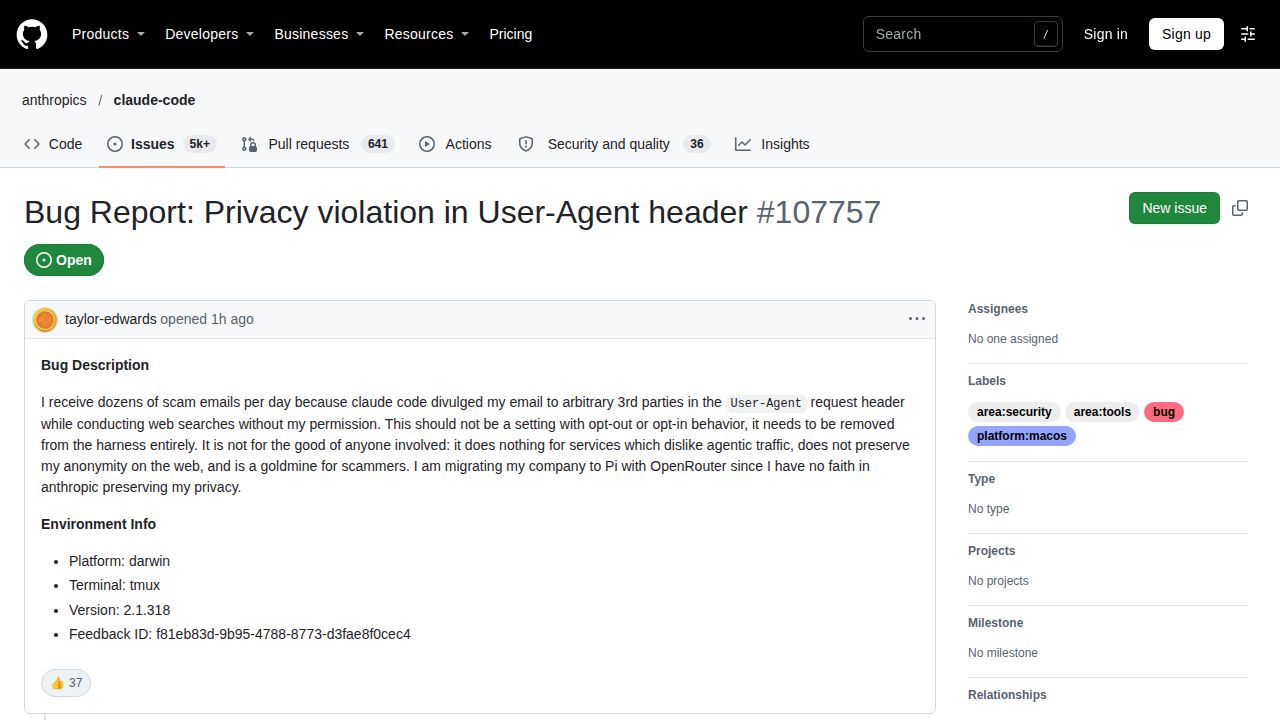
A bug report filed on GitHub indicates that Claude Code, Anthropic's official command-line interface (CLI) for its AI models, may be compromising user privacy by disclosing email addresses to third-party websites. The issue centers on the tool's behavior during automated web searches, where it reportedly includes the user's email address within the User-Agent request header. This header is a standard piece of metadata sent by web browsers and tools to identify the software making the request, but in this instance, it appears to be carrying personally identifiable information (PII).
The practical consequence of this behavior is a significant increase in spam and scam communications for affected users. One reporter noted receiving dozens of scam emails daily, some of which were personalized with their full name and surname. This suggests that third-party websites are successfully harvesting the email addresses from the request headers. The report emphasizes that this is not a matter of user preference or an opt-in feature; rather, it is a structural behavior in the tool's current harness that lacks a mechanism to preserve anonymity or anonymize the user's identity during automated tasks.
Technical observations from the community suggest the behavior may be inconsistent or context-dependent. Some users reported that the tool even utilized corporate email addresses while they were logged into private accounts, raising concerns about how the tool manages session data and identity. While the tool is designed to provide 'machine speed' and autonomy in executing complex tasks, the current implementation appears to trade off user privacy for these capabilities. Due to these concerns, some users have expressed a loss of trust in the tool's privacy protections and have begun migrating to alternative services such as Pi or OpenRouter. The bug report remains open, highlighting a critical need for a privacy-preserving mechanism in the tool's web-searching capabilities.
It remains uncertain exactly how many users are affected or the specific logic within the codebase that constructs the User-Agent header. Furthermore, the source material does not clarify if there are any existing configuration settings to opt-out of this behavior or if a fix has been prioritized by the development team. Until a patch is released, the tool's automated web-searching functionality poses a documented risk of leaking user identity to any site the agent interacts with.