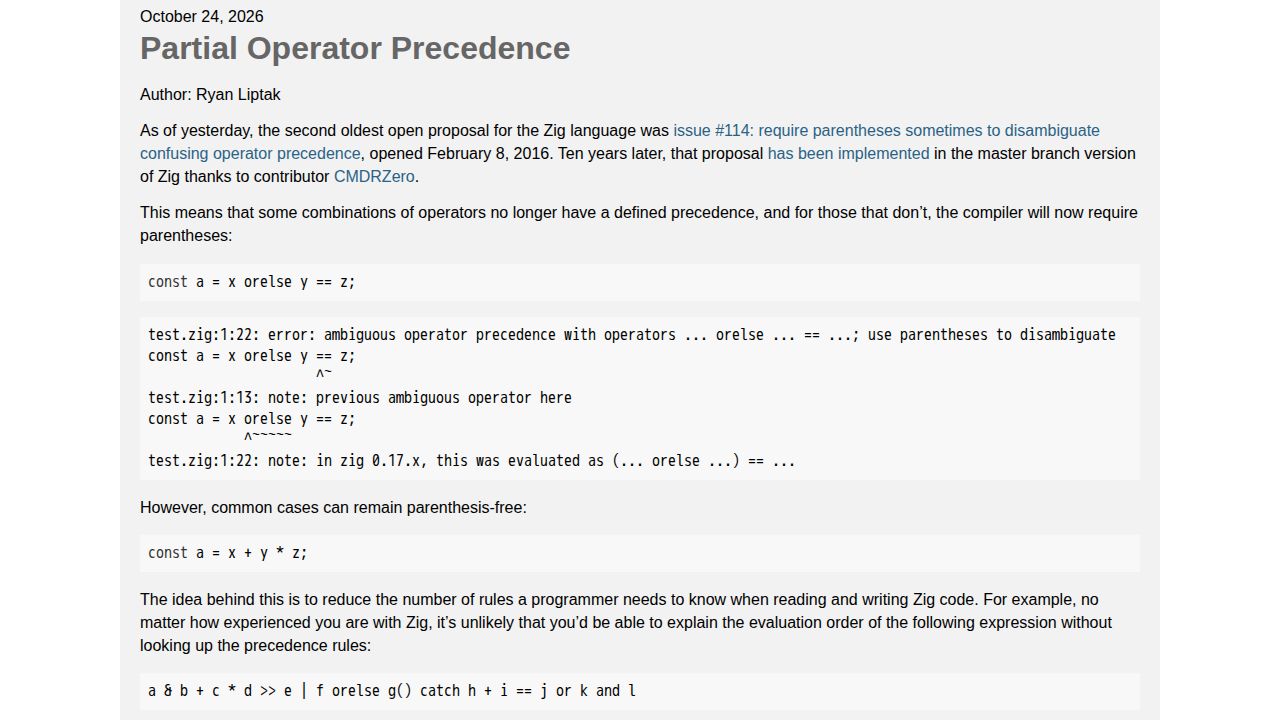
The Zig programming language is shifting toward a simplified model of operator precedence. In many traditional languages like C or C++, complex expressions are governed by a deep 'tower' of precedence levels, which can make it difficult for developers to predict how a statement will be evaluated without heavy use of parentheses. Zig's move toward 'partial' precedence aims to flatten this tower, reducing the number of distinct levels to make the logic of mathematical and logical expressions more transparent and easier to implement.
This change directly impacts code readability by minimizing the need for nested parentheses. Commenters on Hacker News noted that while many languages maintain complex precedence for ease of implementation, Zig's approach seeks a more intentional balance. For example, some languages handle ambiguous cases by defaulting to a specific binding—such as whether a unary minus binds tighter than an exponentiation operator. In some environments, an expression like `-a ** b` might be interpreted differently depending on the specific precedence rules, but Zig's direction suggests a move toward treating such ambiguous cases as syntax errors to ensure that the developer's intent is never left to guesswork.
The design sits on a spectrum of programming language philosophies. While Zig is simplifying its precedence, other languages like Go use a relatively small set of five levels. At the other extreme, languages like Lisp eliminate precedence entirely by requiring explicit forms or parentheses for every operation, while APL processes expressions from right to left. Zig's 'partial' precedence represents a compromise: it avoids the extreme explicitness of Lisp while rejecting the opaque complexity of C-style precedence. However, the move also introduces specific trade-offs; for instance, while Zig accepts certain combinations like `a + b & c`, stricter languages like WGSL (WebGPU Shading Language) would reject them as errors, highlighting that even 'simplified' precedence remains a subjective design choice between different language specifications.