During the late 1990s, the transition from passive media consumption to active creation was facilitated by the rise of accessible personal computing and 'no programming' software. For many young creators, these tools acted as a bridge between imagination and execution. Instead of mastering complex syntax, users could leverage visual editors to build virtual realms. This shift allowed children to bypass traditional academic barriers—such as the difficulty of long division or persuasive writing—and instead focus on the craft of game design, where the primary goal was often 'tending a garden' of virtual minutiae rather than perfecting complex scoring systems.
The cornerstone of this experience was The Games Factory (TGF), a 2D game development suite released in 1996 by Europress (later Clickteam). As the successor to Klik n Play, TGF provided a lineage of software that persists today as Clickteam Fusion 2.5. For a teenager in the early 2000s, TGF was a 'reality-bending' discovery that demystified professional disciplines. It provided a framework for frame-by-frame animation and pixel art, allowing creators to build 'flipbook-esque' animations and custom graphics. Because the software handled the underlying engine logic, creators could spend their time on 'mocking up game concepts, enemy beastiaries, and level designs' in physical notebooks, treating the software as a tool for building a diorama or a theme park.
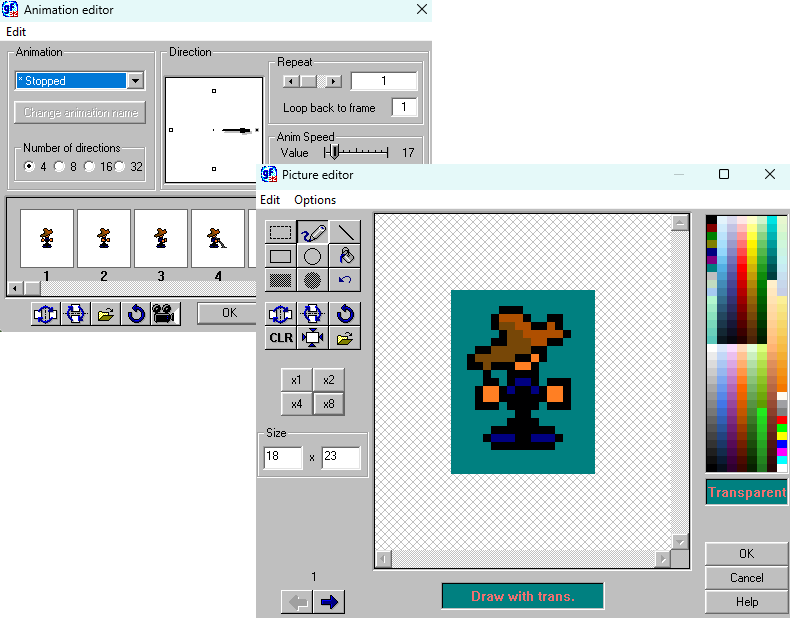
This image illustrates the visual editing tools provided by The Games Factory for creating custom assets.
This accessibility gave rise to the 'Klik' community, a subculture of developers who shared work, feedback, and technical workarounds. This environment fostered a rapid, iterative cycle of development where creators frequently released 'demo' or 'beta' versions of their projects. However, these 'no programming' tools came with specific technical trade-offs. For example, the default platform movement in the software was often rife with bugs and glitches, leading to a community standard where custom movements were the norm. This forced young developers to navigate the limitations of their tools, creating a unique set of skills centered on creative problem-solving and community-driven iteration rather than pure software engineering. While the source material is a personal memoir and does not provide broad market data, it highlights how these specific tools shaped the early identity of independent game development.