Tencent has released Hy4, a flagship large language model (LLM) designed to handle complex, real-world productivity tasks such as software engineering, scientific research, and financial analysis. Built on the Hunyuan architecture, the model features a context window of approximately one million tokens and was developed with a focus on deep co-design with various industrial applications. While the initial preview was released under an Apache 2.0 license, Tencent has indicated that the full weights for the Hy4 model will be made available to the public in the coming days, potentially positioning it as a leading open-weight model in the market.
In a recent data analytics benchmark conducted by Plotly, Hy4 achieved a score of 42 out of 43 (98%) on a specialized exam designed to test multi-turn tool calling and data reasoning. This performance placed Hy4 on the "cost-accuracy frontier," a category of models that provide high accuracy at a lower price point than their peers. Specifically, Hy4 was identified as the most cost-effective model among those scoring 42 or higher, costing approximately $2.11 for a full run of the exam. This efficiency is partly attributed to its high cache hit rate; during the test, 91% of the 22.7 million input tokens were served from a cache, significantly reducing the per-query cost compared to models without similar caching advantages.
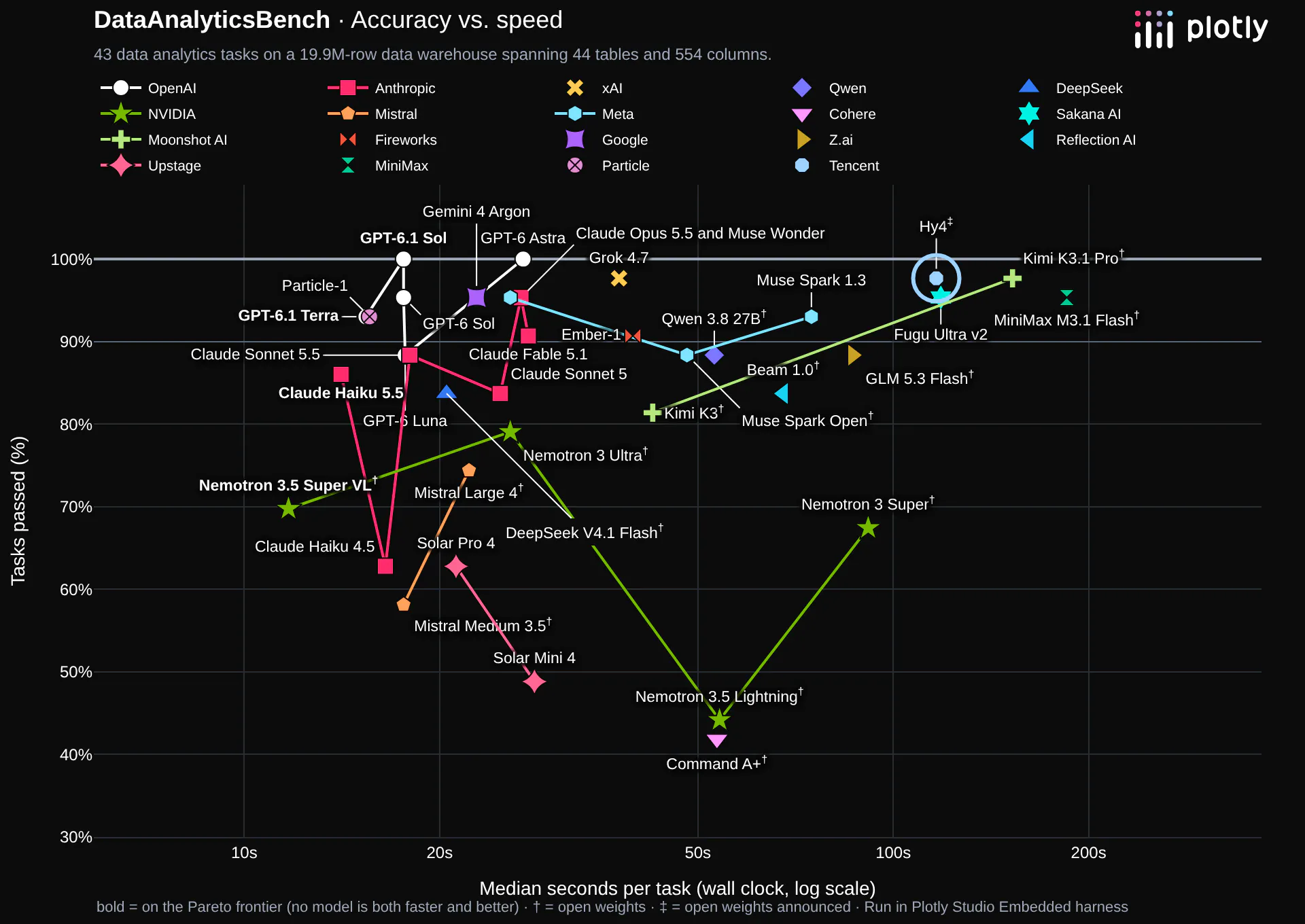
This chart illustrates the specific trade-off between high accuracy and slower processing speeds that defines Hy4's performance profile.
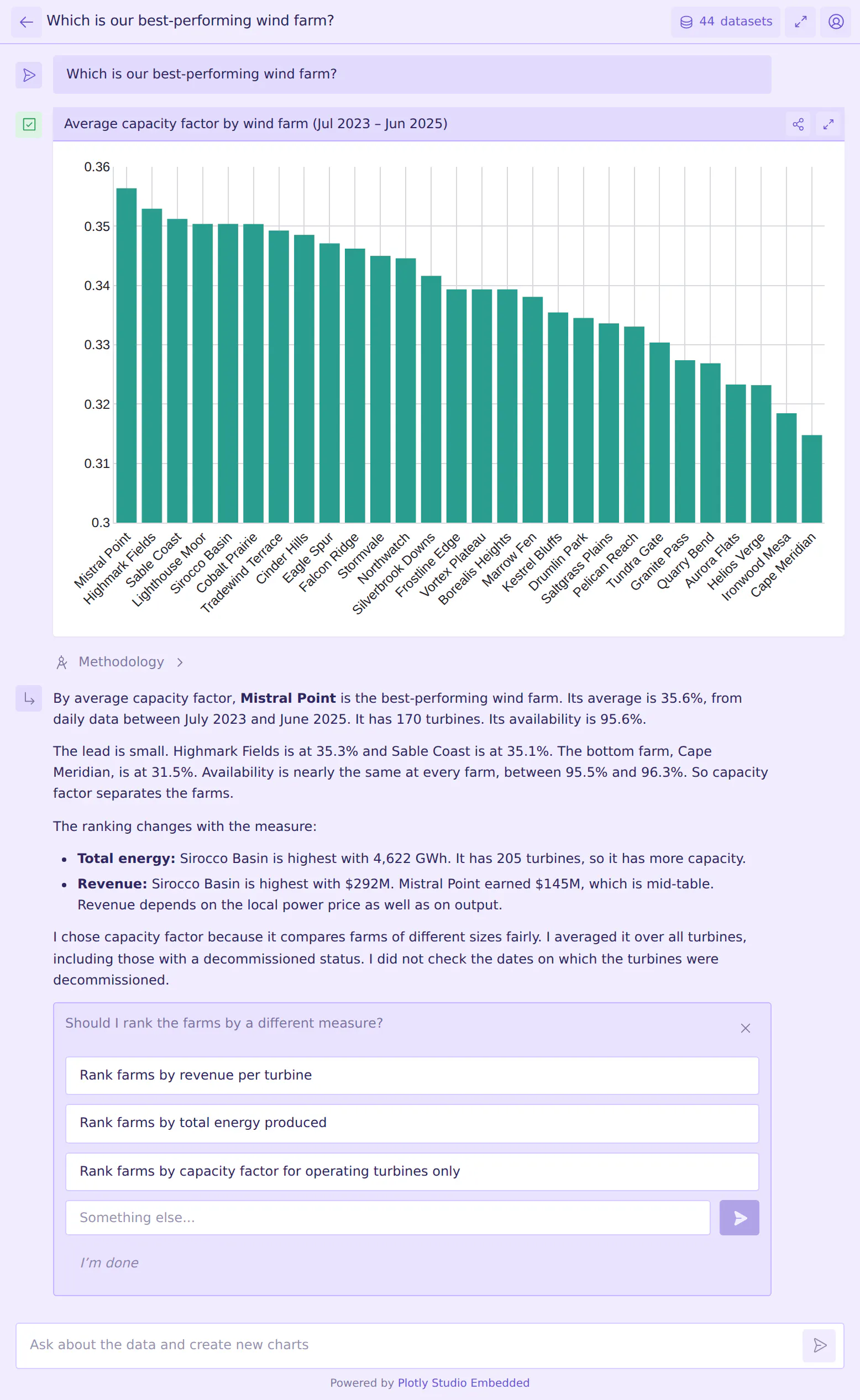
This visual demonstrates the type of complex data reasoning and tool-calling tasks that Hy4 was tested on during the Plotly benchmark.
However, Hy4's precision comes with a notable trade-off in speed. It was one of the slowest models tested, with a median processing time of 117 seconds per question—more than six times slower than GPT-6.1 Sol. This latency is a direct result of the model's "thorough" behavior; Hy4 performs extensive internal cross-checking, often running between 24 and 64 queries per question to verify counts, trends, and assumptions. While this exhaustive approach allows it to excel at identifying statistics traps and auditing data quality, it can lead to extreme outliers in processing time, such as a single query that ran for nearly an hour. For production environments, these results suggest that while Hy4 is highly reliable for complex reasoning, users may need to implement specific time limits to manage its exhaustive verification cycles.