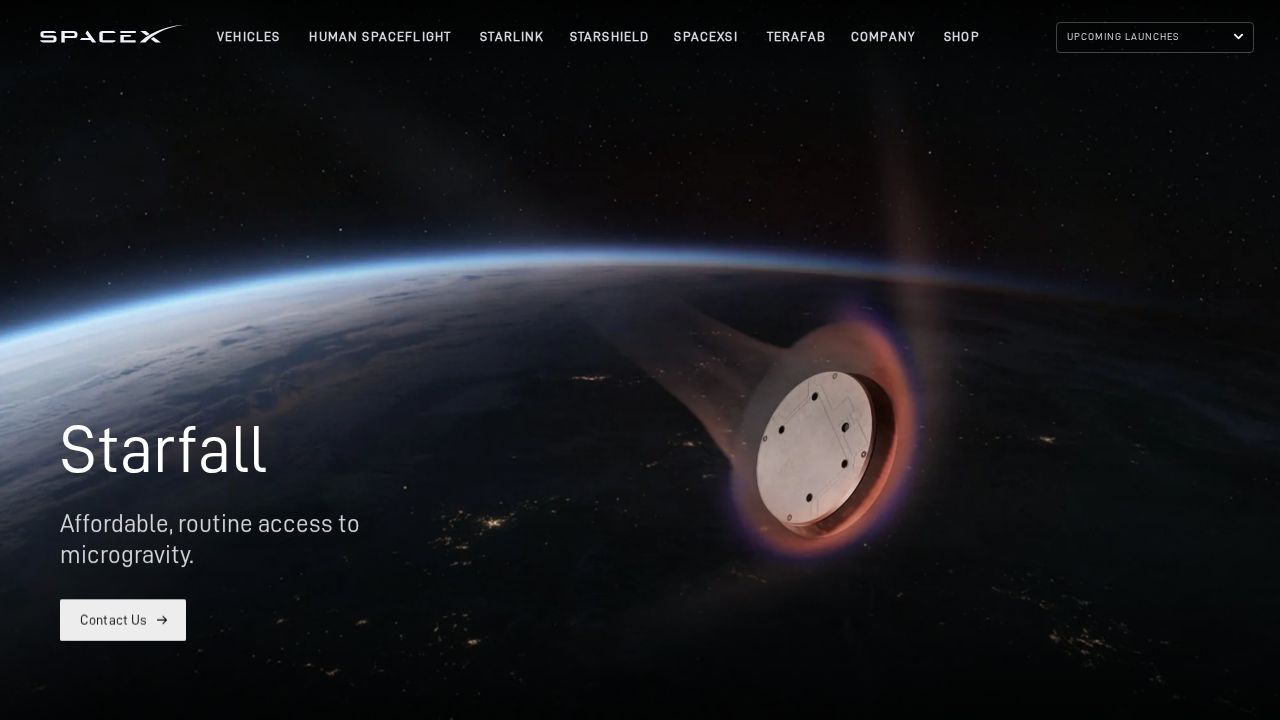
SpaceX has introduced Starfall, a system designed to provide routine and affordable access to microgravity environments. The primary goal of the initiative is to facilitate research and manufacturing activities that are hindered by Earth's gravity. By providing a reliable way to reach and return from orbit, Starfall aims to open up new possibilities for industrial processes that require a weightless environment to function effectively.
One of the primary industrial motivations for space-based manufacturing is the elimination of sedimentation. On Earth, gravity causes particles to settle, which can interfere with the production of high-purity materials. Commenters on Hacker News noted that this makes microgravity particularly suitable for manufacturing semiconductors, pharmaceuticals, solar cell crystals, and artificial organs. Furthermore, specific processes like Molecular Beam Epitaxy (MBE) require extreme vacuum pressures—sometimes taking days or weeks to achieve on Earth—which may be more efficiently managed in a space environment. These conditions allow for the growth of monocrystalline structures and more complex chemical reactions that are difficult to replicate in terrestrial laboratories.
Logistically, the Starfall system functions as a reentry vehicle capable of being delivered to a low orbit. According to discussion on Hacker News, the capsule can be left in orbit to decay naturally over several weeks or can be actively deorbited using its own deltaV. The vehicle is equipped with a heat shield and parachutes, allowing it to land at a designated location on the planet's surface. This capability addresses a significant hurdle for commercial users: the ability to recover manufactured goods. While the specific payload capacities and exact costs for this 'affordable' access remain unspecified in the provided materials, the system's ability to land at a predictable location provides a framework for a circular manufacturing loop in orbit.