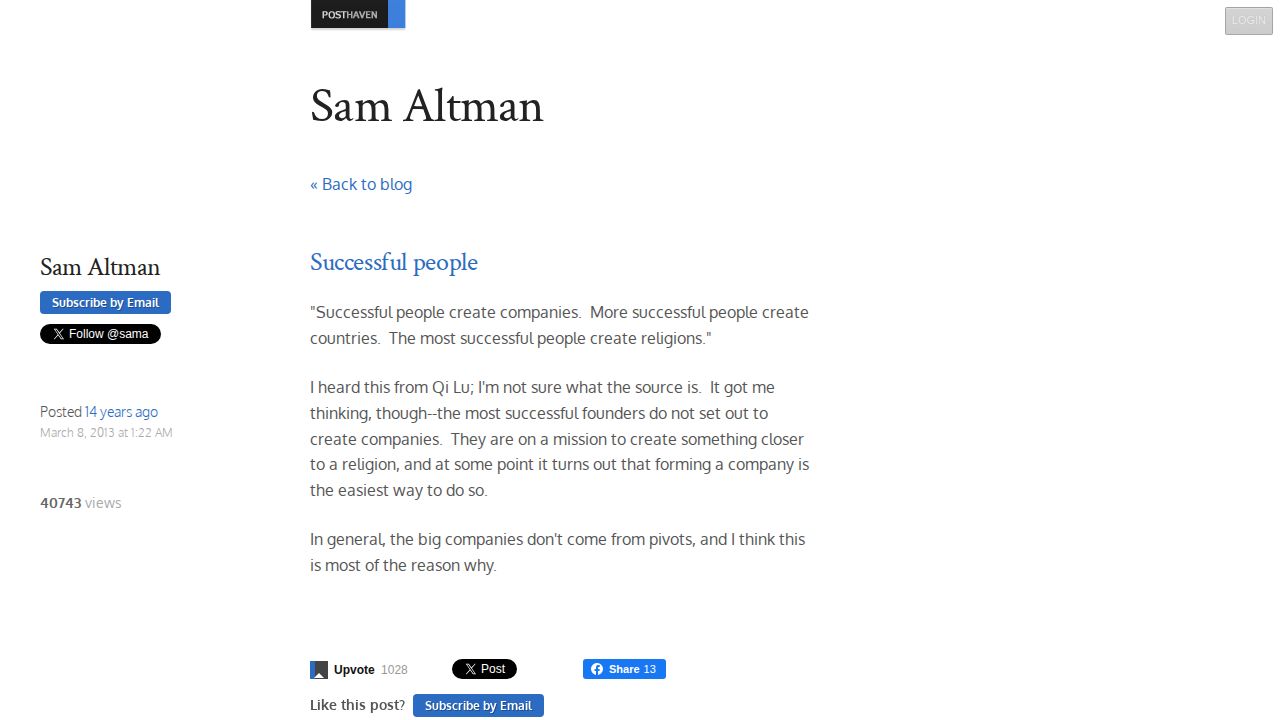
Sam Altman argues that success follows a specific hierarchy of scale and influence. He posits that while successful people create companies, more successful people create countries, and the most successful people create religions. This framework suggests that the ultimate goal of a high-impact founder is not the business itself, but the creation of a belief system or a mission that transcends mere commerce. According to Altman, the most successful founders do not set out with the primary goal of building a company; instead, they are driven by a mission to create something closer to a religion, and they eventually find that forming a company is simply the most efficient way to manifest that vision.
Altman further suggests that this mission-driven approach is a key differentiator for large-scale success. He notes that major companies rarely emerge from pivots, implying that a clear, foundational mission is necessary to sustain growth. In this view, a company is a tool for a larger purpose rather than a standalone destination. This perspective shifts the definition of a founder's role from a business operator to a visionary who builds a framework for collective belief and action.
However, the 'religious' metaphor for organizational culture carries significant trade-offs. Commenters on Hacker News noted that while a sense of belonging and community can provide workers with a powerful sense of identity and self-actualization, it can also lead to extreme bitterness and vitriol if employees fall out of alignment with the organization's goals. Critics in the discussion also questioned the morality of this hierarchy, suggesting that if success is defined solely by the scale of influence, a religion with a single human authority might be more accurately described as a cult. Others argued that this perspective defines success by the magnitude of the accomplishment rather than the ethical consequences of the outcome. The primary source remains a personal commentary and does not provide empirical data to validate these claims or specific case studies of 'religious' missions in business.
Ultimately, Altman's theory suggests that the most enduring and impactful entities are those that provide a sense of purpose beyond profit. While the company provides the structure, the 'religion' provides the motivation, creating a powerful but potentially volatile dynamic for those who participate in it. The primary source establishes this as a personal observation on the motivations of elite founders, leaving open the question of how these missions are sustained or governed as they scale into global influences.
The distinction between a company and a religion in this context lies in the source of motivation: one is driven by economic exchange, while the other is driven by a shared belief system. Altman's observation implies that the most successful entities are those that successfully bridge these two, using the mechanics of a company to deliver the impact of a religion. This creates a unique organizational model where the 'product' is not just a service, but a shared identity and a collective mission.
There remains an inherent uncertainty regarding the boundary between a mission-driven organization and a cult-like structure. As noted in the discussion, the presence of a single ultimate authority can change the perception of an organization's intent. Whether a mission-driven company serves as a positive force for a 'greater good' or leads to the 'willful destruction of entire societies' depends on the specific values embedded in that mission. Altman's post serves as a provocation on the nature of ambition, rather than a blueprint for organizational design.