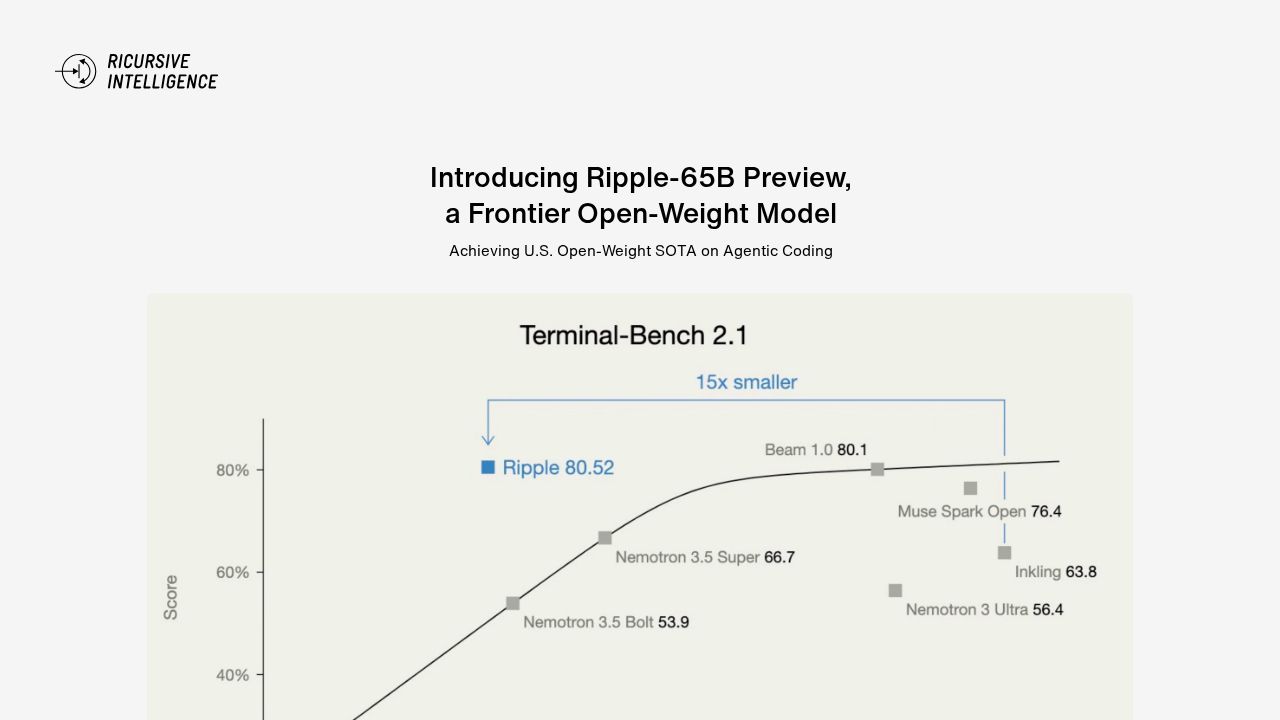
Ripple-65B is an open-weight large language model (LLM) developed in the United States, specifically designed to excel in "agentic coding"—tasks where an AI acts as an autonomous agent to write, debug, and execute code. The developers position the model as a state-of-the-art (SOTA) solution, a claim that refers to its placement on the Pareto curve, which measures the optimal balance between a model's performance and its physical size. By offering an open-weight version, the project aims to provide a high-performance alternative for developers who require local inference or specific transparency into the model's architecture.
In terms of raw performance, Ripple-65B achieved a score of 80.5 on the Terminal Bench 2.1, a metric used to evaluate how well a model handles command-line and terminal-based coding tasks. However, its standing relative to other models is nuanced. For instance, the Qwen 3.8 Flash Next model—which is larger but utilizes a Mixture of Experts (MoE) architecture to remain efficient—scored higher at 84.3. Conversely, the Qwen 3.8-27B model scored lower at 73.0. These figures suggest that while Ripple-65B is competitive within certain parameters, it faces stiff competition from international models that may offer different trade-offs in speed and accuracy.
The model's claims have met with scrutiny regarding the selection of benchmarks and comparison models. Some observers noted that the performance data appears to favor Ripple-65B by omitting superior models in similar size categories, such as Beam 1.0 or Nemotron 3.5 Super, in favor of less competitive baselines. Additionally, the "U.S." branding has prompted questions about the specific data provenance and whether the model's performance is a result of unique domestic training sets or simply a specific optimization for the coding niche. Because the full training data and weights are not publicly audited in this preview, the exact extent of its "agentic" capabilities remains a point of ongoing community evaluation.