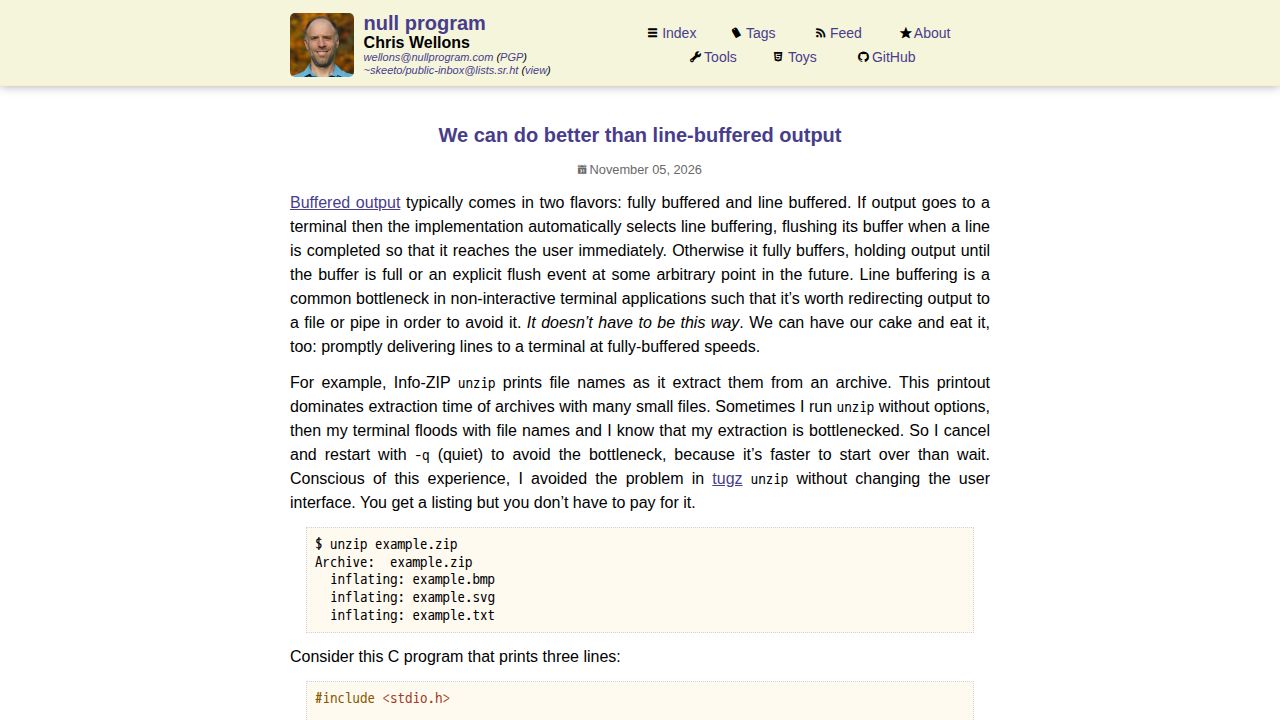
Most terminal applications use line buffering to ensure that users see output immediately. In this mode, the system flushes the output buffer every time a newline character is encountered. While this provides a responsive experience, it creates a performance bottleneck when a program generates a high volume of output in a short period. For example, when extracting an archive with a tool like `unzip`, the process of printing every individual file name can dominate the execution time because each name requires a separate system write call. This often forces users to use 'quiet' modes to maintain speed, sacrificing the visibility of the progress.
To solve this, the author proposes a 'deadline-based' flushing mechanism. Instead of triggering a write on every newline, the system maintains a buffer and only flushes it when a specific time deadline has passed—for instance, every 100 milliseconds. This approach is inspired by Nagle's algorithm, which handles idle time in network communications. By using a deadline, the system can batch multiple lines of text into a single system write if they are produced rapidly enough. Because 100ms is generally faster than human perception, the user sees the output almost instantly, but the overhead of multiple system calls is significantly reduced.
This method provides a middle ground between line buffering and full buffering. In a high-throughput scenario, such as a program processing thousands of files, the deadline-based approach allows the program to 'eat its cake and have it too': it delivers lines to the terminal promptly enough to feel real-time while operating at speeds closer to full buffering. The implementation can be integrated into a program's main loop by checking the deadline between units of work. While this avoids the need for extra threads, it requires the application to be aware of the buffer's state, allowing it to balance the trade-off between output latency and processing throughput. However, the source does not provide specific benchmark data to quantify the exact speed increase over standard line buffering in these scenarios.