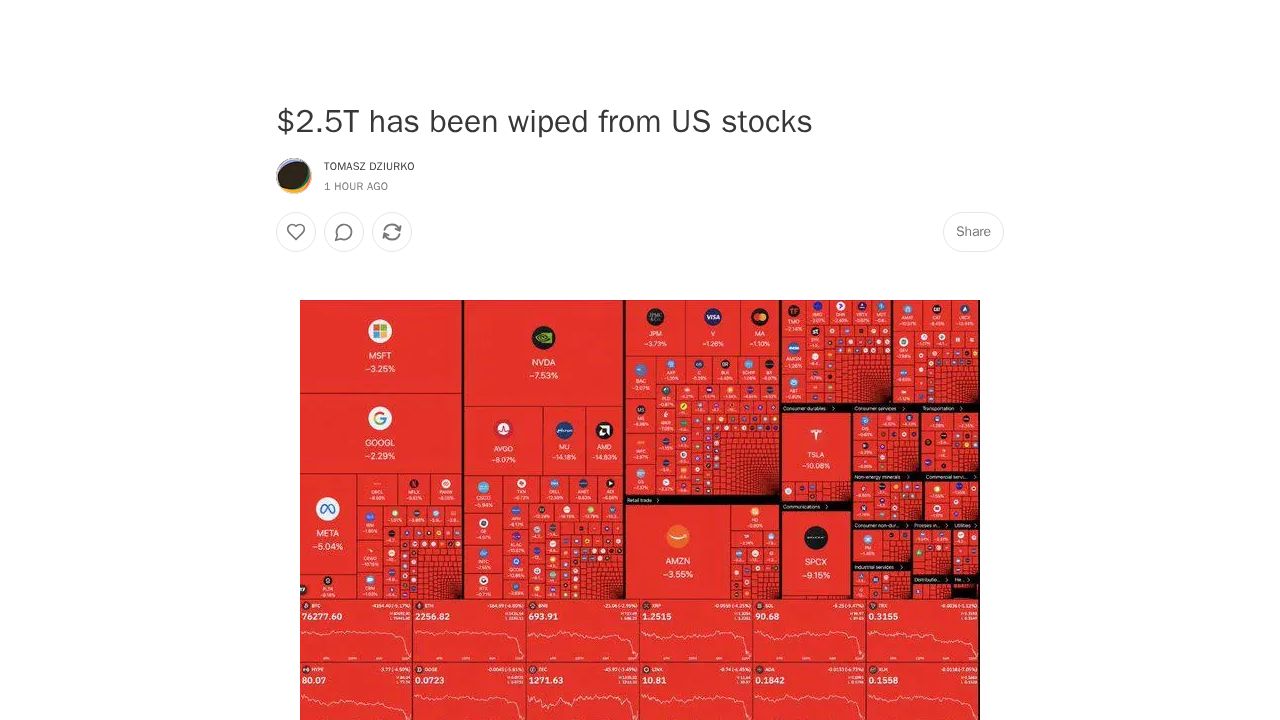
The Nasdaq recently experienced a significant correction, losing approximately $2.5 trillion in market capitalization in a single day. However, the impact of this decline was not uniform across the technology sector. While major 'hyperscalers'—the massive cloud and advertising monopolies like Alphabet (GOOGL), Microsoft (MSFT), and Amazon (AMZN)—saw relatively modest declines of roughly 2% to 3.5%, the companies providing the underlying hardware and infrastructure for AI buildouts were hit much harder. Vendors such as AMD, Micron (MU), Dell, and GE Vernova (GEV) saw double-digit percentage drops, reflecting a shift in market sentiment regarding the sustainability of rapid AI infrastructure expansion.
This divergence is linked to the financial health and capital expenditure (capex) commitments of the primary buyers. Recent quarterly reports show that Alphabet posted negative free cash flow for the quarter, while Amazon's trailing 12-month free cash flow is down significantly despite guiding toward $220 billion in annual capex. Because these hyperscalers possess dominant market positions, they can absorb a slowdown in spending or a pivot in strategy more easily than their suppliers. In contrast, hardware and semiconductor equipment makers, such as NVIDIA, Broadcom, and Applied Materials (AMAT), are priced on the assumption of frictionless, perpetual growth in data center buildouts—an assumption that is currently facing new pressures.
Two primary factors are contributing to this friction: political hurdles and consumer-side supply constraints. Following recent midterm elections, several key states—including Texas, Georgia, and Ohio—where a significant portion of US gigawatt capacity is planned, have seen new leadership that has openly campaigned on pausing data center approvals to address spiking residential electricity rates. Simultaneously, the consumer electronics market is being squeezed as manufacturers like Micron and SK Hynix shift wafer capacity toward High Bandwidth Memory (HBM) for AI servers. This shift has driven up standard DRAM and NAND prices, forcing phone manufacturers to raise retail prices at a time when global smartphone shipments are hitting 14-year lows. Consequently, while the core AI infrastructure faces regulatory and power bottlenecks, the consumer side is struggling with higher costs and lower unit volumes, creating a dual-sided pressure on the hardware supply chain. (primary)