Introducing the complex field of cryptography to a child requires balancing technical accuracy with age-appropriate engagement. For a 10-year-old who enjoys making up their own ciphers, the community suggests a tiered approach that moves from narrative-driven history to practical application. One recommended starting point is focusing on historical ciphers, such as the Caesar or Vigenere ciphers, which can be turned into interactive games. These activities allow children to explore the mechanics of secret writing—like using repeating keys or simple matrix examples—without needing to master advanced mathematics immediately.
For those seeking specific literature, several books are highlighted as bridges between simple puzzles and technical theory. 'Alvin's Secret Code' by Clifford B. Hicks is noted as a classic starting point for young readers. For a more modern technical overview, 'Real-World Cryptography' by David Wong is suggested for its coverage of basic primitives like hash functions and symmetric/asymmetric cryptography. Other narrative-heavy recommendations include David Kahn's 'The Codebreakers,' which provides a deep historical context, and Simon Singh's 'The Code Book.' While 'The Codebreakers' is highly regarded for its depth, some commenters noted that its length and historical requirements might be daunting for a 10-year-old unless read in small chunks.
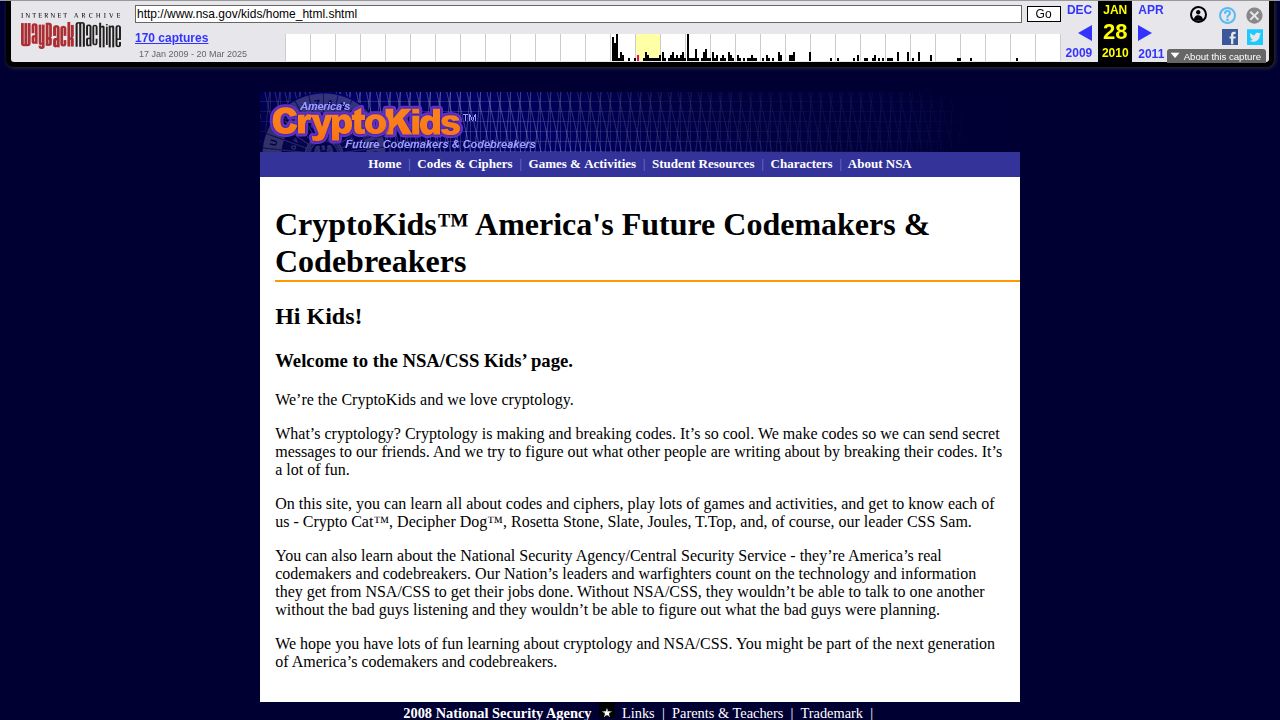
For children who show a high aptitude for math and science, the discussion suggests moving toward structured academic theory. The textbook 'Introduction to Modern Cryptography' by Katz and Lindell is cited as one of the best-structured resources for understanding the foundations of cryptographic theory. However, the consensus is that such material is best approached with an adult who can provide 'meta-skills' in teaching and help contextualize the complex concepts. Additionally, supplementary resources like the archived 'CryptoKids' materials or narrative accounts of cyber-espionage, such as 'The Cuckoo's Egg,' can provide broader context on how cryptography intersects with real-world security and privacy.