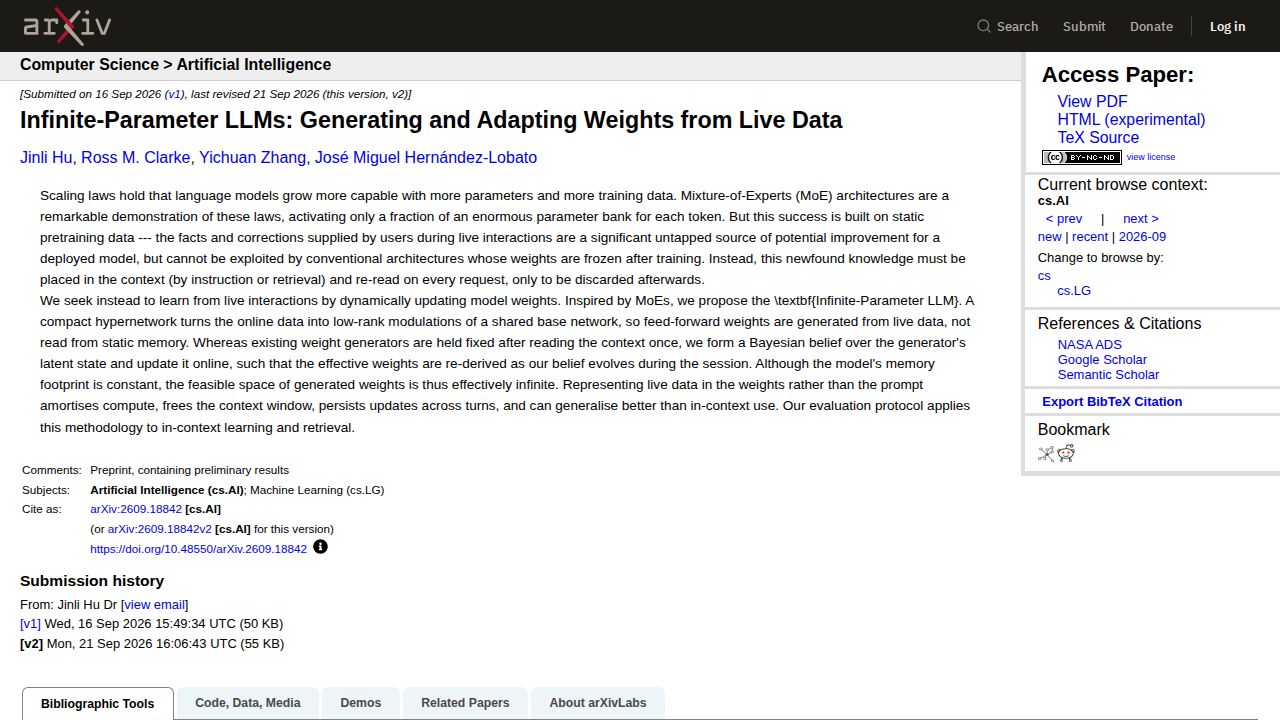
Current large language models (LLMs) are generally built on static weights that are frozen after a pretraining phase. While these models can handle new information provided by users during a conversation, they do so by placing that data into a 'context window'—a temporary memory space that is read for each request and discarded afterward. This means the model cannot truly 'learn' or internalize new facts or corrections from a live interaction without undergoing a separate, costly retraining or fine-tuning process.
To address this, researchers have proposed the 'Infinite-Parameter LLM.' This architecture uses a compact hypernetwork to transform live data into low-rank modulations of a shared base network. Instead of reading weights from a fixed memory bank, the model's feed-forward weights are generated dynamically from the data it receives in real-time. A key distinction in this approach is the use of a Bayesian belief over the generator's latent state. Unlike previous weight-generation methods that might freeze after reading a prompt once, this system updates its belief online, allowing the effective weights to be re-derived as the model's internal state evolves throughout a session.
This method offers several practical advantages over standard in-context learning. By representing live data within the weights themselves, the model can amortize compute costs, free up space in the context window for other tasks, and potentially generalize new information more effectively. However, the transition to continuous learning introduces new complexities. Researchers and observers have noted that maintaining model stability during constant weight updates is a significant challenge, as unpredictable behavior can emerge when a model is constantly evolving. Additionally, continuous learning models may face unique security risks, such as 'poisoning' where specific user inputs could push the model toward unintended behaviors or biases across different sessions.
While the proposed architecture offers a path toward models that truly learn from every interaction, the research is currently in the preprint stage with preliminary results. The specific performance benchmarks comparing this 'infinite' weight space against traditional Mixture-of-Experts (MoE) or Low-Rank Adaptation (LoRA) techniques remain an area for further investigation as the technology matures.