A custom-built kitchen timer solves the trade-off between the clunky interfaces of modern digital timers and the imprecision of traditional mechanical wind-up units. By using a 'quasi-logarithmic' dial, the device allows for high-resolution adjustments during short tasks, such as boiling an egg, while remaining functional for longer cooking periods.
The Quasi-Logarithmic Dial Design
The core innovation of the timer is its non-linear scale, which addresses the difficulty of representing both seconds and hours on a single circular face. The dial is divided into four sections: the first covers up to one minute with ten-second increments; the second covers 1 to 5 minutes with one-minute increments; the third spans 5 to 30 minutes with five-minute increments; and the final section covers 30 minutes to 3 hours with half-hour increments.
This scheme is designed to be self-documenting, where the labels for the end of one section (e.g., '1 min') describe the stepover for the next. This allows the user to achieve high precision for short durations—where small errors matter most—without sacrificing the ability to set long durations quickly.
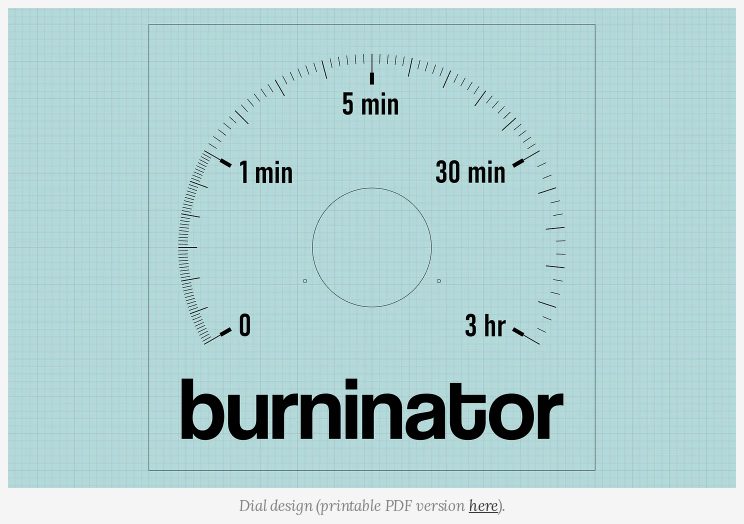
This image illustrates the specific non-linear scale design described in the article, showing how different time increments are mapped to the circular face.
“I decided to build a digital timer with an old-school analog display and an easy-to-use adjustment knob.”
— Quasi-logarithmic kitchen timer
Hardware and Electromechanical Interface
To create the analog display, the builder repurposed a vintage Crompton 244-05VG-LS switchboard-style ammeter. The device is internally an ammeter with a 1 mA full scale, which was modified to serve as a visual indicator for the timer's countdown.
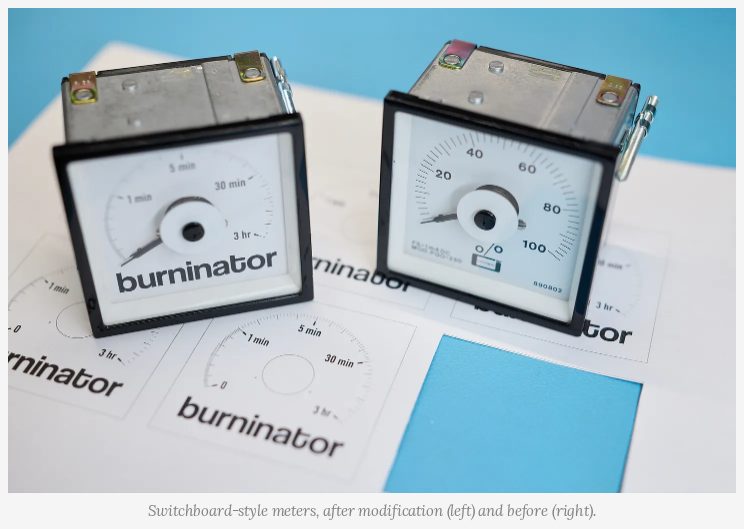
This visual demonstrates the hardware modification of the vintage ammeter used to create the timer's display.
The system is powered by an 8-bit AVR DB series microcontroller that drives the meter using single-bit PWM with a variable duty cycle. A knurled encoder knob provides tactile feedback for setting the time, and a small speaker driven by a rail-to-rail op-amp provides audible alerts.
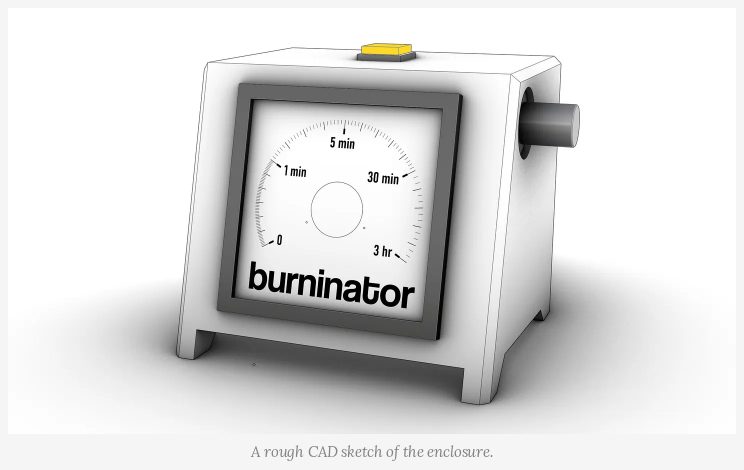
This CAD sketch provides a look at the early design phase of the device's physical housing.
User Experience and Practical Trade-offs
The timer includes a 'wake-up tap' on an illuminated button to ensure the device only activates when intended. Once active, the user has a 20-second window to input the time via the encoder; if no input is detected, the device returns to sleep to avoid nuisance activations.
While the analog dial offers a superior tactile experience, it introduces a potential for 'operator readout error' during long-duration settings. Because the scale is non-linear, estimating the exact position of the needle for a specific hour requires more conscious effort than a standard linear scale, representing a trade-off between tactile precision and visual estimation.