Archaeologists have uncovered the remains of a possible 19th-century castaway camp on Isla de los Estados, a frigid island off the coast of Tierra del Fuego. The discovery, located at Lacroix Inlet in Franklin Bay, provides a rare opportunity to study survival experiences in one of the world's most isolated and challenging maritime environments.
The Discovery at Lacroix Inlet
During a 2026 expedition titled 'Aquí hay dragones,' an interdisciplinary team identified a temporary camp at the foot of a steep hill beside a stream. The site was located in a region characterized by a cliff coast and exposure to strong south-west winds.
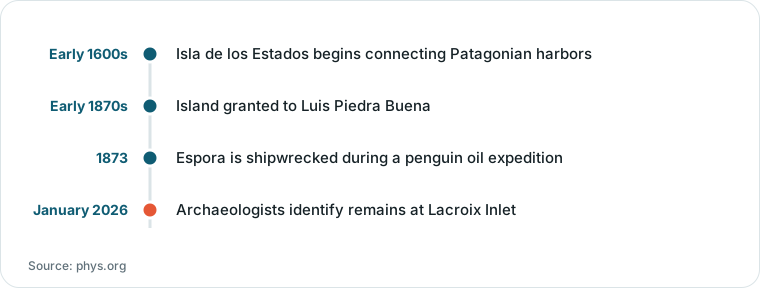
Chart drawn by HN Digest from figures reported by phys.org; values are shown as written in the source.
The team discovered scattered 19th-century artifacts, including a deck prism—a glass block used to let daylight into a ship's deck—and a rudder hinge. These items, alongside glass beads and four-hole ceramic buttons, suggest a period of habitation by a small group of survivors.

This image illustrates the discovery of the castaway camp and the specific artifacts found by the research team.

This visual supports the description of the specific 19th-century artifacts found at the site.
“As archaeologists, being in this isolated and wild place allowed us to taste what a small group of castaways saw and felt about 150 years ago,”
— Archaeologists uncover possible 19th-century castaway camp on island 'at the end of the world'
Links to the Espora Shipwreck
The findings are potentially connected to the 1873 wreck of the schooner brig Espora. According to historical records, the ship was lost during an expedition to obtain penguins for oil, leaving its crew stranded on the island for over two months.
Luis Piedra Buena, a prominent Argentine sailor known for his humanitarian and commercial activities, was among those stranded. To survive, his crew salvaged supplies from the Espora to build a new vessel, the Luisito, which they eventually used to reach Punta Arenas.
Archaeological Discrepancies and Next Steps
Despite the geographical alignment with Piedra Buena's accounts, some evidence remains inconclusive. The current hull remains do not perfectly match historical descriptions of how thoroughly the Espora was dismantled for parts.
The research team has also been unable to locate the specific shipyard where the castaways constructed the Luisito. Future work will involve analyzing the timbers to confirm whether the remains belong to a single ship or multiple vessels, helping to clarify the maritime history of the island.