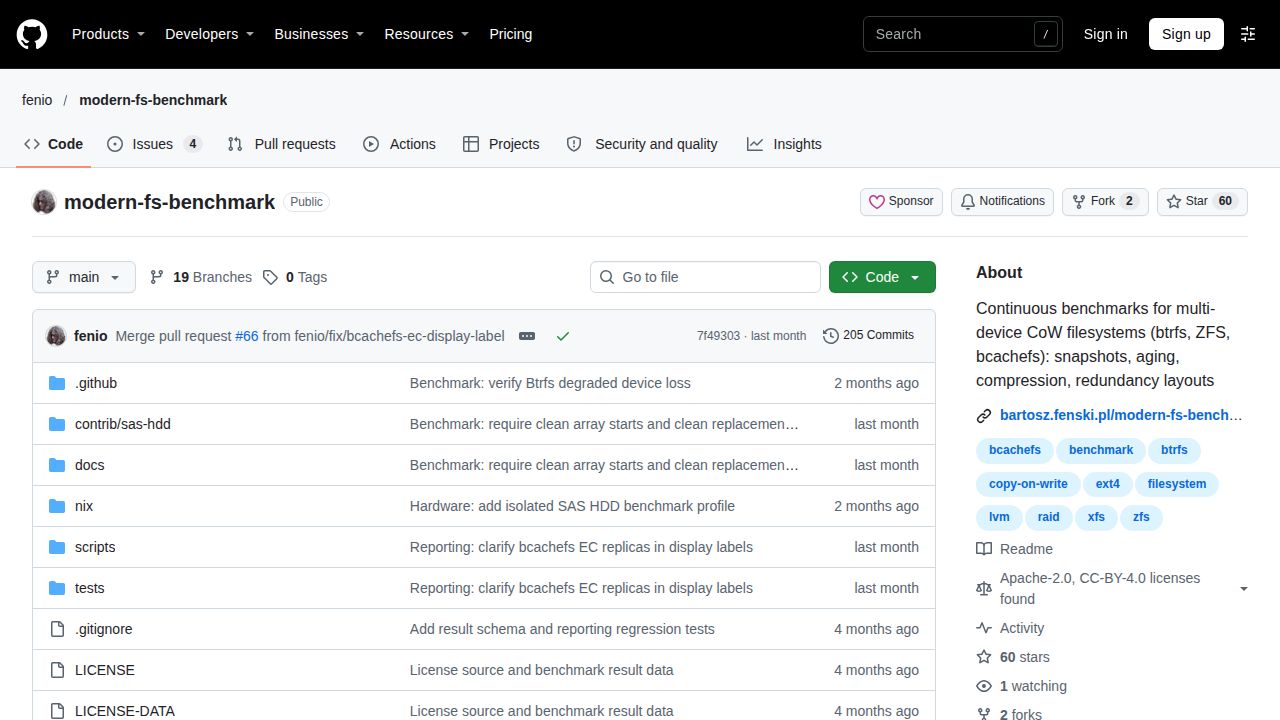
Traditional filesystem benchmarks typically run tools like `fio` on a single device with default configurations. While useful for measuring raw throughput, these tests fail to capture the behavior of modern Copy-on-Write (CoW) filesystems, which are designed to manage complex data structures across multiple devices. In a CoW system, every write operation involves updating metadata and potentially moving data blocks, creating overhead that only becomes apparent under specific workloads like snapshot accumulation, compression, or redundancy management. Because classic benchmarks ignore these 'machinery' costs, they can provide a misleading picture of how a filesystem will perform in a production environment where data safety and advanced features are prioritized.
To address this, the `modern-fs-benchmark` suite measures specific behaviors that single-device tests skip. This includes 'fsync tail latency,' which captures the periodic spikes caused by CoW transaction commits (such as ZFS's transaction groups or Btrfs's commit intervals), and 'snapshot aging.' The latter measures the performance degradation as snapshots accumulate and cause fragmentation. The suite also tracks 'physical I/O amplification'—the ratio of actual bytes written to the physical disks versus the logical bytes requested by the application. This metric reveals the hidden cost of redundancy layouts and filesystem overhead, providing a clearer view of how much 'extra' work the filesystem performs to maintain data integrity.
A critical distinction in these modern filesystems is their approach to data corruption. Traditional stacks, such as ext4 or XFS over a standard RAID array, lack end-to-end checksums; if a disk returns corrupted data, the array may serve that 'lying' data to the application without an error. In contrast, Btrfs, ZFS, and bcachefs verify every read against checksums and can reconstruct corrupted blocks from parity or replicas. However, these features come with trade-offs, such as 'near-full' behavior. Because CoW filesystems require free space to perform even a deletion, they can hit a wall where the filesystem becomes unwritable as it nears capacity. While these systems offer superior reliability, their performance is inextricably linked to these management overheads, which only surface under the multi-device, high-redundancy workloads they were built to handle.