Weight-Space Programming describes the ability of frontier LLMs to analyze and modify the raw weights of a machine learning model—essentially a text description of the model containing a list of floating-point numbers—to change its behavior. Historically, optimizing a model's behavior involved 'hill-climbing' on text artifacts like prompts or training code, or using symbolic optimizers like Adam to update weights via gradient descent. In this new paradigm, an LLM uses its reasoning capabilities to determine what specific parts of a neural network compute and then directly edits those weights to align the model with a natural-language specification.
Recent research demonstrates that frontier models, such as GPT-6 Astra, can identify the specific tasks a network was trained to perform simply by looking at its raw weights. For example, when presented with the 17,253 weights of a policy network, Astra correctly identified games like Breakout and Pong without any environment feedback or code execution. Furthermore, these models can perform 'weight-space' edits to fix specific failures. In one instance, Astra identified a reasoning loop in the Qwen3.5-0.8B model and corrected it by natively editing just 0.016% of its weights. This single-shot correction improved the model's performance on the MATH-500 benchmark from 7.9% to 48.1% while simultaneously improving its instruction-following capabilities.
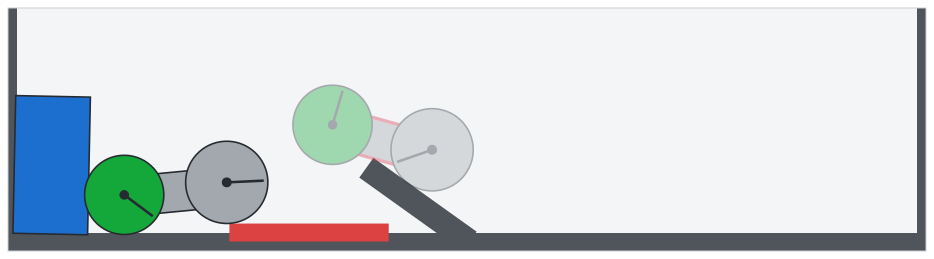
This visual demonstrates the successful outcome of a weight-space edit where a model corrected a specific failure in a navigation task.

This image illustrates the specific task of playing Breakout, which the Astra model was able to identify by analyzing raw weights.
While these results suggest a shift toward reasoning-driven optimization of differentiable networks, the practical implications and limitations remain a subject of debate. Some observers note that the model's reasoning traces for these edits are often incomprehensible to humans, appearing as a series of complex calculations that are difficult to audit. Additionally, critics have pointed out that the process of identifying and fixing weight issues may mirror the steps a human machine learning researcher would take, rather than representing a purely autonomous leap in machine logic. Currently, these experiments focus on small-scale networks, and it remains uncertain how well this capability scales to the billions of parameters found in massive frontier models or if it will eventually replace traditional source-code-based development.