Tiny BASIC was developed in 1975 by Dennis Allison and the People's Computer Company (PCC) as a direct response to the high cost of proprietary software. At the time, early microcomputers like the MITS Altair 8800 were expensive, and the standard BASIC versions available for them were often pirated or sold at a premium. Tiny BASIC was designed to be a completely free version of the language that could fit into 2 to 4 kilobytes of RAM, a significant advantage when typical memory sizes were only 4 to 8KB. To achieve this footprint, the language was intentionally limited: it supports only 26 integer variables (named A through Z) and lacks modern features like strings, arrays, or floating-point math.
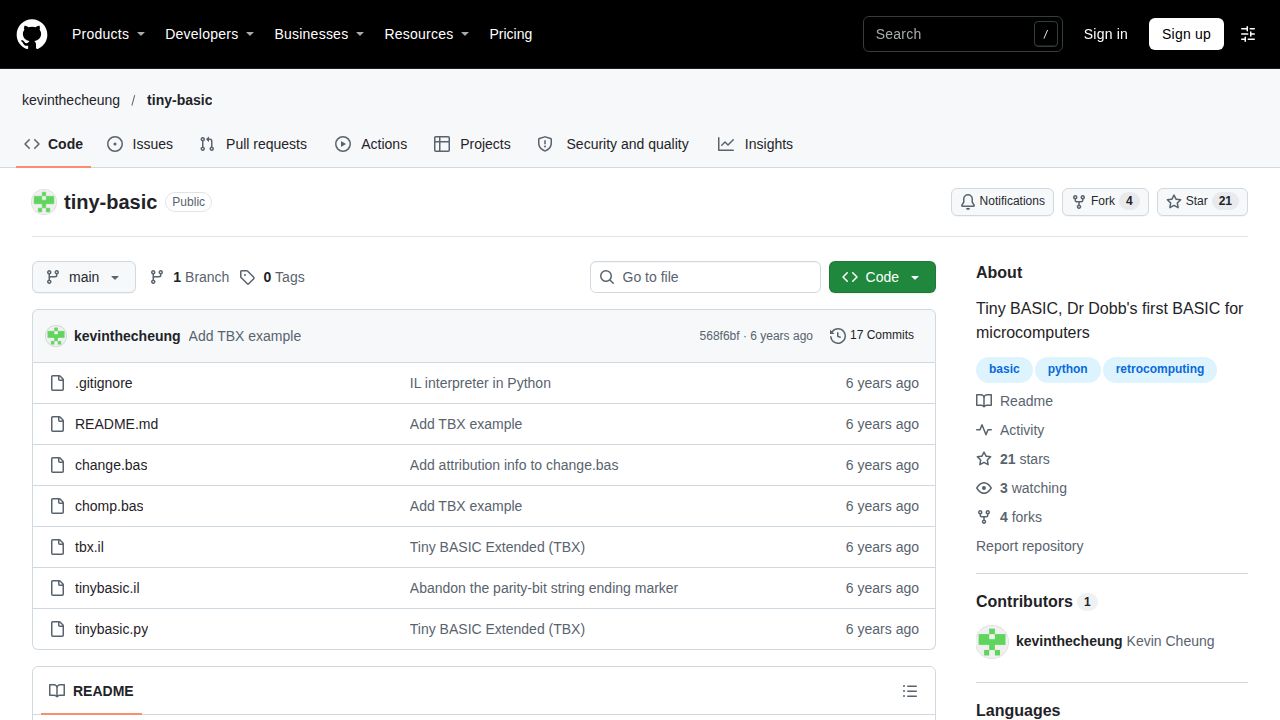
The architecture of Tiny BASIC relies on a two-part implementation system. First, a BASIC interpreter is written in an 'Interpretive Language' (IL), which is a special-purpose, assembly-like language for an abstract machine. Second, an IL interpreter is written for the specific target platform. This design allowed the core logic of the BASIC language to remain constant while only the small IL interpreter needed to be ported to different hardware. While the original 1975 specification was quite restricted, a later version called Tiny BASIC Extended (TBX) added essential functionality such as one- and two-dimensional arrays, FOR loops, and random number generation (the RN function).
Today, Tiny BASIC remains a functional tool for programming microcontrollers, including specific 32-bit ARM Cortex-M Arduinos. While modern hobbyists often opt for high-level languages like MicroPython or CircuitPython, Tiny BASIC provides a viable path for projects where memory is extremely scarce. However, the trade-offs for its small size are stark; users must work within the 255-line program limit (in the standard version) and manage variables using single-letter names. While it serves as a historical artifact of the early 'copyleft' movement—where Li-Chen Wang coined the term to describe the free sharing of Tiny BASIC source code—it also functions as a practical, albeit highly constrained, environment for low-power electronics.