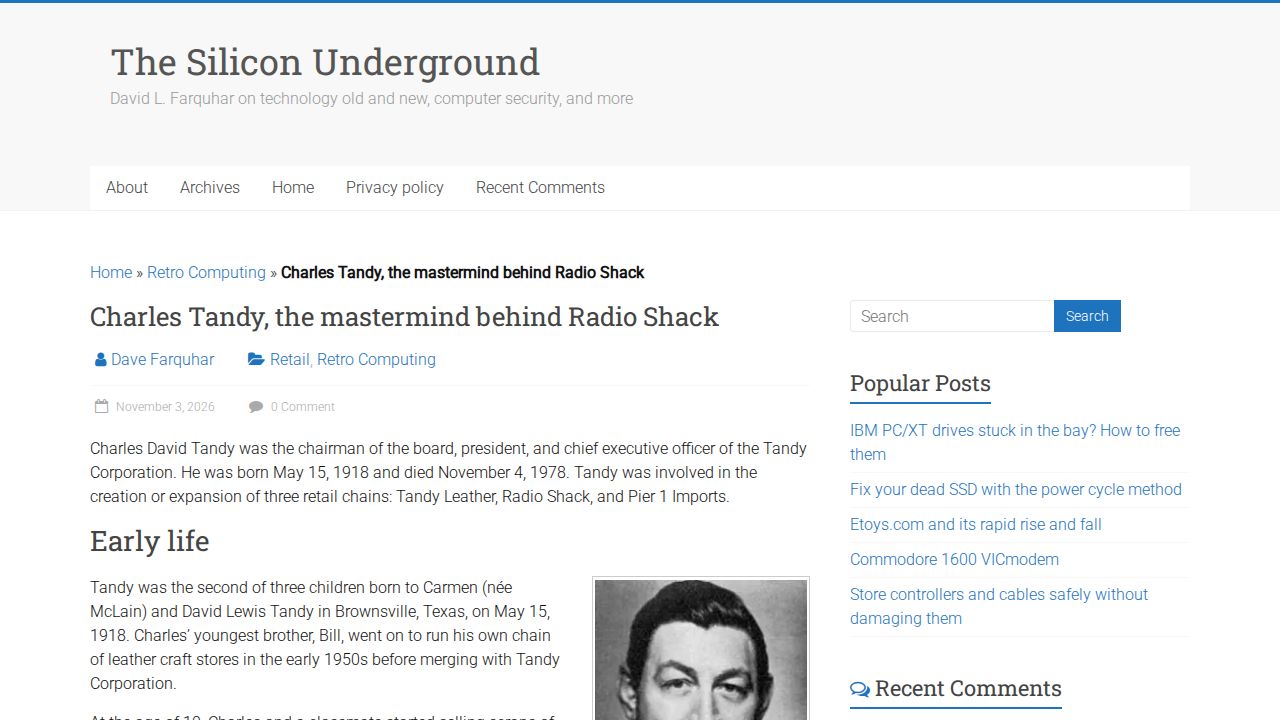
Charles Tandy is identified as the mastermind behind the massive expansion of Radio Shack, a retail chain that became a cornerstone of the electronics hobbyist community. Under his leadership, the company scaled to thousands of locations across the United States, creating a brand identity defined by its physical presence. This expansion allowed Radio Shack to become a primary destination for consumers seeking electronics, ranging from specialized components to branded consumer goods.
The brand's success was largely rooted in its accessibility and variety. For many hobbyists, the stores provided a reliable source for 'good but not great' branded items and, more importantly, a place to purchase discrete transistors and capacitors. This physical ubiquity was particularly significant for IT technicians in rural areas, who relied on the chain as a lifeline for emergency parts and cables. The stores often featured bins of components that allowed users to experiment with circuit building, a practice that served a distinct purpose for a specific era of technology.
However, this retail model involved specific operational trade-offs and eventual structural challenges. Some observers noted that Radio Shack was an early pioneer in intrusive information gathering, often requiring customers to provide names and addresses at checkout to complete a sale. Additionally, while the chain provided unparalleled physical availability, it often came with a high price point for parts. Following Tandy's death, the company's status as a private entity faced significant hurdles; some observers suggested that such structures can lead to the liquidation of a company to cover inheritance taxes, potentially destroying significant business value in a short period of time. The legacy of Tandy's work remains a point of nostalgia for those who grew up with the Tandy 2000 and the physical bins of the Radio Shack aisles.