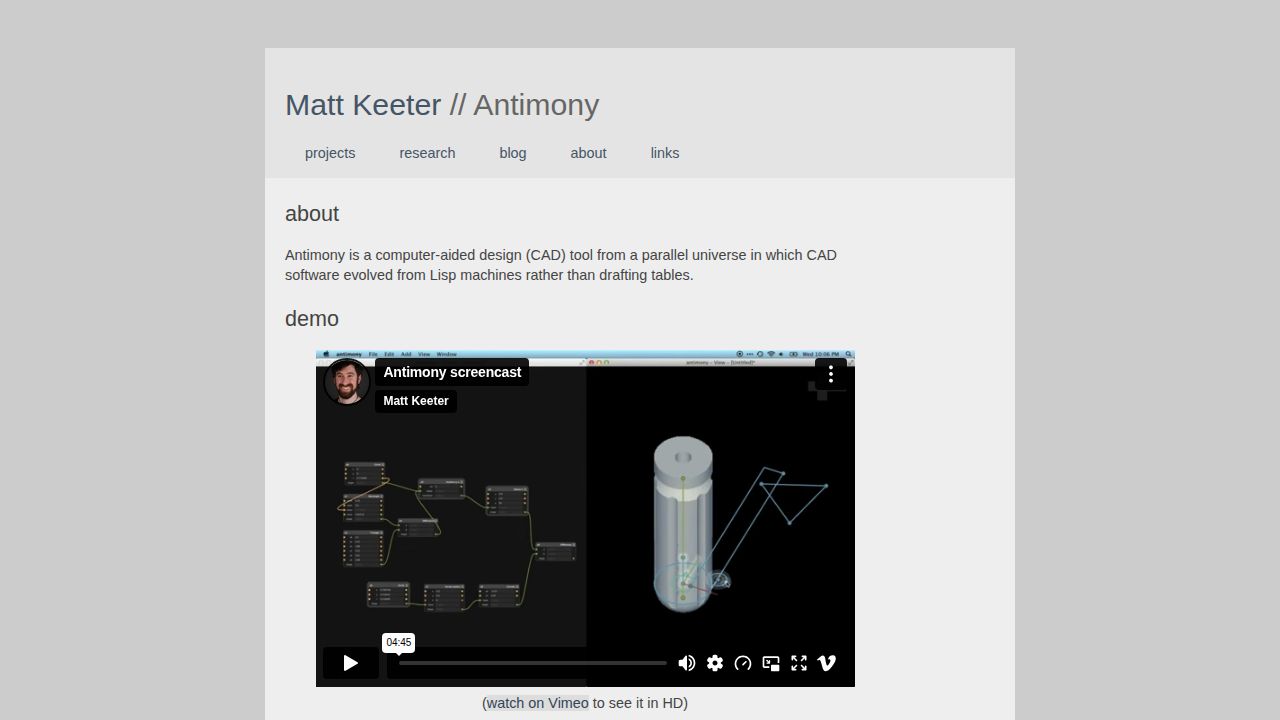
The development of Computer-Aided Design (CAD) software has historically followed two distinct paths: the evolution of manual drafting tools into graphical user interfaces (GUIs) and the rise of 'Code CAD.' Antimony, a project by Matt Keeter, exemplifies the latter, tracing its lineage back to Lisp machines. Unlike traditional CAD, which focuses on the direct manipulation of objects on a screen, Code CAD treats 3D models as the output of a script or a set of instructions. This paradigm shift allows users to define complex geometries through code—such as S-expressions—rather than clicking and dragging elements in a visual workspace.
This programmatic approach offers significant advantages for creating complex, repetitive, or mathematically defined structures. Commenters on Hacker News noted that while Code CAD can be less intuitive than GUI-based parametric CAD in certain dimensions, it is often far more powerful for building intricate designs quickly and easily. The ecosystem of these tools has expanded significantly, with projects like OpenSCAD, PythonSCAD, CADquery, and Build123D providing various ways to define geometry through variables and scripts. These tools allow for a level of abstraction where the logic of the design is decoupled from the final visual representation.
However, the constructive geometry approach used by many Code CAD systems presents specific technical hurdles. Users pointed out that certain operations, such as applying fillets or bevels to edges, can be significantly more complicated to implement in a purely constructive model compared to traditional sketch-based systems like OnShape or SolidWorks. While Code CAD excels at programmatic generation, these limitations highlight a continuing trade-off between the ease of manual geometric refinement and the power of scriptable, high-level geometry definition. Currently, the field continues to explore hybrids that might combine the strengths of both code-driven logic and traditional GUI-based sketching.