The origins of the modern fast-food model can be traced back to the early 20th-century ambitions of brothers Dick and Maurice McDonald. Originally seeking fortune in the moving pictures industry, the brothers worked as film set laborers before purchasing a theater in Glendora, California, in 1930. During the Great Depression, the theater struggled, but a small snack bar in the lobby proved more profitable than the cinema itself. By 1937, the brothers pivoted entirely to food service, opening an octagonal stand in Monrovia called the "Airdrome," which served fresh orange juice and hot dogs to travelers near a local airfield.
By the late 1940s, the brothers had established "McDonald’s Barbeque" in San Bernardino, a successful roadside restaurant that utilized a fleet of carhops to deliver food directly to customers' vehicles. However, the brothers were dissatisfied with the inefficiencies of the traditional drive-in model, which suffered from high turnover and inconsistent service. In 1948, they closed their doors to experiment with a radical new concept: "Levittown on a bun." Inspired by the assembly-line logic used to build suburban homes in New York, they sought to streamline every aspect of food preparation to maximize speed and profit.
To achieve this, the brothers slashed their menu from twenty-five items to just nine, eliminating labor-intensive dishes like barbeque. They introduced mechanical innovations, including a mechanized press for beef patties, automatic condiment dispensers, and "Multimixer" blenders capable of churning out five milkshakes at a time. Crucially, they removed the option for customer substitutions to maintain the pace of the assembly line. They also replaced carhops with a male staff in white uniforms, inviting customers to walk to a window to view the "fishbowl" kitchen. While the lack of customization initially frustrated some patrons, the model eventually succeeded by offering a lower price point and faster service, creating a blueprint for the modern quick-service industry.
One notable exception to this high-speed model was the preparation of their french fries. While the rest of the kitchen functioned as a rapid assembly line, Mac McDonald perfected a slow, deliberate chemical process to ensure quality. He discovered that drying Idaho russet potatoes in the desert air was essential to break down sugar content before frying; any attempt to hasten this specific step resulted in greasy, limp potatoes. This distinction highlights a key trade-off in their early model: while the service and assembly were optimized for speed, the core product still required specific, time-consuming preparation to maintain the quality that eventually drew massive crowds.
While the brothers' innovations led to significant personal success—including profits of $100,000 a year—the source does not provide specific data on the long-term financial sustainability of the "no substitutions" rule or the exact profit margins of the new model. It establishes that the brothers successfully traded variety for volume, but the specific impact on customer retention during the initial transition remains an unquantified part of their early history. The primary focus of their success was the creation of a repeatable, efficient system that could be observed and imitated by others, effectively turning the kitchen into a public spectacle of industrial efficiency.
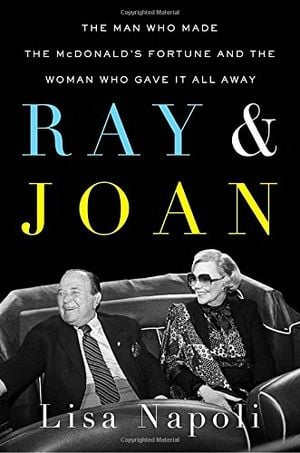
The image depicts Ray and Joan Kroc, who are the primary figures associated with the expansion of the McDonald brothers' original fast-food model into a global empire.