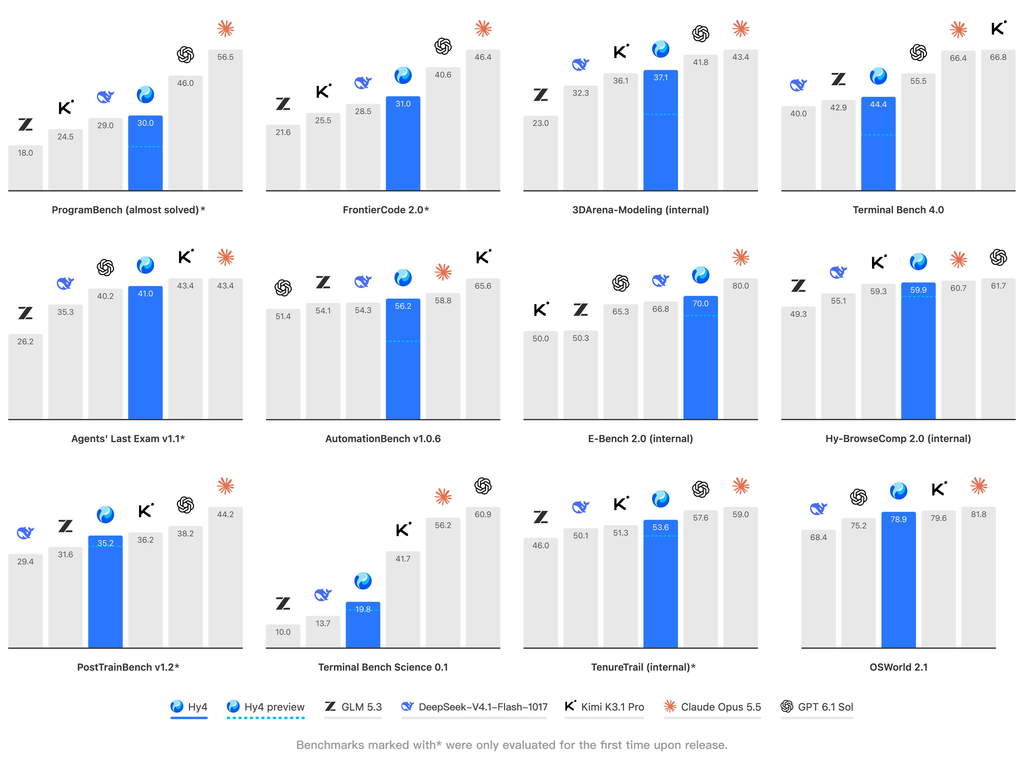
Tencent has announced the release of Hy4, a new large language model (LLM) designed to compete with leading open-source AI models. While previous iterations focused primarily on text, Hy4 introduces visual understanding capabilities, allowing the model to perform tasks such as fine-grained image processing, complex chart analysis, and mathematical visual reasoning. The model is also designed to handle 'long-horizon' agentic tasks, which involve planning and executing multi-step processes over extended periods.
The image illustrates the visual understanding and long-horizon agentic tasks supported by the Hy4 model.
One of the most significant technical additions in Hy4 is its 'computer-use' capability. This allows the model to interact directly with both command-line interfaces (CLI) and graphical user interfaces (GUI) to perform everyday tasks. To support this, Tencent provided specialized training on professional software, including Blender and CAD (Computer-Aided Design). These capabilities are integrated into various workflows, such as game development—where the model supports complex logic for engines like Unreal Engine, Unity, and Godot—and scientific research, where it assists in mathematical construction and physical modeling.
Beyond general capabilities, Tencent highlights Hy4's performance in specialized professional fields. In a blind evaluation involving 213 financial professionals, Hy4 reportedly outperformed other models like DeepSeek-V4.1-Flash-1017 and Kimi K3.1 Pro across 579 real-world financial tasks. To manage the risks associated with open-source releases, Tencent implemented specific safeguards: the model was trained on defensive cybersecurity data while explicitly excluding offensive materials, and it underwent internal reviews to ensure its biological knowledge does not facilitate open-ended experimental design. While these performance and safety claims are provided by Tencent, they currently lack independent third-party verification.