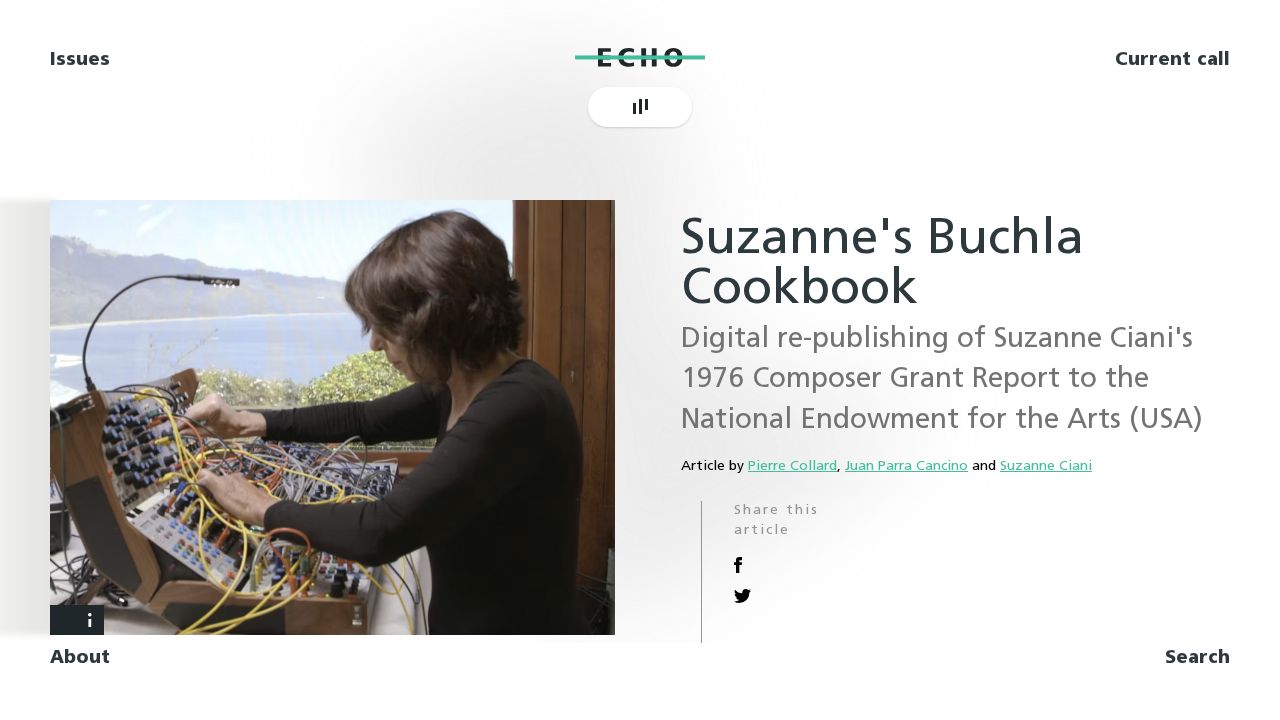
In 1976, composer Suzanne Ciani submitted a report to the National Endowment for the Arts to document her compositional practice with the Buchla Series 200, an electronic music system known for its 'West Coast' synthesis philosophy. This document, now known as the 'Buchla Cookbook,' serves as a rare primary source that captures the transition from abstract avant-garde theory to the physical manipulation of voltage-controlled hardware. Unlike standard technical manuals that describe a module's features in isolation, the Cookbook provides a practical account of how to achieve musical metamorphosis during a live performance, documenting specific patches and the transitions between them.
The core of the Cookbook focuses on the Model 248, or Multiple Arbitrary Function Generator (MARF). The MARF is a 16-stage memory module that can function as a sequencer, an envelope generator, or an oscillator depending on how it is addressed and patched. Ciani’s documentation identifies specific musical ideas—such as 'Keyboard Rotations,' 'Melodic-Rhythmic Reliefs,' and the 'Vertical Sequencer'—to demonstrate how to navigate the instrument's design space. These techniques reflect a synthesis of Ciani's classical training and the cybernetic systems of the 1970s, prioritizing voltage-controlled processes over traditional piano-style keyboards, which Ciani viewed as an 'inappropriate interface' for the Buchla's unique capabilities.
Today, the Cookbook remains a living manual for the modern modular synthesis 'renaissance.' It provides a bridge for a new generation of musicians who are discovering non-keyboard instruments and using modern Buchla 200e systems or Eurorack recreations, such as the 248t module released in 2026. By documenting the 'raw material' of her sequences and the logic of her signal paths, Ciani’s work offers a blueprint for live modular improvisation that remains relevant fifty years later. While the digital edition includes interactive illustrations and audio examples to clarify these concepts, the original text remains a foundational reference for how to build and move between musical ideas in front of an audience.