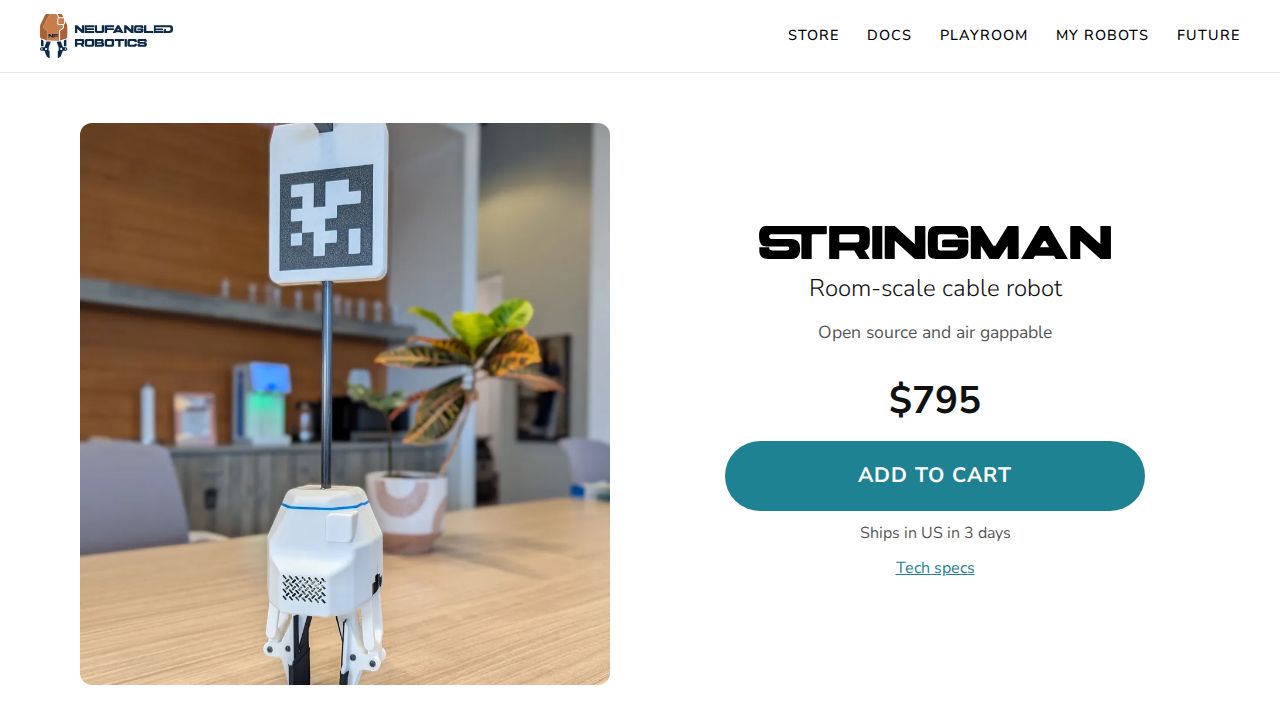
Stringman is an open-source, room-scale gripper robot designed to move and lift objects using a cable-driven mechanism. Priced at approximately $800, the project focuses on functional kinematics—the geometry of motion—rather than the complex aesthetics of traditional humanoid robots. By utilizing a system of cables and motors, the robot can perform tasks such as picking up heavy items like blankets or organizing household objects like children's toys.
The core mechanism of Stringman relies on its cable-driven architecture, which allows it to exert significant lifting strength relative to its size. Unlike standard robotic arms that rely on rigid joints and heavy actuators, Stringman's cable system distributes force across the structure. This design enables the robot to handle large, soft objects, a capability that some observers noted as a primary strength of the prototype. However, this reliance on cables introduces specific technical challenges, such as the risk of cables being yanked down or the need for sophisticated closed-loop control systems to prevent the robot from swaying during operation.
Discussion surrounding the project highlights a divide between the desire for humanoid aesthetics and the practical benefits of specialized designs. While some enthusiasts expressed a preference for the 'allure' of bipedal chassis, others argued that the most efficient design for a specific task does not need to look human. The project's potential applications range from domestic use, such as tidying up toys, to industrial scales, where similar cable-driven systems are used for large-scale sheet routing. Despite its ingenuity, the current iteration remains a prototype, with some noting that a polished consumer product would require more robust hardware and refined aesthetics to be viable for household environments.