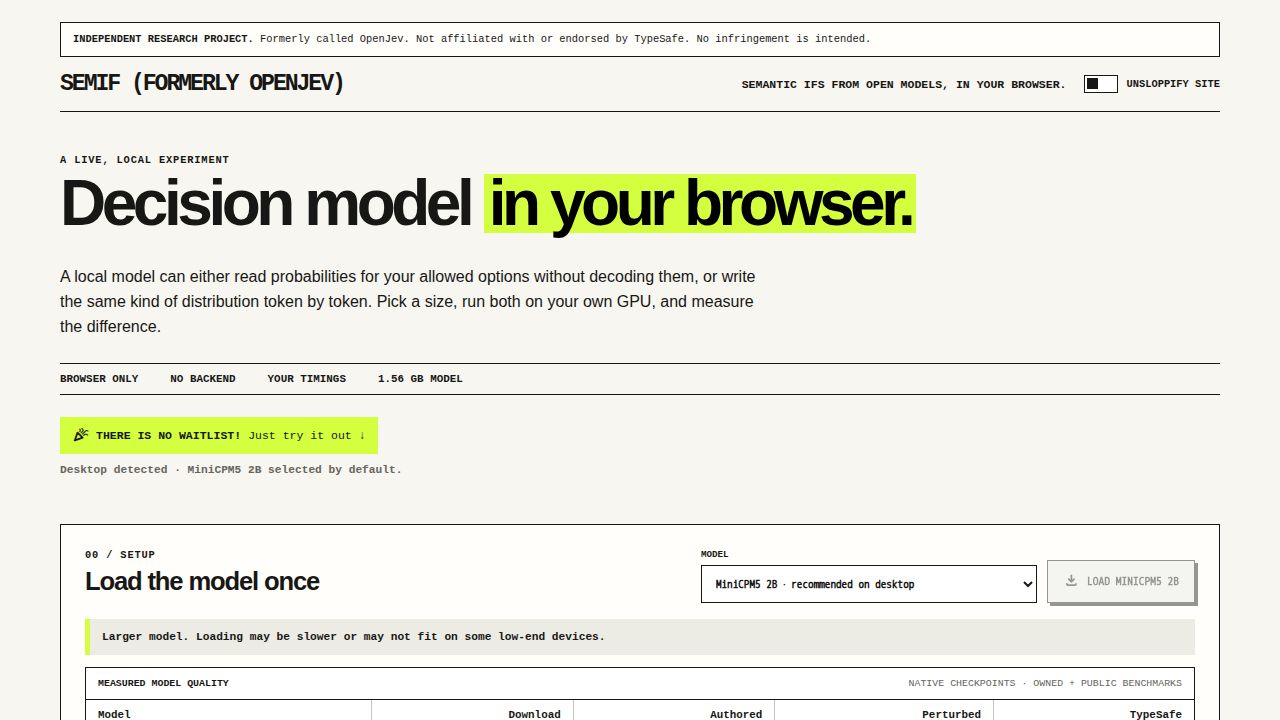
OpenJev is an open-source reproduction of the 'Jev' interface, a system designed by TypeSafe for 'runtime-defined semantic decisions.' Unlike standard Large Language Models (LLMs) that are optimized for generating conversational text, Jev is described as a non-generative, non-instruction-tuned classifier. It functions more like a highly sophisticated version of a BERT-style model, specifically tuned to provide a confidence-aware score for a set of predefined options. This approach allows it to act as a reliable decision-maker that can drive state machines intelligently by guaranteeing that it will not generate tokens outside of a specific, provided set.
The technical distinction between Jev and standard 'structured output' (such as forcing an LLM to output JSON) lies in the 'seq-to-1' paradigm. While standard LLMs perform 'seq-to-seq' tasks—where the model must predict a sequence of tokens—Jev focuses on selecting a single best option from a fixed vocabulary. This shift significantly reduces the computational overhead and latency associated with generating long strings of text. However, because OpenJev is an open-source reproduction of the interface rather than a direct copy of the original proprietary model, it utilizes a specific technical 'hack' to achieve these results. It sends a throwaway request to establish a shared state, relies on inference engines like SGLang to keep that state in a prefix cache, and then sends separate requests for questions, converting the resulting scores into probabilities for the allowed answer tokens.
While OpenJev offers substantial advantages in speed and cost over full-scale LLMs, it involves notable trade-offs in reasoning depth. Users have noted that smaller models used in these implementations may lack the 'knowledge and instinctual reasoning' found in larger models like Qwen or GPT-4. Furthermore, while the system is designed to be more deterministic, it remains susceptible to prompt injection, where a user can manipulate the input to force a specific classification. In complex logic tests, smaller models used in the OpenJev framework may produce 'coinflip' answers, highlighting the boundary between high-speed classification and the deep reasoning capabilities of larger generative models.